
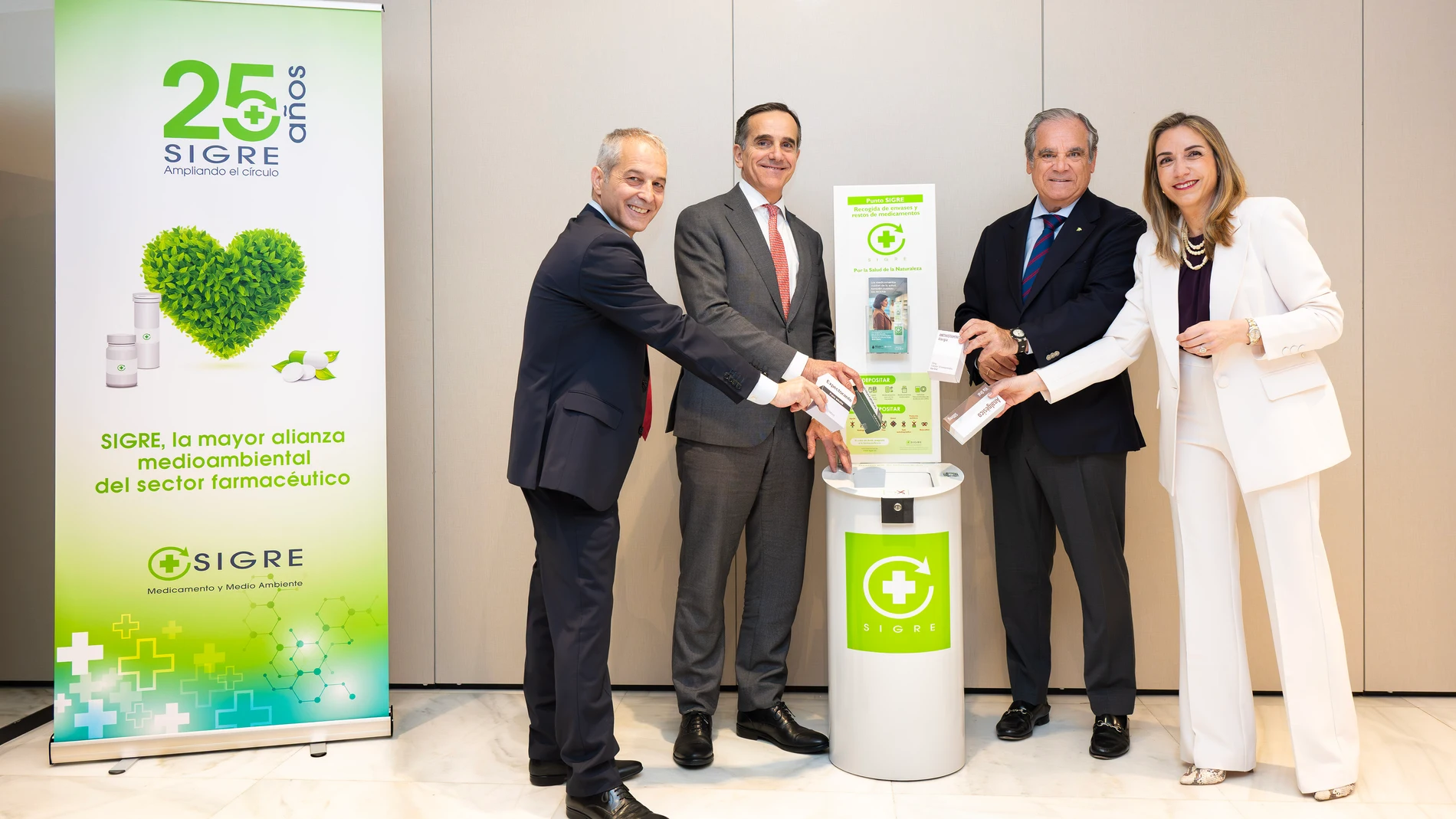
SIGRE celebrates its 25th anniversary, becoming the largest environmental alliance in the pharmaceutical sector in Spain and an international reference model in environmental sustainability, circular economy and public health protection.
This alliance and the SIGRE management model pursue a double objective: the environmental one: promoting the application of eco-design measures that allow reducing the generation of waste and guaranteeing the collection and correct environmental treatment of the medicine waste generated. And the health: encouraging the periodic review of the domestic medicine cabinet to avoid the unnecessary accumulation of medicines in homes and raising public awareness about the health risks derived from their inappropriate use.
Balance of 25 years
The main representatives of SIGRE have taken stock of a quarter of a century of activity and have presented some of the data that explains the evolution of the system since its creation. During an informative breakfast held today in Madrid. An evolution that has obtained the support of society, achieving that in 2025 the recycling of medicines will grow by more than 5%, reaching 110 grams of empty containers or with remains of medicines per inhabitant.
Currently, medicines are recycled in three out of every four Spanish homes, 90% of citizens consider it harmful to throw them in the trash or down the drain, and 99% of the population has at least one SIGRE Point in their municipality.
“SIGRE was born 25 years ago at the initiative of the pharmaceutical sector itself, as a pioneering, responsible and voluntary response to a challenge that is still fully valid today: guaranteeing that the remains of medicines and their packaging are managed safely to guarantee public health and care for the environment,” said Juan Yermo, general director of Farmaindustria and president of SIGRE.
A collective model of the pharmaceutical sector
SIGRE today has the participation of 397 pharmaceutical companies, 142 pharmaceutical distribution warehouses and more than 22,200 pharmacy offices. This capillarity has made it possible to consolidate a close, safe and effective system, in which each agent in the pharmaceutical sector plays an essential role: the industry promotes and finances the system, distribution guarantees reverse logistics and traceability, and pharmacies act as a collection and advice point for citizens.
In the words of Miguel Vega, general director of SIGRE, “this initiative is not just a waste collection system; it is the largest collaborative project in the pharmaceutical sector in terms of circular economy and an example that demonstrates that
“Sustainability objectives can only be achieved through alliances that bring together the work carried out by each of the agents involved.”
The system has evolved under the One Health approach, which recognizes the connection between the health of people, animals and the environment. In this sense, SIGRE remembers that the responsible use of medicine does not end when the treatment ends, but when its waste is correctly deposited at the SIGRE Point of the pharmacy.
The pharmacy, key to consolidating the recycling of medicines
During the press conference, Jesús Aguilar, president of the General Council of Pharmaceutical Associations and vice president of SIGRE, highlighted the role of the pharmacy as the visible face of the system before citizens.
“The capillarity, proximity and professionalism of the pharmacy have been decisive for the use of the SIGRE Point to have become an increasingly established habit among Spaniards. And this is crucial, because recycling medicines is not only an environmental issue; it is directly related to their responsible use and the safety of patients,” he highlighted.
Currently, nine out of ten pharmacists encourage citizens to deposit empty containers and leftover medications at the SIGRE Point. Furthermore, 80% of citizens express their pride in the high percentage of Spanish households that recycle medicines.
Reverse logistics: 1,400 tons less CO₂ every year
Pharmaceutical distribution has been one of the pillars of SIGRE since its origin. In fact, the Federation of Pharmaceutical Distributors (FEDIFAR) participated in its creation by designing an efficient, viable logistics operation adapted to the reality of the pharmaceutical channel: the reverse logistics model, which integrates the management of medication waste into the existing logistics circuit, and thus avoids the creation of parallel structures.
This system takes advantage of the routes for distributing medicines to pharmacies to collect waste deposited by citizens at SIGRE Points, which reduces the environmental impact of transportation. Thanks to this logistics model, the emission of 1,400 tons of C2₂ into the atmosphere is avoided each year.
“Reverse logistics is one of SIGRE’s great strengths, because sustainability is not added to the system, but is part of its own operation,” explained Matilde Sánchez Reyes, president of FEDIFAR and vice president of SIGRE, who added that “its integration into the daily logistics of pharmaceutical wholesalers possibly explains why today SIGRE continues to be a reference model.”
Ecodesign: more than 3,500 initiatives since 2000
One of SIGRE’s most relevant advances in these 25 years has been the promotion of eco-design of pharmaceutical packaging. Since 2000, pharmaceutical companies have implemented more than 3,500 ecodesign initiatives, which have reduced the average weight of pharmaceutical packaging by more than 25%.
Every year, nearly 500 million units of medicines are put on the market—one in three—with some environmental improvement in their packaging. For example, the last
Packaging Prevention Plan, developed from 2021 to 2023, allowed for the implementation of 749 eco-design measures, with an estimated saving of more than 2,800 tons of raw materials.
But, the pharmaceutical industry’s commitment to environmental sustainability continues. The new Prevention and Ecodesign Business Plan 2024-2028 encompasses 92% of the medicine packaging units marketed and represents 90% by weight of the materials placed on the market by the sector, and contemplates the application of 1,000 new prevention and ecodesign initiatives over the coming years.
Cumulative environmental impact
Over these 25 years, SIGRE’s activity has prevented the felling of 246,000 trees, the equivalent of 16 parks in El Retiro in Madrid, as well as the emission of 100,000 tons of CO₂ into the atmosphere. It has also contributed to saving 460 million liters of water, 485 million kWh of energy and 80 million liters of oil.
In addition, SIGRE’s drug waste sorting plant has incorporated artificial intelligence and robotics to improve the separation of materials. Thanks to these advances, in 2025, 70.59% of the packaging materials deposited at the SIGRE Point were recovered for recycling.
A new stage from 2025
Since January 2025, SIGRE has expanded its activity to the management of medication packaging waste generated in laboratories, healthcare centers and pharmaceutical channel facilities throughout Spain.
This expansion represents a new stage for the organization, which seeks to respond to a more demanding regulatory context and move towards a more complete vision of the medicine’s life cycle.
“We cannot limit ourselves to preserving a model that has worked well; we must reinforce it, expand it and adapt it to new challenges. We want SIGRE to continue being a reference in sustainability, innovation and sector collaboration,” stated Miguel Vega.
International recognition
The SIGRE model has been recognized by organizations such as the OECD, the United Nations Environment Programme, the United Nations Global Compact Spain and the National Plan against Antibiotic Resistance, for its contribution to the correct management of drug waste and the prevention of environmental and health risks.
On the occasion of its 25th anniversary, SIGRE wanted to thank the pharmaceutical industry, distribution, pharmacies, public administrations and citizens for their involvement in this initiative. A collaboration that has allowed us to consolidate a waste management model that simultaneously protects the health of people and the health of the planet.