
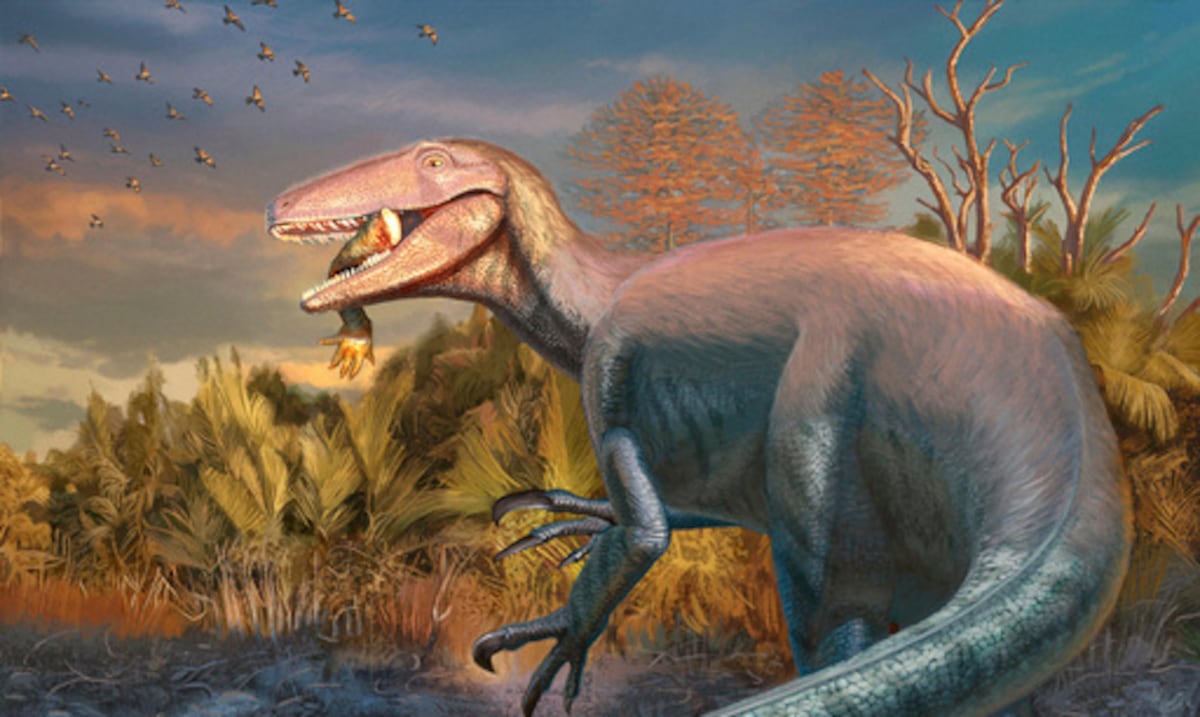
New York – Scientists discovered a new Argentina’s dinosaur with powerful claws, which fed on an old crocodile bone.
The new finding possibly was 7 meters (23 feet) long and came from a mysterious group of dinosaurs called megagaptorans. They walked about what is now South America, Australia and parts of Asia, dividing into different species for millions of years.
The Megaraptizans were known for their elongated skulls and their “huge and very powerful claws,” said Lucio Ibiricu, of the Patagonian Institute of Geology and Paleontology, who was part of the discovery team.
1 /17 | Costumes and a lot of fun: this is the world career of T.rex. People arrive to see the T-Rex World Championship Races in Washington. (AP Photo/Lindsey Wasson) – Lindsey Wasson
But it is not yet clear how they hunted these creatures and where they are located in the evolutionary timeline, mainly because the fossils recovered so far were incomplete.
In a new study, the researchers said they discovered part of a skull, as well as arms bones, legs and cola of rock formation Lake Colhué Huapi in Patagonia. They noticed unique characteristics in the bones that made them realize that it could be a new species.
The latter megaraptoran clan member called Joaquinrapor Casali “fills an important emptiness by providing one of the most complete skeletons so far,” said Federico Agnolin, of the Argentine Museum of Natural Sciences Bernardino Rivadavia, in an email. Agnolin did not participate in the investigation, which was published Tuesday in the journal Nature Communications.
The creature probably lived between 66 and 70 million years ago, near the time when dinosaurs became extinct, and was at least 19 when he died, although scientists do not know what killed her.
The bone of the front leg pressed against its jaws, belonging to an ancient relative of the crocodiles, could give some clues about their diet and if it was the main predator in the wet prehistoric alluvial plains.
Ibiricu appointed the new dinosaur in memory of his son Joaquín. While Joaquin was very young and had not yet developed a fascination with dinosaurs, Ibiricu still thinks he would have appreciated that they appoint him in honor of one.
“All children love dinosaurs, so it would probably also be a fan”said.
The Department of Health and Science of The Associated Press receives support from the Department of Scientific Education of the Howard Hughes Medical Institute and the Robert Wood Johnson Foundation. The Associated Press is solely responsible for all content.