
The scenario is simple and is repeated in thousands, if not millions, of homes: a minor doing digital homework in their room, a teenager browsing the web looking for the latest in fashion, little-known anime… or whatever they are looking for. EITHER one of the more than 3 million workers who, in Spain, do it remotely, according to data from the Ministry for Digital Transformation. And they all have a device in common: a computer. And a shared task that is reduced to navigation, processing text and consulting data using artificial intelligence.
There are those who do it with laptops, with desktop computers and, increasingly, (almost 3% more each year according to information from independent consulting firms) they are leaning towards a mini PC. The advantages are obvious: they take up the space of a pocket book, weigh just 600 grams and have about 10 ports to connect several monitors simultaneously. And its price and power rival the “monsters” of tower computers. And now one arrives who has all the ballots to occupy more homes.
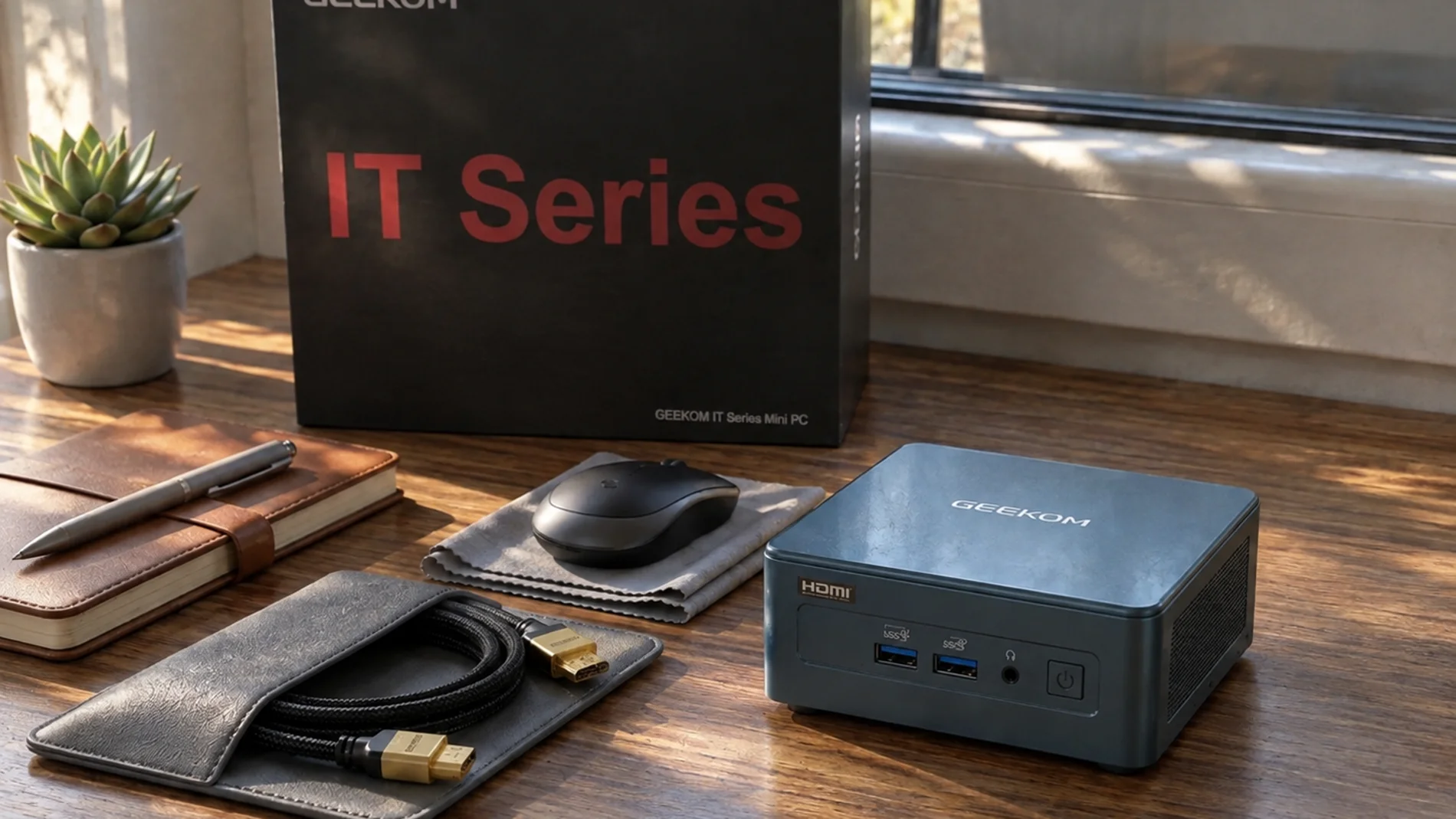
This is the Geekom IT12 2026. We have already tested several devices from this brand and They all share the same DNA: good construction, reliability, competitive price and compatibility with numerous systems and peripherals. And IT12 2026 does not deviate from this family. The unit I tested incorporates an Intel Core i3-12300HE, accompanied by 16 GB of RAM and a 256 GB SSD unit. A configuration that should be interpreted without prejudice. The surname i3 may lead you to think of a modest processor, but this twelfth generation model has eight cores and twelve threads, with a maximum frequency of 4.3 GHz. What does this mean? First, we are not looking at a state-of-the-art processor, it is true, but it does present us with an architecture capable of easily managing the usual tasks of a home computer: navigation compatibility with the AI that we all use (yes, Claude, ChatGPT, DeepSeek, Gemini…) and data and text processing. In these sections, she feels very comfortable.
For example, I have the “digital bad manners” of keeping at least 10 tabs open… in at least two of the three browsers that I usually use. And there were no problems. I also wasn’t averse to having multiple Microsoft programs open while connected to an audio and podcast streaming service. Without a doubt, the 16 GB of RAM helps maintain a smooth experience in that scenario, while the SSD drive helps the system boot and applications open without unnecessary waits.
But where I was pleasantly surprised was in the use of agentic AI. In “bureaucratic” terms this would be that IT12 offers a practical platform to explore personal AI agents and workflow automation, allowing you to perform tasks such as collecting information, organizing spreadsheets, processing files, generating content and programming. In practice, I have asked an AI to analyze my teenage daughter’s Physics and Chemistry homework and adapt the results it obtains to influence certain areas that are more difficult for her, with explanations, exercises and examples that make it easier for her. And for all this I asked for reliable sources. The IT12 had no problems. Detail: This does not mean that all of this is processed by the mini PC itself, but that, when connected to an AI agent, it has enough power to work with it.
Of course, I have the advantage that my teenager’s world revolves around anime and movies and not video games: asking IT12 to move the most demanding titles would be like evaluating a city car by its times on a circuit. That’s not where you have to prove your worth. However, where it is surprising (again) is in the connectivity. Its size does not prevent it from offering a generous provision: two USB4 ports up to 40 Gbps, two HDMI 2.0 outputs, 4 USB-A connections, 2.5 Gb Ethernet, Wi-Fi 6E, Bluetooth 5.4 and SD card reader. This variety allows you to connect several peripherals, use up to 4 screens and take advantage of external devices without constantly resorting to adapters. It’s an especially valuable feature on a computer that can function as a home work center.
There is also room to grow. The 16 GB of memory can can be expanded up to 64 GB using SO-DIMM modules, and storage is not limited to the 256 GB of the initial configuration. It is possible to replace the main drive and add other internal storage options. The latter deserves attention: 256 GB may be enough for documents, applications and files for regular use, but it is somewhat tight if we accumulate photos, videos or large music libraries. The possibility of expanding capacity prevents this limitation from necessarily becoming a long-term problem.
The IT12 proposal is not, therefore, to offer the maximum possible power, but to concentrate a reasonable amount of performance in an extraordinarily small format. Its processor has resources for daily work, the memory allows it to handle several applications, and the connectivity makes it easy to integrate it into a desktop without giving up peripherals. It is a combination that can also be attractive for a home office, a second home or any space in which we do not want to dedicate half a desk to the computer.
Is the mini PC for everyone? No. Anyone who needs to play demanding titles, work with large audiovisual projects or run very heavy professional applications should look for another category of equipment. But it also makes no sense to demand the same from a computer of this format and configuration as from a much more expensive and powerful tower. The GEEKOM IT12 has a virtue that does not always appear in the technical sheets: it knows its place. It doesn’t try to impress with power it doesn’t need or disguise its limits. It is a small computer, well connected and capable enough to accompany most of our digital lives. with the code LAR1IT12 can be purchased for 459 euros.