
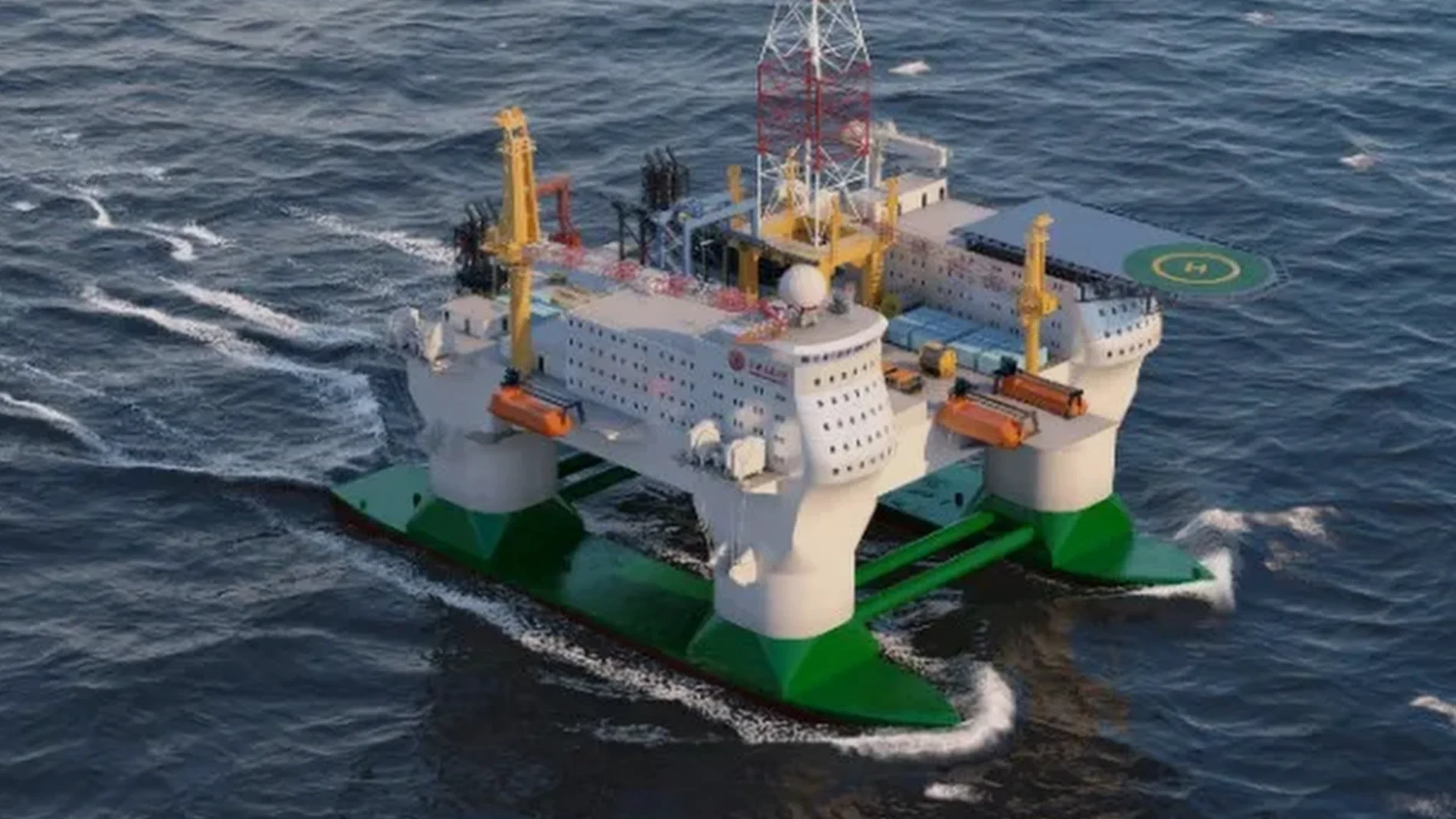
There are laboratories that are built underground. Others orbit the planet. And now, one of the most ambitious is beginning to float. China has launched what it describes as the first large-scale “open sea” marine laboratory: a kind of mobile artificial island, designed to live in the ocean for months and study, from there, everything that happens below the surface. It’s not a ship, it’s not an oil platform. It is, in a way, a new category.
The structure, known as “Open-Sea Floating Island”, is a double-hull semi-submersible platformdesigned to operate in extreme conditions and continuously. Its design allows it to work at depths of up to 10,000 meters, which is equivalent to practically any point in the Earth’s ocean.
It’s not just a laboratory: it’s a complete system. It includes facilities on the platform itself, laboratories on associated ships and support centers on land. Everything connected to turn the ocean into a permanent experimental space The ambition is clear. According to the projectdeveloped by Shanghai Jiao Tong University, It will be used to test underwater mining technologies, study deep ecosystems, analyze the origin of life and improve climate models such as typhoon prediction. And there is a revealing detail: it is designed to be inhabited for long periods: up to 238 people living on board for months without resupply.
To understand the magnitude of the project, it is worth comparing it. For decades, ocean exploration has depended on scientific ships like the RV Zhong Shan Da Xue (an icebreaker from Sun Yat-sen University), true floating laboratories, but limited in time and stability. They are mobile platforms, yes, but always in transit There are also fixed stations, such as adapted oil platforms or coastal bases, but none combine permanence, mobility and the capacity for large-scale experimentation in the open sea. This floating island tries unite these worlds: the stability of a fixed installation with the flexibility of a ship.
And then there are the inevitable comparisons. CERN occupies an area of tens of kilometers underground, with its famous 27 km ring. It is a gigantic laboratory… but anchored to the territory, designed to study the infinitely small. The International Space Station, on the other hand, is much more compact (about the size of a football field), but it represents something different: a laboratory in extreme conditions, isolated, where the location itself is part of the experiment. The Open-Sea Floating Island lies, conceptually, between the two. It does not have the scale of CERN, but it shares its vocation as a large scientific infrastructure. It is not in space, but like the Space Station, it is designed to operate in a continuous, isolated, hostile environment. The difference is that its “extreme medium” is not the void, but the deep ocean.
There is also a question of physical scale that helps to visualize it. The main platform, more than 100 meters long and displacing tens of thousands of tons, is closer to a military ship or a small artificial island than a traditional laboratory. But its true size is not in its dimensions, but in its scope: the entire ocean as a testing ground.
“It can travel at practically the same speed as a scientific vessel – concludes Yang Jianmin, from Shanghai Jiao Tong University – Once it reaches the operational area, it can be ballasted to carry out research and experiments. Thanks to its high load capacity, long stay capacity and great resistance to typhoons, it can carry out this type of work in more adverse maritime conditions, for longer periods. and in deeper waters.”