

Consistency in his recipe for success and openness to new opportunities are the forces that investor Orlando Bravo balances to ensure the upward trajectory in his private equity firm Thoma Bravo and in his role as a mentor to emerging companies in Puerto Rico.
”Good leaders are disciplined and consistent. It’s not a week yes, a week no. ‘I’m going to do this, I’m going to do that. Now, I’m going to see all my consumers in April and I won’t see them again until next year.’ No, that’s not the case,” he said.
In turn, the co-founder of the firm that currently manages around $166 billion in assets urged the business community not to worry about fashionable terms, such as generative artificial intelligence (GAI), or speculation about changes in government administration and macroeconomics.
“Technology is not revolutionary, it is evolutionary. For example, there are people very, very concerned with AI. In 2025, AI will not change all of our jobs. It’s not going to be anything, nothing like that,” he said.
On the contrary, he indicated that companies will be able to add IAG services or solutions to existing products, as they make financial and operational sense.
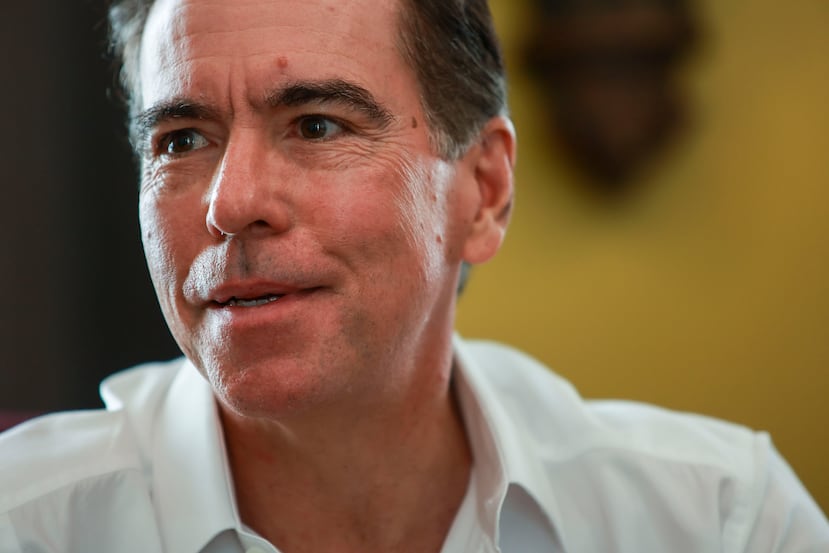
“For people, my recommendation is: stay focused on the micro, on the details that belong to you. If you have a business here in Puerto Rico, win the competition. That’s more important than what’s happening with the interest rate. It’s intellectually interesting to talk about, but focus on the business. Compete and make good decisions,” urged Bravo, who received Business at the headquarters of its philanthropic arm, Bravo Family Foundation (BFF), in Miramar.
The investor, with a personal wealth that the specialized media Forbes estimates at $9.8 billion, added that “there will always be uncertainty. There will always be wars and changes in the economy. Nobody can control it and nobody can make predictions about it.”
In turn, Bravo emphasized the importance of closely studying what is happening within the human team, both in startups and in non-profit organizations: “Do I have those people next to me who are growing enough, to give him more and we can do more? How many people are leaving each year?”
“As a leader of small or large companies, the most important thing you need is someone who likes that market so much, who is so focused on that market, for some reason, who is always growing that business, who has this passion for the consumers in their business. product and that I am listening to them closely, what they need, what they want, how I am doing it. “That is essential,” he added.
He pointed out that this philosophy is an essential part of the formula that he applies year after year to Thoma Bravo and the companies that the firm acquires.
“We know what our lane is: the software that they sell to other companies, what we call software enterprise-level… and the opportunities are the same ones we have been following for 20 years,” said Bravo, whom Forbes has dubbed “Wall Street’s most sought-after dealmaker.”
As a concrete example, he mentioned that in 2022, they purchased QAD Software, which provides solutions to run operations and processes in manufacturing companies around the world. “That company was one of the first companies I called when I started in the business in 1997. But it took all that time for the price to be right and the company to be pretty good.”
“We have been following it for more than 20 years and we bought it. “That happens a lot,” he said.
Although the firm led by the Mayagüez native is practically an icon in the world of investments in alternative assets and private investment, the sector is not exempt from challenges: from new regulatory requirements to a universe of companies that would be candidates for acquisition, but that show less growth or high leverage.
In a recent report about the expectations of the private equity by 2025, the firm PricewaterhouseCoopers (PwC) indicated that the sector, in general, has remained suppressed in recent years, in part, due to the challenges of valuing the assets to be transacted.
“
For people, my recommendation is: stay focused on the micro, on the details that belong to you. ”
According to PwC, with the exception of the second quarter of 2024, when private investment activity in the United States recorded over a thousand transactions with a valuation close to $125 billion, both the volume of transactions and their value have moved downwards. from the first quarter of 2023.
In an interview with CNBC last October, Bravo indicated that building relationships and gaining knowledge about companies to make a transaction feasible can take three to five years before it can materialize.
This reality, coupled with other factors such as the push of economic activity or interest rates, makes it difficult to build a line or pipeline of transactions even between knowledgeable ones like Bravo and his team.
In 2025, according to Bravo, the plan is to maintain the pace of monitoring about 1,000 companies, close the purchase of three to four that are valued between $3,000 million and $12,000 million, and sell more or less that same amount.
“In the world of Alternative Asset Managementof the Private Equity “They are the biggest businesses,” said the investor, who trained at the La Inmaculada Academy in Mayagüez and completed his university education at Brown University and Stanford. “We buy companies and transform them from being tremendous innovators to being tremendous businesses. And you can do both things at the same time.”
This duo of innovation and profitability is what it seeks to transmit to the entrepreneurs participating in the Rising Entrepreneurs Program (REP), one of the BFF initiatives.
“We want to teach these entrepreneurs how to run companies, that is, to be able to grow them without losing money, without needing so much money from outside, because there is also less capital here. It’s not like Silicon Valley, where a guy can go out and say ‘I want $100 million because I have this idea’… and I think it’s a better way,” he said.
Bravo celebrated that the REP has been able to retain the judges and mentors that it has brought in to support, with their experience and expertise, the entrepreneurs of Puerto Rico “because they are inspired by the talent that is here.”
“The challenge is more to be able to connect those entrepreneurs also so that they compete and sell to international companies. Because, remember, the market here is not very big. It is more limited. So if you want to have a huge company, in technology, you have to sell things to the big finance companies in the United States, to the big manufacturing companies. “It is the only way,” he analyzed.
Thoma Bravo specializes in acquiring technology companies, primarily from software enterprise level, to promote its strategic growth, according to the website of the firm co-founded by Bravo and Carl Thoma. The investment philosophy “focuses on working collaboratively with existing management teams to help drive operational results and innovation,” the firm explains on its official website.
“Our firm has acquired or invested in more than 500 companies in software and technology that represent a valuation of approximately $265,000 million,” summarizes Thoma Bravo on its official website.
Currently, according to data from the private investment firm, Thoma Bravo maintains a portfolio of approximately 80 companies. The firm has offices in San Francisco, Chicago and London, among other important cities.
A significant milestone for the firm was reached in 2023, when Thoma Bravo became one of the main shareholders of Nasdaq, after selling the stock operator, the company Adenza, for about $ 10.5 billion, paid in a combination of cash and shares.
The Puerto Rican’s upward route was unknown to many locally.
It was not until Hurricane Maria, when the phenomenon devastated Puerto Rico, that Bravo’s name became familiar. This, despite the fact that the investor – often a keynote speaker at world-class events, interviewed in major business publications in the United States and Europe – maintains close ties with his family and La Sultana del Oeste.
After the cyclone, Bravo announced its philanthropic initiative in Puerto Rico, a multi-dimensional project that has included direct support to communities affected by natural disasters; the REP, which has been a platform to strengthen local businesses of various kinds and even financially support innovative projects such as Skootel and BrainHi, and other similar initiatives.
As a sign of his connection with Puerto Rico, Bravo will soon be a special guest at a series of events and conversations on El Nuevo Día in collaboration with the Spanish News Agency (EFE).
Joanisabel González collaborated with this report.