
Lovers of the History of Spain know that our country was, at one time, became one of the largest empires in history along with the British, Mongolian and Russian. Such was its size that, between the 16th and 18th centuries, it was the most powerful in the world, with territories in both Europe and America, Africa and Asia. A time that, however, It came to a complete end in 1898 with the loss of Cuba.
Although many mark the beginning of the fall of the Spanish Empire during the crisis of 1808when Napoleon’s troops invaded Spain, resulting in the Spanish War of Independence, the truth is that its decline began during the Eighty Years’ War (1568-1648). This was the longest war conflict that the Hispanic Monarchy had to face, which meant an innumerable loss of resources and soldiers.
This war, also known as the Dutch Revolt, arose from the confrontation between the Spanish crown against the United Provinces of Hollandthe antecedent of the current Netherlands. The latter decided to rise up due to their discontent with the then Spanish King Felipe II, causing a series of naval battles whose setting was the English Channel, the Caribbean and Southeast Asia.
A fleet of 14,000 men set out for the English Channel with the aim of weakening the Dutch.
However, there was a battle that would mark the outcome of this long war and, with it, the decline of the Spanish Empire. This was the Battle of Las Dunas, in 1639during the reign of Philip IV. A battle that arose after the orders of the royal ruler, the Count Duke of Olivares, to carry out a maritime and land attack, relying on numerical superiority which the monarchy had at that time.
To carry out this feat, the valid He put Antonio de Oquendo y Zandategui in commandadmiral general of the Navy of the Ocean Sea and who participated in one hundred naval combats. This had the objective of reaching The Tercios, the most prestigious infantry units of the empire, who were in full campaign in Flanders, both the money and the military material sufficient to achieve victory.
Likewise, they sought to lower the confidence of the Dutch with a series of attacks. To do this, they had a fleet made up of galleons and merchant ships, in which 14,000 soldiers would travelboth Spanish and other nationalities. The ships left A Coruña towards the English Channel with a clear numerical superiority, although with troops with little combat experience and scarce provisions, as explained in “National Geographic”.
Despite outnumbering them, the Dutch fleet managed to defeat the Spanish fleet.
This, added to the characteristics of the Dutch cannons, caused that in the first confrontation with the Dutch fleet, commanded by Martin H. Tromphad to withdraw due to the amount of damage they suffered. Although the battle did not end here, as the attacks continued two days later, causing both sides had to take refuge in search of supplies.
During the confrontation, the Spanish fleet took the opportunity to send several merchant ships with materials to the Tercios that were in Flanders. And, after the withdrawal, from Oquendo set course for the English port The Downswhich would end up giving its name to this battle. Known as the naval battle of the Dunes, this began after the Dutch, taking advantage of the characteristics of the terrain and the fact that the Spanish were stocking up, decided to attack.
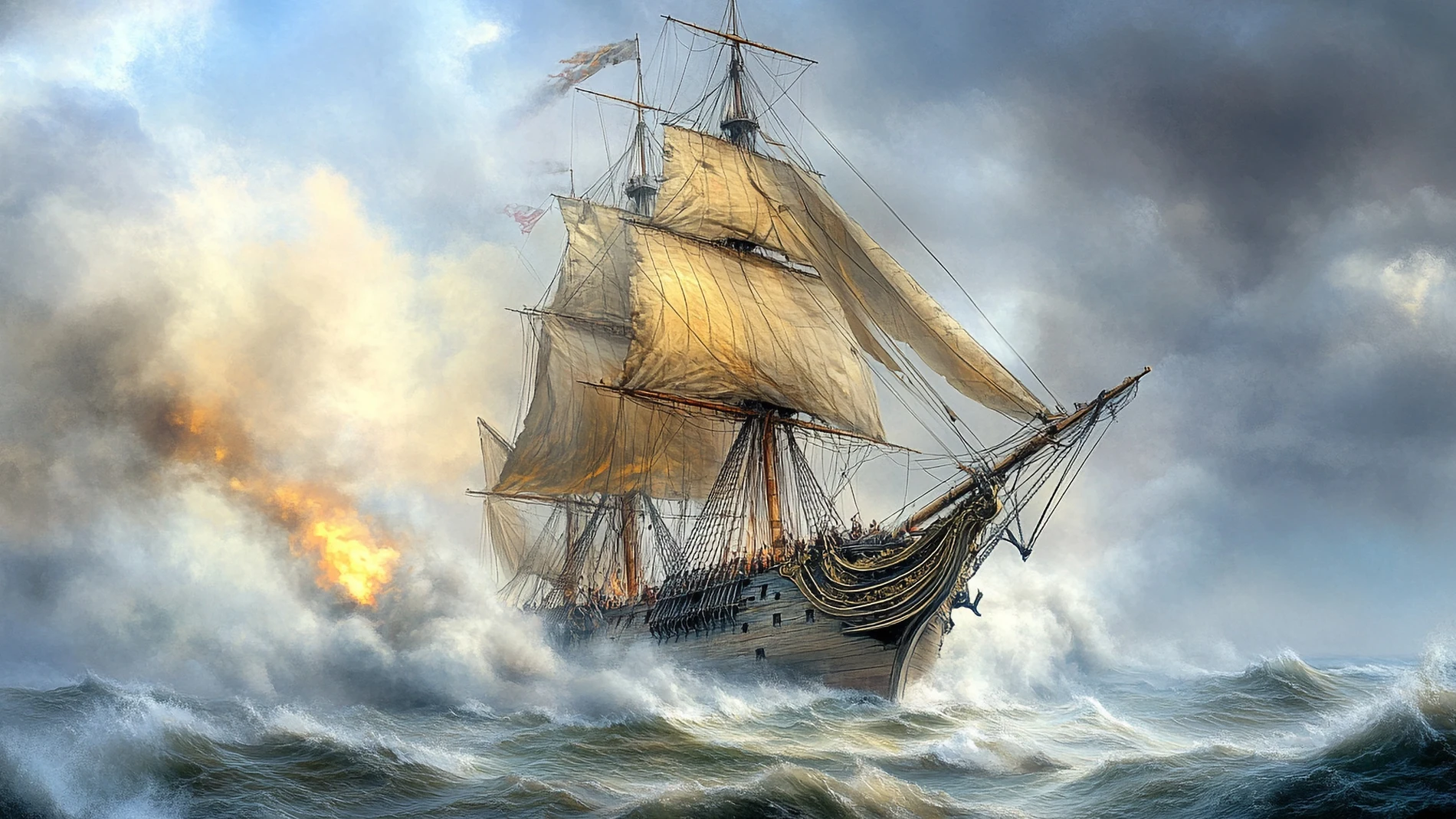
The combat began on October 20, 1639 and quickly what should have been a resupply area It became a dangerous trap for the Spanish. That area was characterized by thick fog. Furthermore, the Dutch did use of burlotesold boats loaded with flammable material that were set on fire and thrown towards the enemy fleet.
A combination of factors that caused The Spanish Empire lost 6,000 men and 43 shipswhile Antonio de Oquendo managed to escape with only nine galleons. A defeat that would presage the outcome of the Eighty Years’ War and It would mark the beginning of the decline of one of the most powerful empires in the world.