
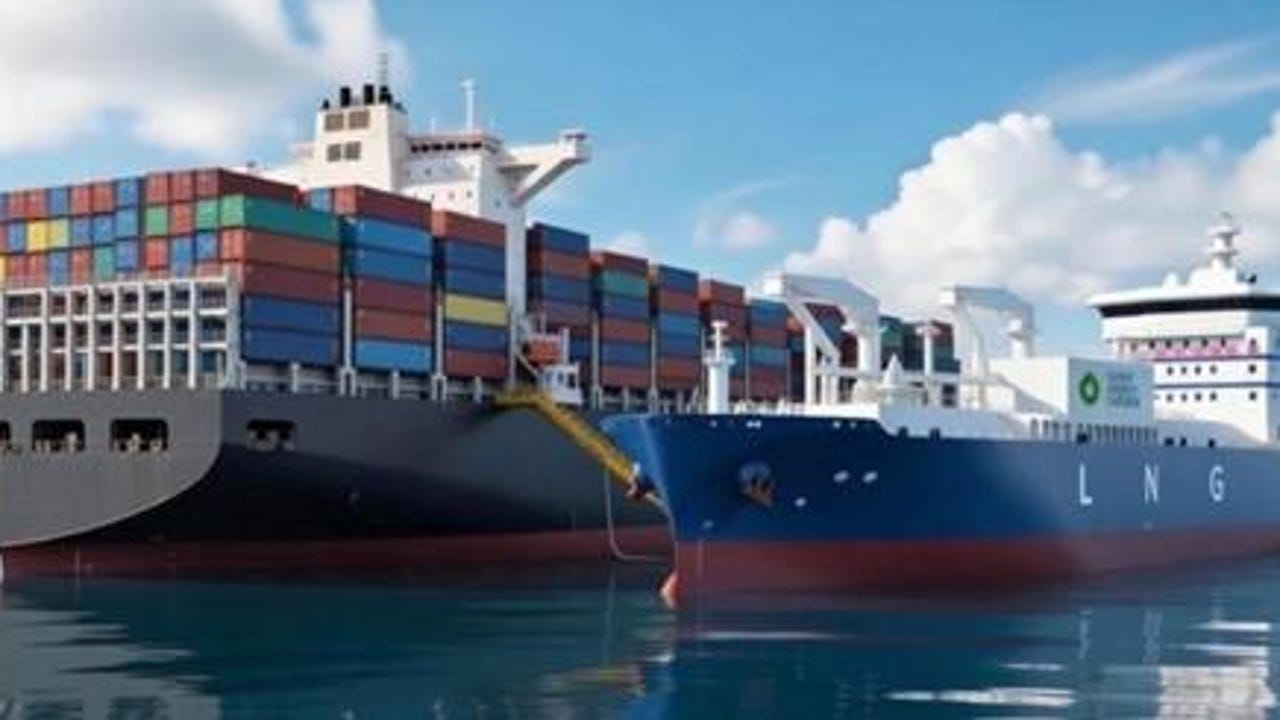
The decarbonization of maritime transport has taken a big step forward with the strategic initiative of Naturgy and Enagás – through its subsidiary Scale Green Energy – to join forces to build and charter a state-of-the-art vessel, the Mistral LNG, a vessel equipped to supply liquefied natural gas (LNG) and bioLNG to all types of vessels.
With a loading capacity of almost 19,000 m³ and advanced technology to minimize emissions, this project began construction at the beginning of this year 2026 and will be chartered by Naturgy in 2028 with a long-term contract. The ‘Mistral LNG’ will operate, as the main market, in the Iberian Peninsula, which is reinforced as a strategic hub in southern Europe for the supply of sustainable fuels in the maritime sector.
Growing demand
This project will help meet the growing demand for alternative fuels in maritime transport and compliance with new European regulations that require a progressive reduction in emissions linked to maritime fuels. In 2024, orders for ships powered by liquefied natural gas (LNG) and bioLNG doubled compared to 2023 and, according to forecasts, the demand for LNG bunkering will continue to increase in the Iberian Peninsula progressively in the coming years.
According to experts, liquefied natural gas (LNG) and bioLNG are the alternative fuels best positioned at the moment to lead the energy transition, by having a larger fleet in the coming years and greater infrastructure to supply liquefied natural gas.
The process of supplying, storing and loading fuel) and lubricants on ships for their operation – also known as bunkering. It is an essential operation for maritime logistics, carried out in ports or on the high seas using tankers, trucks or land facilities, essentially functioning as a “floating gas station” for safe refueling.
Naturgy’s commitment to Bunkering is, in the opinion of Ángel Caballero, Director of Maritime Transport of the energy company, “a key solution to decarbonize maritime transport, since the supply of this fuel is a specialized operation that offers high standards of safety and efficiency, contributing to significantly reducing polluting emissions and complying with environmental regulations.”
Alternative fuels
Compared to traditional fuels, liquefied natural gas eliminates 100% of sulfur oxide (SOX) emissions, between 80 and 90% of nitrogen oxides (NOX) and 25% of CO2. With the use of LNG as a maritime fuel in Spain, around 2 million tons of CO2 could be reduced by 2030, which would be equivalent to the introduction of more than one million electric vehicles into the market.
With this initiative, Naturgy positions itself as a strategic operator in the Iberian LNG bunkering market, whose growth is expected to be exponential in the coming years, and advances its commitment to promote the energy transition by offering competitive solutions to its customers. The company has extensive knowledge in the energy supply sector and plays a key role in the supply of Spain as the main importer of natural gas.
For its part, Enagás – through its subsidiary Scale Green Energy – is consolidating itself as a leading shipowner in LNG bunkering in southern Europe by incorporating this new vessel into its current fleet of three ships: Levante LNG, Alisios LNG and Haugesund Knutsen, contributing to the European strategy to reduce emissions in maritime transport and generating a tractor effect on the LNG plants in Spain. The seven regasification plants in Spain are already adapted to supply LNG for bunkering, and those in Barcelona, Cartagena, Huelva and Gijón have already launched the BioLNG supply service to ships and tankers.