
This week marked one year since the start of the conflict in the Middle East. On October 7, with the Hamas attacks and Israel’s military response, the possibilities of cooperation in the area on energy matters were blown up. And the gas reserves of the Eastern Mediterranean were producing timid rapprochements between countries; example of it was the creation in 2019 from the EastMed Gas Foruman organization designed to control the development of natural gas in which Cyprus, Egypt, Greece, Israel, Palestine and Jordan participated.
The deposits discovered mostly in the last decade include Israel and Palestine to a large extent, but also Lebanon and Egypt and their exploitation has turned Israel as gas exporter (replacing the import of oil and coal). But what are the gas reserves locked in the Eastern Mediterranean?
In 2010, the Tamar and Leviathan sites were discovered off the coast of Israel; Aphrodite in Cyprus and Zorh in Egypt.
The one of Tamar 90 km west of Haifa port It is located 5,000 meters below sea level. Its estimated reserves are around 389 BCM (389 billion cubic meters). Exploitation was started by Noble Energy, with financial help from P Morgan and Citigroup from the US, or Barclays and HSBC from the UK) and it is currently Chevron that controls 30% of the reserves (it bought Noble Energy in 2020). Thanks to this field, the Israeli government signs the first natural gas export agreement, in this case with Jordan (it also exports to Egypt, despite citizen opposition in both Arab countries). Furthermore, “it is the most delicate, because it is within reach of Hamas’ artillery and has suffered several production stoppages: it was closed for a month at the beginning of the war (an event that especially affected Egypt, also because Israel changed its energy strategy to make sure to cover its internal consumption), and it was closed again a few days ago after the Iranian attacks,” says Gonzalo Escribano, professor of Applied Economics at the UNED and director of the Energy and Climate program at the Elcano Royal Institute.
The site of Leviathan is considered one of the largest deep-sea gas discoveries in the world in an area of 330 km2 120 kilometers west of Haifa. Chevron, a company that has a 39.66% stake, has just announced that it is stopping its plans to expand the exploitation of this field, which it claims has the capacity to supply Israel’s energy needs for 40 years. Exports to Egypt and Jordan began in 2019, but the EastMed project gas pipeline (considered of community interest) would also leave from here, starting from Israel, it would carry natural gas from 2028 throughout the Mediterranean to Italy, passing and also feeding on the reserves. found in Cyprus, Greece and Egypt. An area of waters in permanent conflict that has led to Chevron’s recent announcement to also stop work in the Cyprus field.
Alternative to Russian gas
Ursula von der Leyen’s commission signed an agreement in 2022 with Israel to convert the country into a new natural gas supplier for Europe in its search for independence from Russian gas (there are also European companies that have permits to exploit these reserves). «It is true that it matters little right now, but we must take into account derived circumstances that are adding up. Now Egypt becomes a competitor of the EU in gas purchases. Furthermore, if there are problems with Qatar’s exports the numbers would be important. And this depends on what happens in the Strait of Hormuz,” says Escribano.
Gaza Marine deserves special mention, a site that was discovered in 1999, but has been under Israeli control due to its fear that exploitation by Palestine would serve to feed the coffers of Hamas. Gaza Marine, which is located about 30 km from the coast gazatí contains about 30 bcm of gas. In 2023 there was an attempt at a joint exploitation agreement with Palestine, so that part of the gas would be used to alleviate energy poverty in Gaza and another part would be exported to Egypt, but with the outbreak of the conflict “any possibility of an agreement has been blown up.” », says Escribano.
In the north there are two other sites: Qana and Karish. They represent another important point in the history of encounters and disagreements in this area. In 2022 Lebanon and Israel signed an agreement for their joint exploitation, in which Lebanon could enjoy exploitation north of line 23 including Qana, while Israel remained the Karish field. It was a milestone that was mediated by the United States and that was done in a context of lack of relations between both countries; Lebanon in fact does not recognize Israel. However, this past September 29, Israel’s Energy Minister Eli Cohen confirmed that the country wants to suppress the agreement, which he says was a serious mistake.
Strait of Hormuz
The expansion of the conflict towards Iran leaves a new concern: are we facing a crisis that can affect the global economy? At stake is the passage through the Strait of Hormuz, which Iran threatens to close. Gas from Qatar passes through here and also between 20 and 30% of world oil production (five of the 10 largest crude oil producers are located in this region). A situation that adds to the problems derived from the attacks by the Yemeni militia in the Red Sea that has already affected the routes for oil and products such as car batteries or photovoltaic modules (it has also triggered emissions from transportation that now must go around the Cape of Good Hope). «The problems in the Red Sea have distorted oil logistics and now different scenarios can open up depending on what Israel does. If they are attacks on refineries, it may not affect the barrels of crude oil, but if Iran closes this step, the barrels would be endangered. Even so, it is important to point out that we have been at war for a year, everything has happened and, however, it has not had many repercussions on the price of gas and oil until now,” concludes Escribano.
Solar panels in Gaza
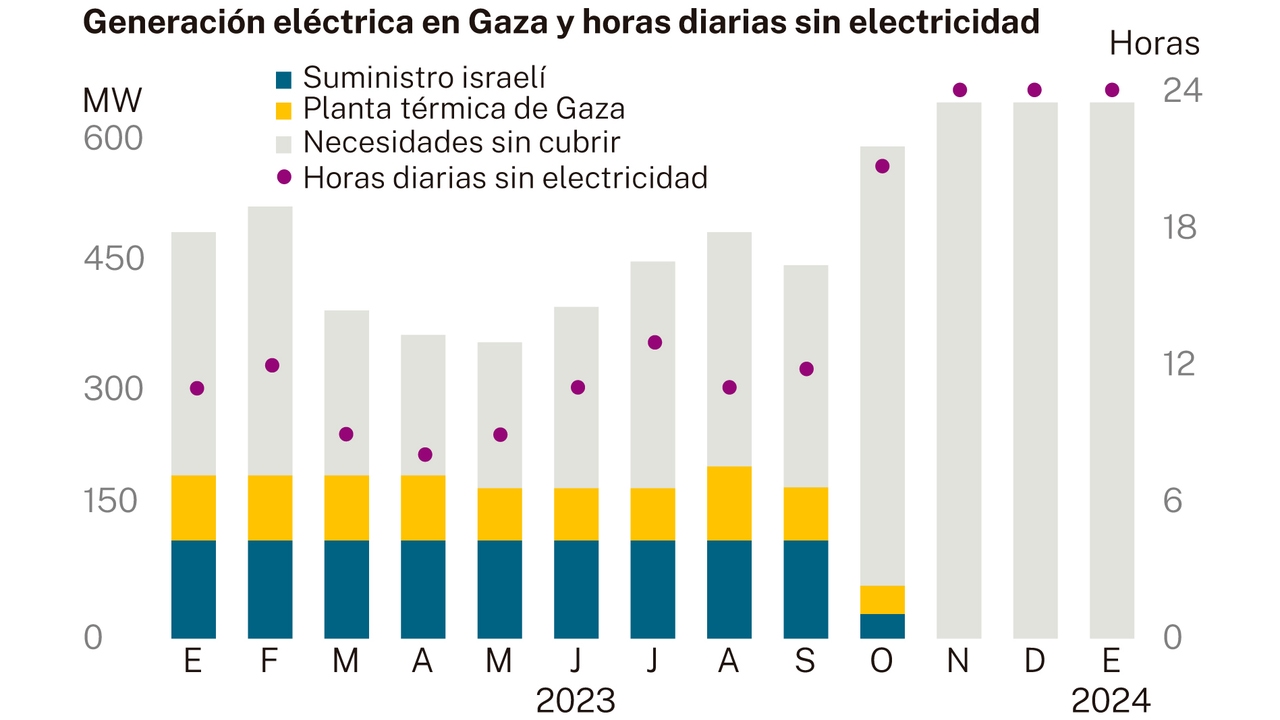
The situation in Gaza before the conflict was already one of energy poverty. Part of the fuel that fed the strip through a fuel oil plant came from Qatar and another part of the needs were covered by electricity imports from Israel. But this “only covered a third of the demand. You cannot keep medicines or study or surf the Internet for much of the day,” says Escribano. Hamas’ inability to resolve the problem led to a series of protests throughout 2023 in the strip. «These difficulties have promoted alternative decentralized solutions: photovoltaic solar energy. The installation of solar panels on roofs began as a private initiative, but quickly spread to numerous businesses and international cooperation projects. “China, Germany, Qatar, the World Bank have financed facilities that will have disappeared under the bombs.”