
The night sky seems calm. But in reality, Earth’s cosmic neighborhood is full of dangers. According to estimates cited by NASA scientists, more than 15,000 asteroids capable of destroying a city They could be orbiting near Earth without having been detected yet. These are not giants capable of causing a global extinction, like the one that wiped out the dinosaurs 66 million years ago, but they are objects large enough to cause regional devastation if they hit a populated area.
The figure has been widely circulated in recent days after different media, in print and on the web, reported on an intervention by Kelly Fast, head of planetary defense at the US agency. According to this information, the scientist mentioned the data during the annual meeting of the American Association for the Advancement of Science (AAAS), held in Phoenix. Fast noted that astronomers estimate that There are about 25,000 near-Earth asteroids of this sizebut only about 40% have been identified so far. The rest, more than fifteen thousand, remain outside the radar of current telescopes.
What exactly does “city killer” mean? In astronomy this informal expression is sometimes used to refer to asteroids about 140 meters in diameter or more. Such an object would not trigger a global catastrophe, but it would release an enormous amount of energy if it hit Earth.
To get an idea, just remember what is known as the Tunguska Event, which occurred in Siberia in 1908. In that case, A much smaller object, probably about 40 meters, exploded in the atmosphere and leveled more than 2,000 square kilometers of forest, felling thousands of trees. An asteroid several times its size could completely devastate a large modern city. Paradoxically, the most dangerous asteroids are not the multi-kilometer giants. Those are relatively easy to spot and virtually all of them are catalogued. The challenge is in those of intermediate size.
Many of these objects are dark, small and move in orbits similar to that of the Earth, which means that they spend long periods hidden in the glare of the Sun from our perspective. Ground-based telescopes, which detect asteroids by observing sunlight reflected from their surface, can easily miss them under these conditions. That is why astronomers often repeat a seemingly simple idea: the greatest risk is not the asteroid we see coming, but the one we have not yet discovered. In fact, that is precisely Fast’s phrase: “What keeps me awake at night are the asteroids we don’t know about”,
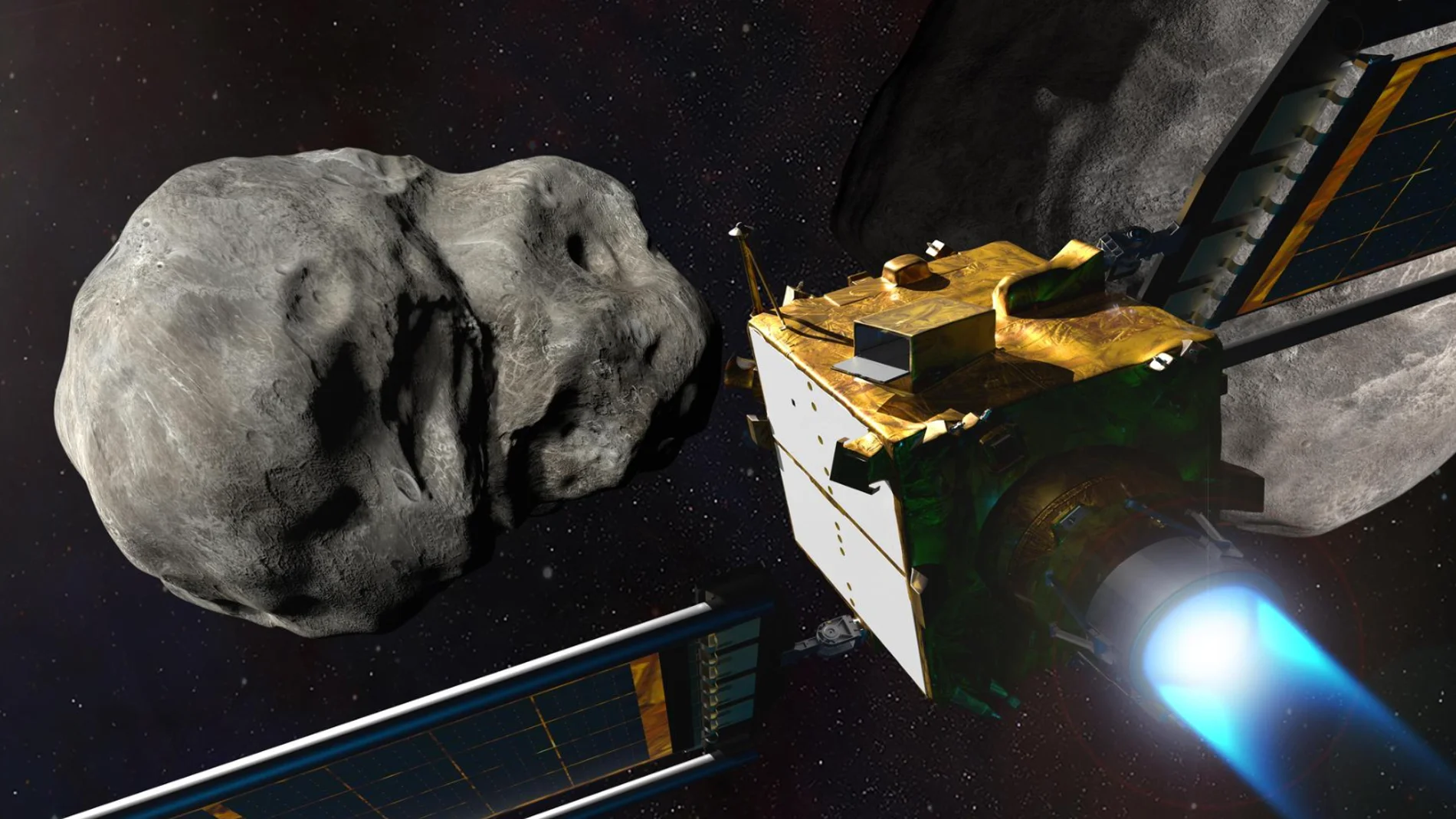
Can we do something? In the field of planetary defense there is a fundamental rule: the sooner an asteroid is detected, the easier it is to deflect it. In 2022, the Double Asteroid Redirection Test (DART) mission deliberately impacted the small asteroid Dimorphos and managed to modify its orbit around its main body. It was the first real demonstration that a spacecraft can alter the trajectory of a celestial object. But that was because we were able to see it…
To confront those that remain hidden, NASA is preparing a new space observatory: the Near-Earth Object Surveyor. Unlike many current telescopes, this instrument will not look for the light reflected by asteroids, but rather the heat they emit. When observing in the infrared, You will be able to detect dark objects that go unnoticed today.
Scientists hope that this mission will allow the vast majority of potentially dangerous asteroids to be located in the coming decades. As a final point, it is important to clarify that the figure of 15,000 unknown asteroids may sound alarming, but it is worth adding an important nuance: There is currently no known asteroid with a significant probability of impacting Earth in the next century.