
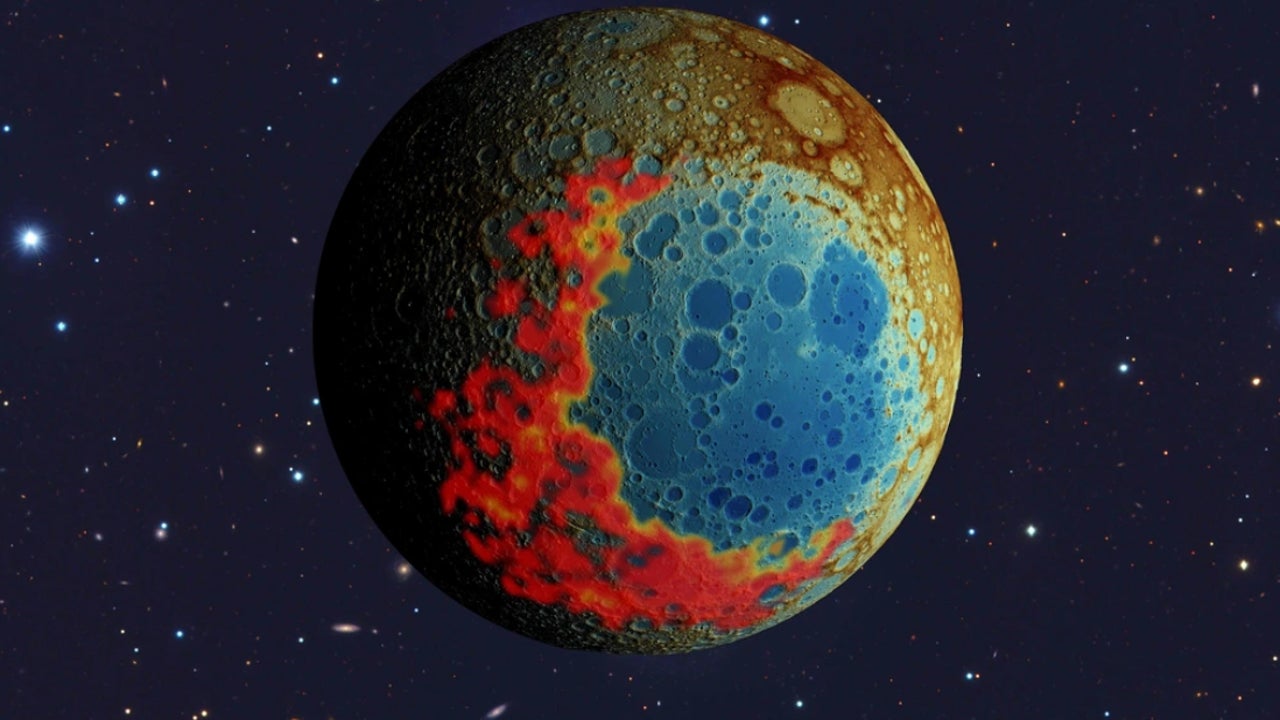
The third stage of the Artemis program contemplates returning to the Moon after 53 years, the last time we set foot on our satellite. And the place selected for this new lunar footprint is the lunar South Pole. There’s just one problem: it’s not what we thought..
A team of NASA scientists has discovered that We Might Have Been Wrong About How the Moon’s Largest Crater Formedthe South Pole-Aitken (SPA) basin, approximately 4.3 billion years ago.
In a study published in Nature, the authors, led by Jeffrey Andrews Hanna, point out that the more than 1,900 kilometer crater appears to have been the result of an indirect impact to the southand not from the frontal impact of an asteroid, as previously believed.
The findings could help explain why the far side of the Moon is riddled with large craters, while the visible side, more explored, is relatively smooth. Additionally, they could have “important implications for upcoming human exploration of the lunar south pole,” the study notes.
This is because the space agency’s missions will land on the lower edge of the basin, the best place to study the largest and oldest impact zone on the Moonwhere most of the ejecta, material from the depths of the lunar interior, should accumulate.
In other words, the region where we plan to land the first astronauts on the Moon in more than half a century, in just two years, could still contain more clues about the evolution of the Moon and its interior structure than we thought: a happy coincidence that should make us even more excited about NASA’s long-awaited return.
The team analyzed the shape of the solar impact basin and compared it to other giant impact basins in the solar system. They found that its oblong, teardrop-shaped shape was probably due to a southward impact, which tore through the lunar crust and revealed heavier minerals. in the process.
Current theories suggest that The Moon was once covered by an ocean of magmaa result of the energy it released when it formed. The heaviest minerals They sank to form their mantleeitherlido, while the mtolight s floated to the surface to form its crust.
Some “leftover” minerals, such as potassium, rare earths, and phosphorus (or KREEP, as scientists point out), evaded much of this process and instead They concentrated in the remaining magma ocean, eventually becoming trapped between the mantle and crust..
“If you’ve ever left a can of soda in the freezer, you’ve noticed that as the water solidifies, the high fructose corn syrup resists freezing until the end and instead concentrates on the last traces of liquid – explains Andrews Hanna in a statement -. “We believe something similar happened on the Moon with KREEP.”
However, the KREEP-rich material accumulated much more on the near side of the Moon, and not on its far side, which Before, it was more volcanically active, a surprising asymmetry that remains a great mystery.
“The latest findings suggest that the cortex thickened on the hidden side, and that the magma ocean below was ejected to the sideslike squeezing toothpaste out of a tube, until most of it ended up on the visible face,” adds Andrews Hanna.
The gap formed by the impact to the south suggests that the region lies on the boundary between the KREEP-rich crust and the more regular crust.
“The last remains of the lunar magma ocean ended up on the visible side, where we observed the highest concentrations of radioactive elements – says Andrews Hanna -. But At some earlier time, a thin, irregular layer of magma ocean would have existed beneath parts of the far side.which explains the radioactive ejecta on one side of the south polar impact basin.”
The findings highlight how much there is still to learn about our closest celestial neighborand how our current knowledge is far from definitive.
“With Artemis, we will have samples to study here on Earth and we will know exactly what they are – concludes Andrews Hanna -. Our study confirms that “These samples may reveal even more about the moon’s early evolution than previously thought.”.