
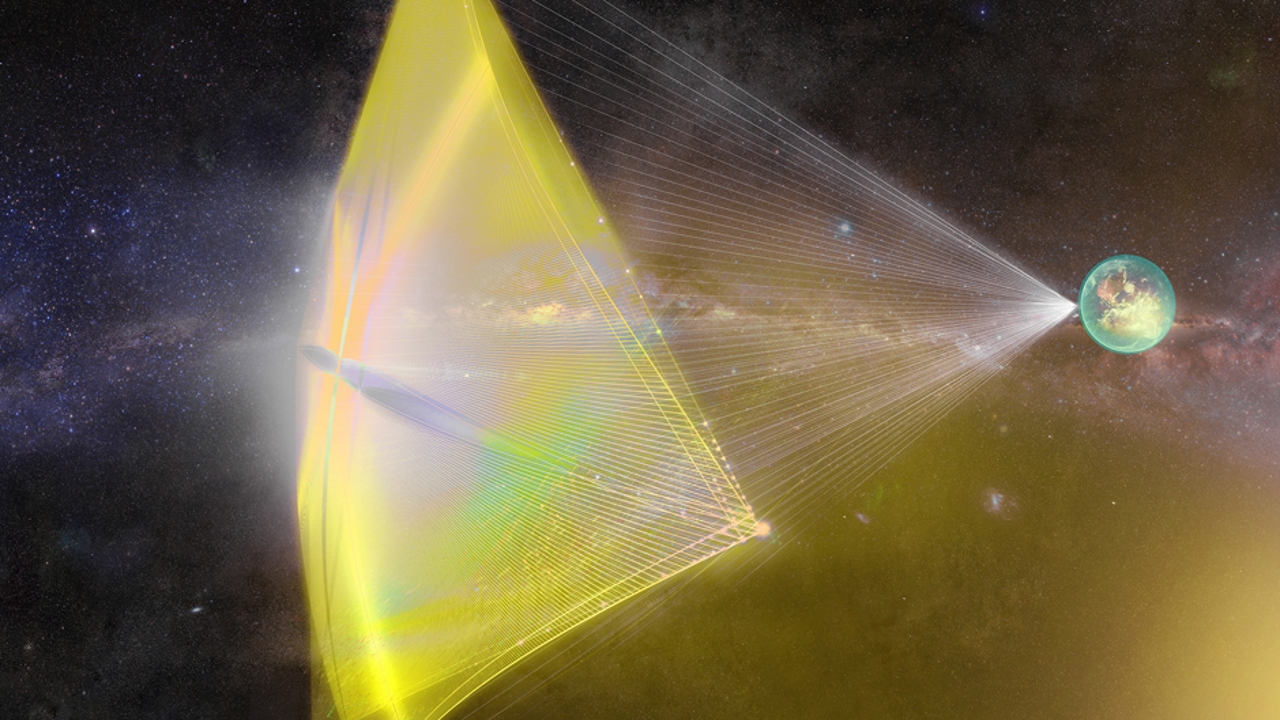
In 2017, at a conference held in Beijing, China, Stephen Hawking stated that increasing population and energy demand will turn the world into a scorching fireball by 2600. Fortunately, he added a dose of hope to this apocalyptic scenario. : our only chance is to escape from our planet, is a project, known as Breakthrough Starshot.
The initiative, of which he himself was a part Hawking with Mark Zuckerberg and Yuri Milner (physicist and billionaire), is based on the construction of small spaceships powered by rays of light that could reach Alpha Centauri.
“The History of humanity is a story of great leaps: from Africa, across the oceans, to the skies and into space – they explain on their website -. Since the Apollo 11 trip to the moon, we have been sending our machines ahead of us, to planets, comets and even interstellar space.”
But with today’s rocket propulsion technology, it would take tens or hundreds of millennia to reach our neighboring star systemAlpha Centauri. The stars, it seems, have set strict limits on human destiny. At least until now.
In the last decade and a half, technological advances have opened the possibility of powered space travel by light to a fractioneithern significant speed of light. This involves a ground-based light projector that propels ultralight nanocraft (miniature space probes attached to “light sails”) at speeds of up to 160 million kiloeithermeters per hour. A system of this type allowsYoto a missioneitheroverflight number for reach Alpha Centauri in just a few minutestos from 20 toños since launchtransmitting images of its recently discovered planet, Proxima b, and any other planets that may be found in the system, as well as collecting other scientific data such as analysis of magnetic fields.
“Breakthrough Starshot aims to demonstrate the proof of concept of ultrafast light-powered nanocraft and lay the foundation for a first launch to Alpha Centauri in the next generation – add those responsible -. On the way, the project could generate important complementary benefits for astronomyincluding exploration of the solar system and detection of Earth-crossing asteroids.”
Obviously, a number of difficult engineering challenges remain to be resolved before these missions can become a reality. It’s not just about getting there, but about equip ships with analysis technology, enough energy to obtain that information and the ability to transmit it. And even so, if this is achieved, it would take decades until the information returns to Earth… if we are lucky and we are still here.