
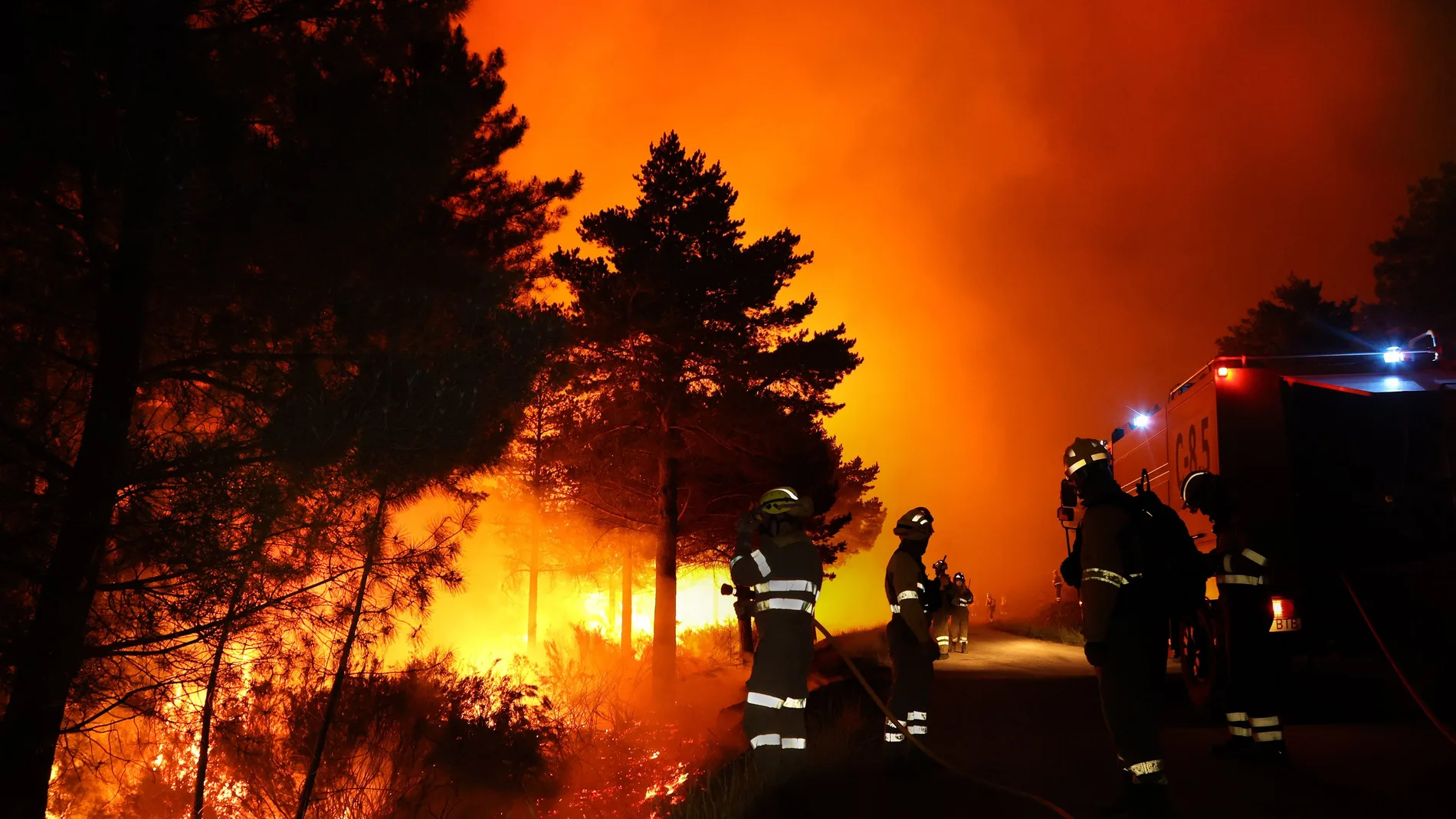
At the beginning of the season, meteorological services publish their weather forecasts for the following three months. This year it is not new to find this forecast in spring and neither is it new that meteorologists
go talk about above-average temperature trends. As for rainfall, “the trend is more uncertain… Periods of abundant rainfall alternating with drier phases are not ruled out.” Will it be a rainy spring? This question, this year, is especially relevant. It is for forestry engineers and fire prevention experts, especially after what happened last summer. Up to 62 large fires devastated 350,000 hectares of forest.
But what does rain and fire have to do with each other? The winter and spring of 2025 were abundant in rain, and while water may seem like a good idea for prevention, weather patterns show that just the opposite is happening. Eduardo Tolosana, dean of the Official College of Forestry Engineers, explains: “Winter rains are not as important as spring rains, because in many cases the vegetation is practically stopped by the cold. So the rains generate reserves in the soil, fill the aquifers, but do not directly contribute to the vegetation growing much. The spring ones fall just when the plants are waking up and are already able to actively absorb water from the soil. This is what happened last year. “The spring rains were very abundant and that generated a lot of fine vegetation – herbaceous and shrubs – very important in the spread of fires.”
In recent years there has been talk of megafires, fires that when they arrive are inextinguishable and that are already considered inevitable due to climate change. «We are having a profusion of disturbances that already existed, but that are now much more frequent and extreme. Last year, not a single drop fell throughout June. This caused all the fine plant material to dry out and become very available to burn. This is what happened in León or Lugo. Areas of scrubland burned with great virulence and at high speed during the heat waves of July and August, and exceeded the capacity of extinguishing operations, not only due to their extension, but also due to their intensity and the simultaneity of fires in tremendously extreme environmental conditions. What we see in recent years makes it clear that we do not need more airplanes or firefighters. It is true that we need means to respond effectively to fire, but extinction is simply a response. The solution is in prevention »says Luis Berbiela, forestry engineer and member of the board of the Pau Costa Foundation.
The engineer comments that there are certain myths about forest management: «The idea of a pristine, immaculate, untouched landscape. However, we forget that 100% of our landscapes are cultural, derived from the actions of man for centuries. Non-intervention, sooner or later, causes imbalances. Another myth is that some species burn more than others, but the reality is that what burns depends on the plant structure, the continuity of that fuel in the territory and the environmental conditions that exist at the time of the fire. What spreads the fire is the structure. Last year a very important part of what burned were bushes or leafy trees. Only 100 hectares were planted with eucalyptus throughout the campaign. Eucalyptus is spoken of as an incendiary species and, however, what burns mostly are areas of scrub,” he comments.
In 2022, the Pau Costa Foundation brought together more than 60 experts from different fields – ranchers, environmentalists, forest management experts, firefighters and journalists – to prepare the so-called Declaration on Large Forest Fires. It proposed a key measure: if Spain has 28 million hectares of forest, at least 1% of that area should be actively managed each year. That would mean working on about 260,000 or 280,000 hectares and allocating around 1 billion euros annually to fire prevention. “It is essential to act and invest in a real way in the prevention of fires and in the adaptation of forests to climate change,” he says.
Rural abandonment
Climate change is behind the large fires, yes, but their extension and virulence also have to do with rural abandonment and the lack of forest management. And fire, experts say, is a natural part of the forest and can occur even without human presence (lightning, volcanic eruptions…). The key is to prevent small fires from becoming catastrophic in terms of the environment and human lives.. For this, different density reduction techniques can be applied. Rural abandonment means that people stop cutting firewood, cultivating crops or grazing, and these areas become covered with bushes and become increasingly dense. They are a bomb when a fire breaks out. What would be the solution? From the point of view of forest management, carry out clearing, use extensive livestock farming to control the abundance of grass and apply controlled burning. Extensive livestock farmers and the sustainable use of wood, firewood and other forest products should be supported,” says Tolosana.
To put a figure, he says: «In Europe approximately 60% of what grows in forests is cut down each year. That means that there is a part that accumulates. In Spain this figure is reduced to just over 30%. That means that much of what grows in the bush is accumulating. We have increasingly dense forests, with more and more trees and increasingly larger. And that, if it is not managed by humans, fire will manage it.”
And speaking of 2026, The month of January has been the rainiest in the last 25 years. The eight storms in a row that crossed the Peninsula in the depths of winter have raised the alarm among meteorologists and engineers. At the beginning of winter, the Official College of Forestry Engineers published a decalogue of actions to reduce the risk of large fires and adapt forest management. Among other measures, He asks that there be planning documents in all the mountains, because they only exist in 24% of the surface, “a percentage that grows very slowly.”
They also request stable financing and specific funds for management or direct aid to forestry, in addition to public-private collaboration, since 72% of the forest area is private. Likewise, they consider it necessary to improve the forest road network as a basis for more active and profitable forest management.
More forest mass
56% of the Spanish territory is covered by mountains, a figure that has grown in recent decades due to rural abandonment. That means about 28 million hectares. «If we wanted to prevent 10% each year, we would have to act on almost 3 million hectares. But prevention is not valid forever: the vegetation grows again and we must act again. And that is not economically possible,” explains Tolosana. That is why the engineer recommends locating the so-called strategic management zones: areas where prevention is most effective. «Through simulation models, potential fires and their trajectories are studied depending on climatic variables, slope or vegetation. It is determined where the fire is most likely to end up happening. In these areas, firebreaks are created, the distance between trees is increased or brush is cleared. It can also be done by introducing livestock or using fire as a tool through prescribed burning. There is a lack of effort because prevention actions do not have an obvious reflection. If you prevent it, you don’t know if that fire would have occurred,” he says.
Population at risk
Just as there is a population at risk of flooding because it has been urbanized where it should not have been, there is also hThere is a population most exposed to the possibility of a forest fire. “We must distinguish between the risk of forest fire and the risk of forest fire,” explains Luis Berbiela.
«The first depends on the conditions of the territory: slope, vegetation or climate. The second has to do with the vulnerability of the population. No one can guarantee that when the fire reaches the door of their house there will be a firefighter waiting for them. That’s getting more and more difficult. “If someone buys a beautiful house in the middle of the forest, they have to know that they are not only buying the views and enjoyment of the landscape, they are also buying danger.”
Forest flood management
Eduardo Tolosana adds one last interesting note: Forest management can also help avoid or minimize flooding events. «We worry a lot about flood zones, downstream, which is where the populations are, but the water does not come out of the rivers, it comes out of the mountains, where precipitation begins to accumulate. If we are able to protect the headwaters of the basins, laminating the water with reforestation for example, we will be able to stop the speed with which the water reaches the flood zones and reduce the impact.