
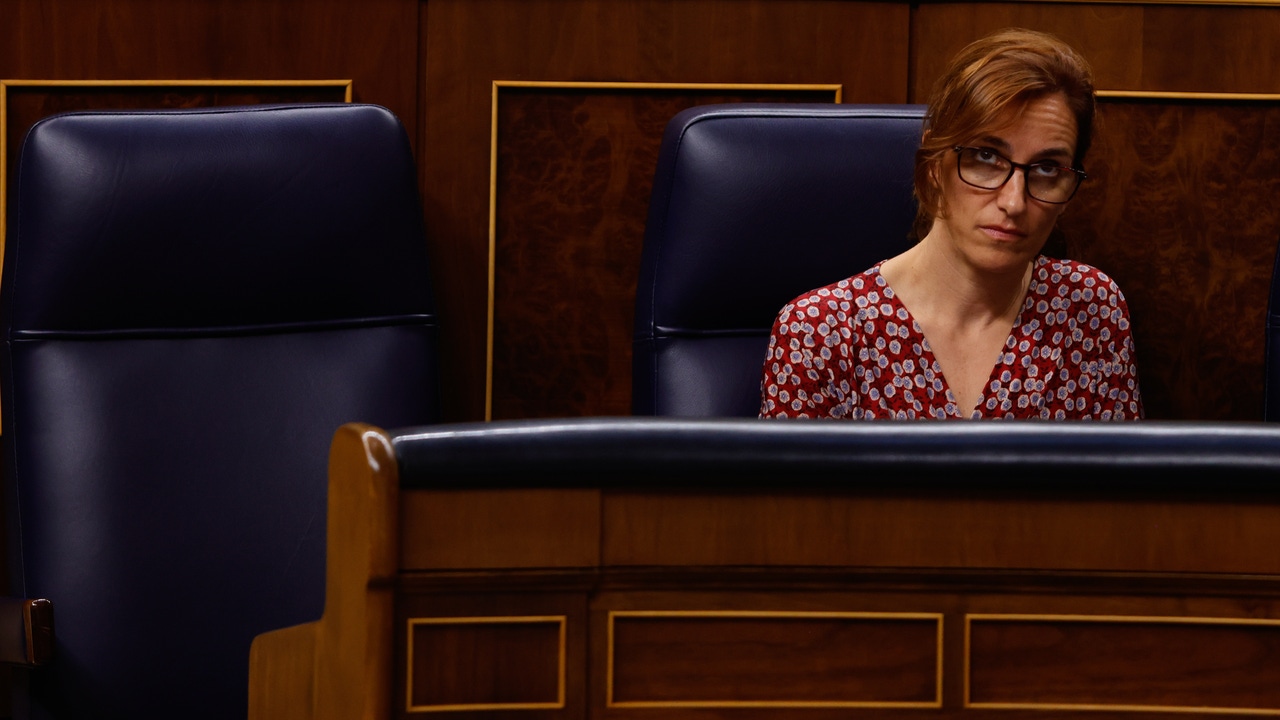
It has been a year since PSOE and Sumar signed the pact “Spain moves forward. A new progressive government coalition”. Within it, a series of health measures were contemplated that the Minister of Health, Monica Garcia, – now marred by the alleged cover-up of his party colleague, Íñigo Errejón, – has not yet started.
Therefore, Last Thursday, the Popular Group in Congress requested García’s appearance to account for these breaches, just as LA REASON has been able to know.
The first of these promises was to “protect the universality of our National Health System (SNS), culminating in the approval in the Cortes of the Law that modifies various regulations to consolidate Equity, Universality and Cohesion.” As of today, what they have done could be summarized in “cutting up” the Cohesion and Equity, Universality and Public Management Law, of the previous minister Carolina Darias. The Universality Law that they announced and brought to Congress is not progressing and, week after week, the period of amendments is being extended, despite the fact that they have a majority in the Table created for this.
No Plan for Primary
Even more delayed is the promised “shock plan to strengthen primary care throughout the State” which, according to the text of the aforementioned pact, “will allow the CCAA to increase staff, improve infrastructure and modernize the equipment of their health centers.”
Mónica García’s number 2, Javier Padilla, has already announced on several occasions that the Primary and Community Care Plan 2025-2017 will be presented before the end of this year, and has even described it as “ambitious”, but “tremendously pragmatic and possibilist”. Empty words until real measures with economic memory are announced, as this newspaper already highlighted.
Another of Mónica García’s electoral promises was to “end waiting lists in public health, establishing by law maximum waiting times in the SNS: 120 days for surgical interventions, 60 days for specialized outpatient consultations and 30 days for complementary tests, regardless of the place of residence. In the case of mental health, the maximum waiting time guarantee will be a maximum of 15 days for young people, adolescents and those under 21 years of age.”
Record waiting lists
This statement now sounds tremendously utopian and unreal when faced with the harsh reality, which is that of a total of 848,340 people on the waiting list for non-urgent operations, which represents an increase of 3.4% (28,300 people) in relation to the same period of the previous year, according to the data released by the Ministry itself last week,
In addition, the average waiting time for a surgical intervention stood at 121 days, which represents an increase of 9 days compared to June 2023. To this we must add that the percentage of patients who must wait more than six months has grew 3 percentage points, reaching 20.5%.
But even more bloody is the no commitment to mental health.
In the famous pact it was announced: “we will ensure the right to a universal, public and quality mental health. Within the framework of a State Pact for Mental Health, we will put special focus on young people, with a reinforcement of the ratio of mental health specialists and a plan of specific measures aimed at preventing youth suicide.”
And what have they done so far? Last Tuesday, the PSOE presented a non-legal proposal to reinforce the digital protection of the mental health of youth. Nothing else.
Another of the electoral promises of the pact was that of increase healthcare positions in medicine, nursing and psychology in public universities, and the MIR, EIR and PIR positions. In addition, they committed to “promote the public sector stability law to reduce the temporality of health professionals”.
Until now, The expansion of MIR places carried out by Health has not reached 3% and, most importantly, it has not focused on Family Doctors. Let us remember that, today, in Spain, there is a need for Family specialists and paediatricians, from 6,000 to 10,000 according to the medical societies and about 4,500 according to the Ministry itself.
The last two unfulfilled promises are to “renew health technology so that the SNS is a benchmark in technological innovation” – according to the sector, what our country needs is a structured long-term plan – and to “integrate the needs of rare diseases in the global planning of universal coverage” – of which this Ministry, to date, has only presented an evaluation report of the current strategy in the SNS–.
No progress in the Oral and Visual Health Plan
The promise of increasing the portfolio of public health services and benefits with respect to oral health, visual health, deserves special mention due to the pomp with which it has been announced since García arrived in Health. “We will propose a specific direct aid program for the purchase of glasses and contact lenses for children under 18 years of age for families with fewer resources,” they promised. To date, there has been no specificity in this area, nor is it known what budget would be available. for it.
Recently, the minister announced that these products will become part of the benefits covered by Social Security in 2025 “progressively, starting with the children of the most vulnerable families.” Seeing is believing.