
Moncloa needs the tension in the street, “there will be no peace”, to place Santiago Abascal at the center of the campaign. “It is the only way that Sánchez can beat Feijóo,” maintain socialist sources. Government delegates, the party’s “cubs”, unions, nearby civil associations and even digital networks are put at the service of the cause, in implicit and, in some cases, completely ordered coordination. It’s all part of a well-planned strategy. This offensive is worrying different territorial organizations due to the risk that the growing tension will get out of hand.
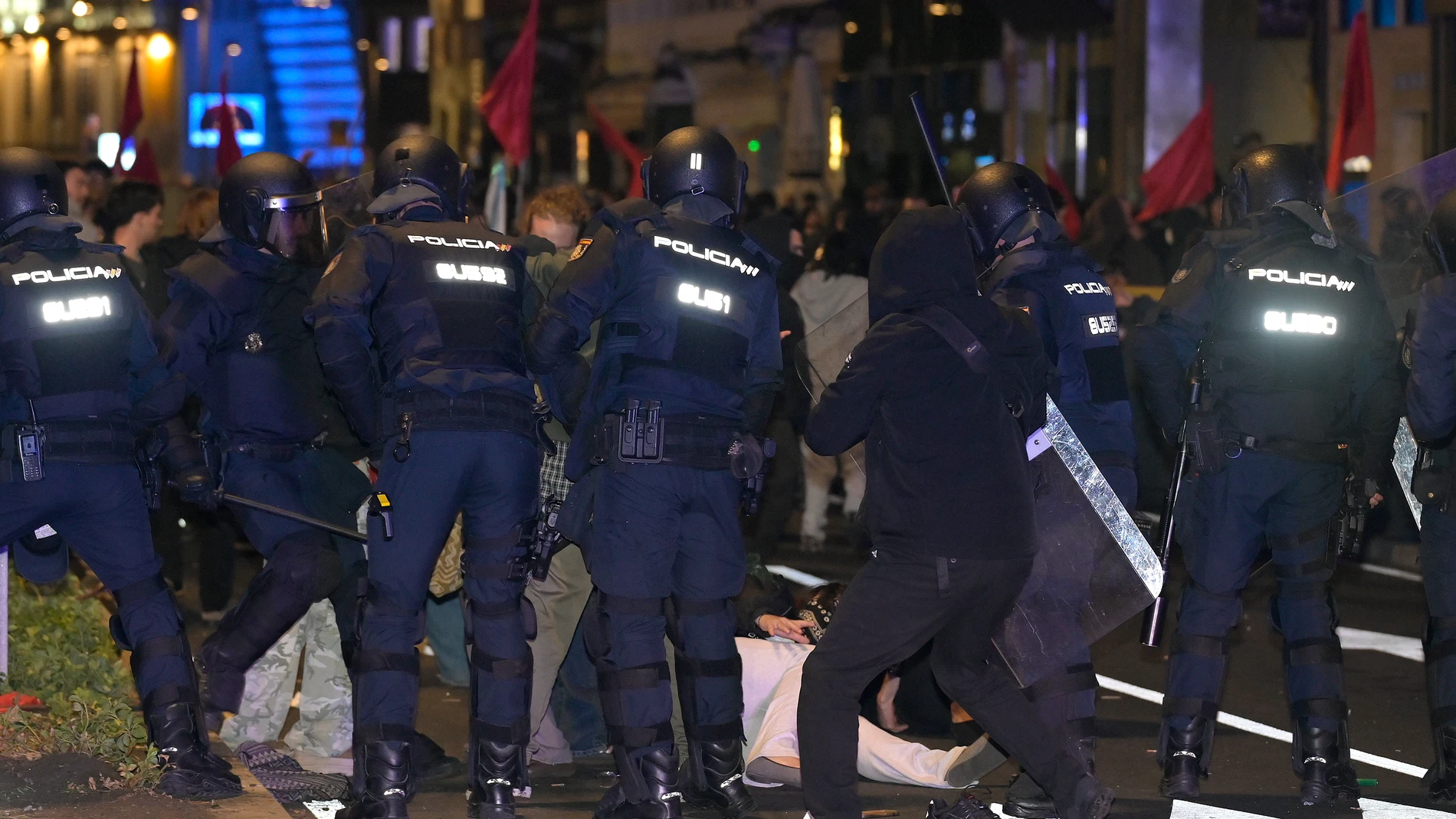
The incidents recorded this Wednesday in A Coruña, during Abascal’s visit, are the image of where the campaign wants to go. The Socialist Youth participated in the protest against the president of Vox together with Galiza Nova, the BNG youth organization, student unions and groups linked to the defense of housing. The rally brought together thousands of people in the Plaza de María Pita, where the Abascal event had also been held: the coincidence was authorized by the Government Delegation. The day ended with clashes between protesters and police, two arrested and several injured.
The participation of the young socialists constitutes one of the most relevant political elements of what happened, since they went to the square an hour before Abascal’s appearance, amid slogans of rejection of Vox, and participated in the movement to “warm up” the climate. The Socialist Youth are not a minor satellite, but a very important piece in the political structure of the PSOE. Their territorial implantation, their presence among students and young activists and their ability to participate in campaigns and public events make them an instrument of generational mobilization, and they are also a source of future leaders and institutional positions.
The importance of their presence in the protests against Vox does not lie solely in the number of militants they can contribute. Its participation introduces an organization linked to the PSOE in mobilizations that, on occasions, share space with groups located further to the left of the party and with nationalist organizations.
The concern expressed by socialist territorial sources focuses precisely on the political consequences of this coexistence between different forms of mobilization. “The party can decide the participation of its members, but it does not control the behavior of all the groups that coincide in a rally. The presence of violent groups can end up completely altering the meaning of a protest and shift the focus from the demands to the riots,” the Andalusian federation reflects.
The second great instrument of mobilization is found in the digital sphere. The PSOE has been strengthening its presence on social platforms for some time and trying to compete with Vox for the space of political communication aimed at young people.. Ferraz has identified Instagram and TikTok as important stages of this competition, without abandoning his activity in X.
This infrastructure is especially useful in a campaign marked by confrontation. A local protest can quickly become a national issue through videos, photographs, statements and cross-claims. The images of A Coruña confirm this way of operating: An appearance by Abascal, which was initially local, ended up occupying the political conversation due to subsequent confrontations. Moncloa knows this, and has this digital “army” on the march.
The PSOE machinery also has an extensive territorial presence, which Moncloa also intends to take advantage of. At the center of the controversy are the Government Delegations, whose heads are appointed by the Executive. The episodes in Santiago and A Coruña have placed under scrutiny the management of the opposing concentrations that were authorized and that ended in altercations.
And, of course, in this satellite structure, which participates in the planned offensive in the street, CCOO, UGT and the rest of the union organizations have their role. Also student associations, housing groups, feminist organizations and some anti-racist entities, for example, that they have a role in the protests.
The background of all this mobilization is the electoral dispute. The socialist sources consulted maintain that Sánchez needs to modify the axis of the campaign to weaken Feijóo as much as possible, and Vox is a necessary instrument to achieve this. “Placing Vox at the center of a scenario of conflict gives it prominence and angers the right-wing electorate even more. The more tension, the better for Abascal, and the worse for Feijóo,” says a socialist deputy who is already campaigning in his constituency. “The constant presence of Vox also conditions the debate within the right. Each controversy related to Abascal raises questions about Feijóo’s position, his relationship with Vox and the conditions of possible parliamentary or government understandings,” adds an interlocutor with a position in the Government.
But confrontation can produce consequences other than those intended. The experience of other countries shows that mobilizations against radical right parties do not have a uniform electoral effect. In some cases, they have contributed to reducing their support; In others, they have reinforced the identification of their followers with the party. Violence also introduces an element of uncertainty that makes any electoral calculation difficult.
That is the risk that worries different territorial organizations, which are already in the pre-campaign for their May elections. “These things are known how they begin, but not how they end, or against whom,” says an autonomous councilor.