
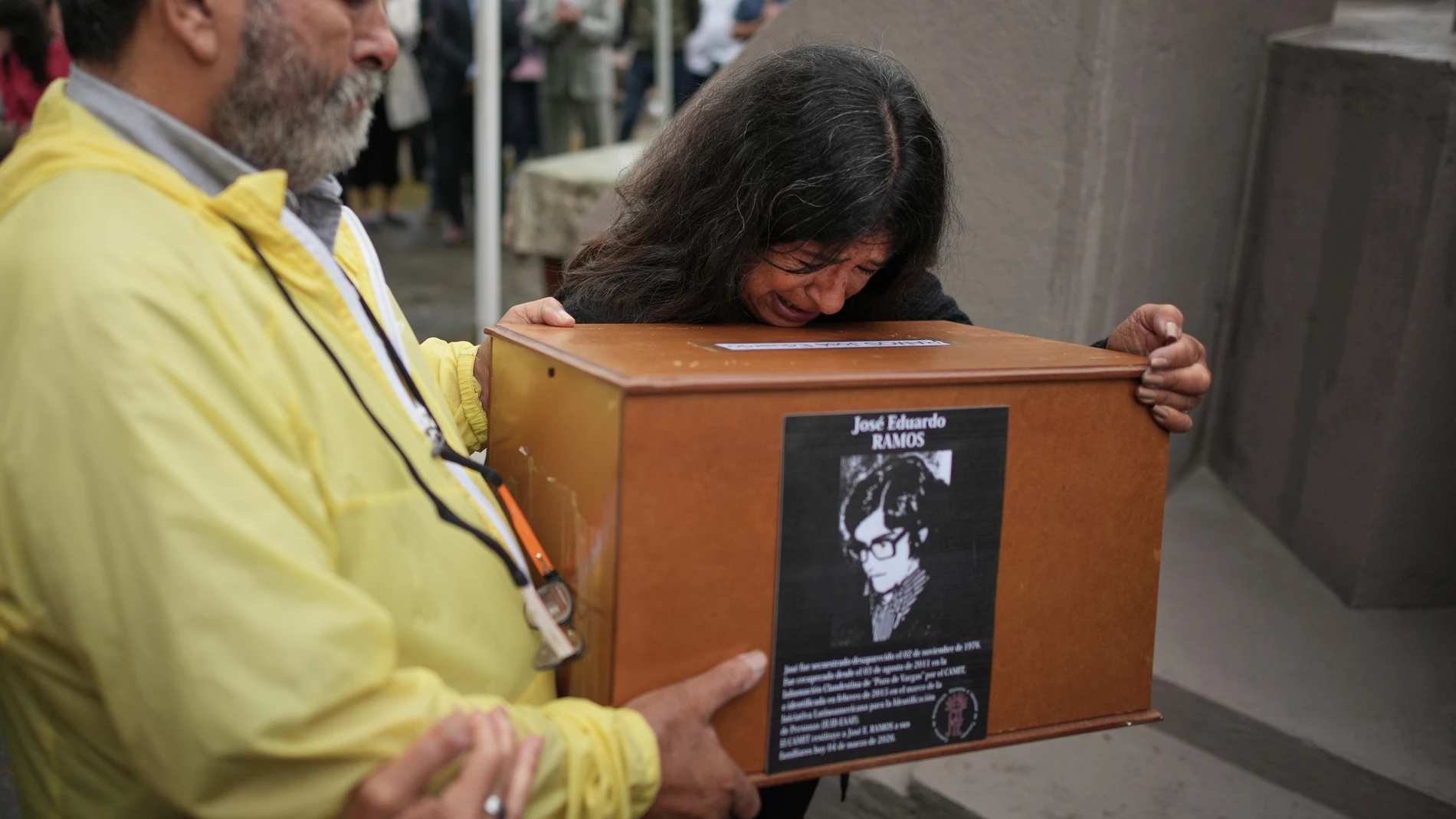
“We continue to claim for our thousands of missing people. It is a fight of the present because there are many genocidaires that we have not yet been able to prosecute,” he says. Alexandrina Barry. She is an orphan of that dictatorship, she was three years old when the coup plotters murdered her parents, they chased them to Uruguay, within the framework of the bloody “Operation Condor.”
Today she is a human rights activist and until two years ago she was a left-wing deputy. He continues to battle in court against the military who committed crimes against humanity, led by Jorge Rafael Videlawho died at the age of 87 in 2013, sitting on the toilet in his cell, where he served only one year of the life imprisonment to which he had been sentenced.
Although the government of Javier Milei has no intention of outright condemning this tragedy that, 50 years ago, triggered the bloodiest military coup In that country, thousands of Argentines and hundreds of civil and human rights organizations, universities, labor unions and unions, are getting ready to remember today, in the smell of crowds and in every corner of the country, the date that unleashed the dictatorship: the coup d’état of March 24, 1976 against Isabel Martínez de Perón, “Isabelita”, who, as vice president, had assumed command of the country after the death of her husband, General Juan Perónin July 1974.
Seven years of terror and 30,000 missing
50 years ago in Argentina, a dictatorship of horror was installed that lasted 7 years (1976-1983). More than 600 clandestine detention centers and concentration camps have been counted and it is estimated a figure of 30 thousand missing. The Argentine justice system determined that the dictatorship commanded by General Videla carried out a “systematic extermination plan”, which included the disappearance of people, torture, the theft of babies and the use of clandestine detention centers. In addition to newborns, the coup Military Junta kidnapped schools, universities, institutions, unions, human and civil rights, but not the memory of a country. Or the majority. There are those who, like Javier Milei, prefer to forget and turn the page.
“You cannot build anything on a lie. So, as long as they do not admit that there were not 30,000, it cannot be discussed,” said the president last year, around this same time, in reference to the number of missing people maintained by human rights organizations. And he insisted: “I do not agree with this one-eyed vision that Kirchnerism wanted to impose on us and I always said: I want the full memory; That is, a half-told truth is not true, it is a lie.” Since he was a candidate, Milei has avoided condemning the coup d’état and has become obsessed with denying the number of missing people.
Millions of Argentines, however, do not forget. For all of them, the mourning continues: until the location of the thousands of missing people is known, the hundreds of stolen babies are identified and all those involved in the crime are convicted. more than 100 investigations still open.
Memorial Day
In Argentina, March 24 was decreed as “Memory Day” and is a holiday throughout the country. The history of the 1976 coup d’état and the tragedy that Argentina experienced with the military dictatorship It is transversal to three generations that today are those testimonial voices that tear apart and demand justice and memory: that of the survivors of torture, that of the children of those murdered and that of the grandmothers of the Plaza de Mayo, who are the mothers of the disappeared who They search incessantly for their kidnapped grandchildren and given for adoption to the military or families around them. They have already located 165, but they estimate that they are missing about 400 more who were born in the middle of the dictatorship and who today are between 43 and 49 years old.
Teresa Labarde Calvo and his mother Adriana Calvo They survived that barbarity. Teresa was born by a miracle inside a Ford Falcón patrol car at full speed when her mother, bandaged and tied, was being taken from a police station to a concentration camp called Pozo Banfield, where the military took all the women prisoners to give birth.
“They were going at full speed and I yelled at them to stop, that my daughter was going to be born, I can’t take it anymore, I told them, and they responded: it’s no use, you’re going to die anyway,” Adriana, now deceased, said in her testimonials. With her hands tied behind her and her eyes blindfolded and in an impossible birth, Teresa was born and fell to the floor of the patrol car hanging by the umbilical cord.
Amnesty laws
Her mother could not see or touch her. “I asked them to give me my baby, who was lying down and crying, but they didn’t do it and they didn’t stop.” It was there, in the midst of so much pain and helplessness, that Adriana, kidnapped in February 1977, Due to his activism in the union of university teachers, he swore that, if he survived, he would fight until the last day of his life to achieve justice. And so he did, She was the first survivor to give her testimony which served to open cases against dozens of soldiers, including Jorge Videla, once the “Punto Final” and “Due Obedience” amnesty laws, which had benefited the military coup plotters, were repealed.
Adriana said that when she arrived at Pozo Banfield they took her to the “torturing obstetrician”, Jorge Bergés, who died just a month ago, who had just cut her baby’s umbilical cord and he ripped out her placenta. Then he ordered her to bring a bucket and mop the floor naked and just giving birth. After carrying out that task, they just handed over his daughter. And they left the two to their fate. They were not given food or shelter, it was the other prisoners, many of them, stripped of their children, who saved them.
“As the dungeons were already open, all the fellow prisoners, around 20, stood in front of me, inside the dungeon, shouting like lionesses: ‘They’re not taking her. They’re not taking her.’ And it was impossible for them to take her out if they didn’t kill us all. It was absolutely impossible because they formed a human wall that they couldn’t get through. And Teresa stayed with me.” Adriana also said that in that prison she ate a soup every three days. And many women stopped eating their ration to donate it to the newcomer who had to breastfeed her daughter. And they went without eating for days.