
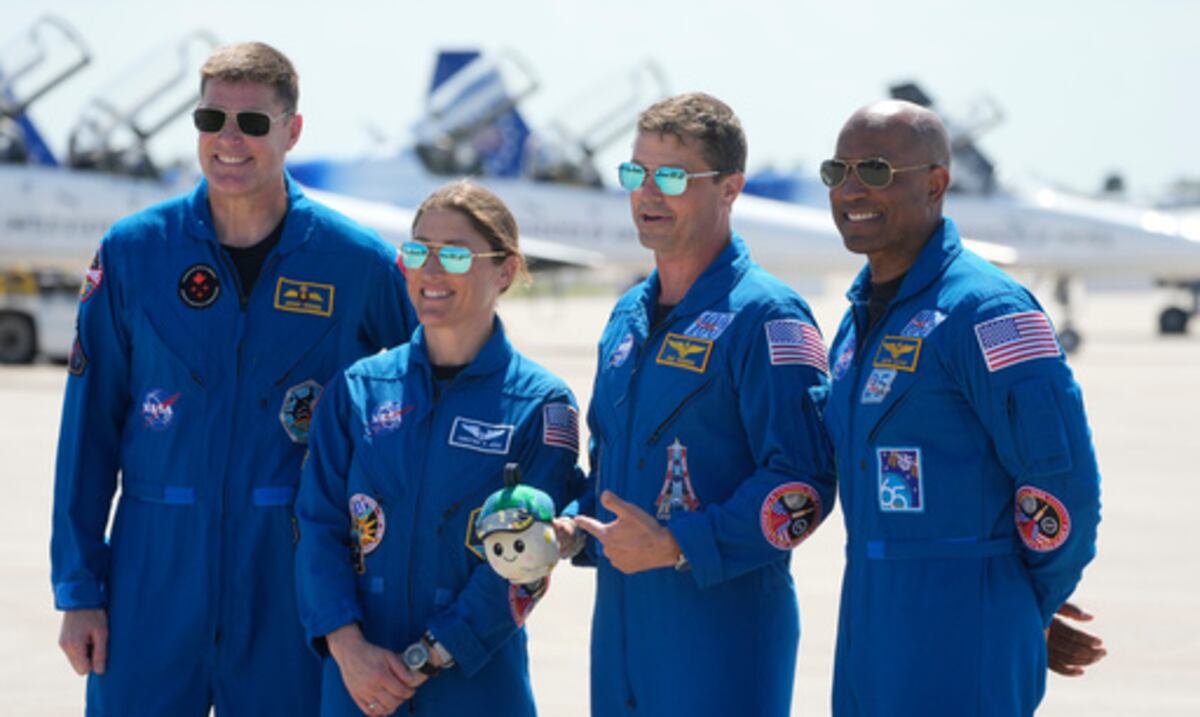
Cape Canaveral, Florida- The four astronauts who will take the next lunar jump POT They bear very little resemblance to those of the Apollo era.
The Americans who paved the way to the Moon more than half a century ago were white men chosen for their experience as military test pilots. This first crew of Artemis includes a woman, a person of color and a Canadian, products of a more diversified astronaut corps.
None of them lived during NASA’s famous Apollo program, which sent 24 astronauts to the Moon, including 12 moonwalkers. This time they won’t land on the Moon, or even orbit it, but the round trip will take them thousands of miles deeper into space than even the Apollo astronauts ventured, promising unprecedented views of the lunar far side.
Here’s a look at the Artemis astronauts, whose mission aims to pave the way for future moon landings:
Commander Reid Wiseman
At the head of the mission, which lasts almost 10 days, is a widower who considers solo parenthood – and not the trip to the moon – his greatest and most rewarding challenge.
Wiseman, 50, a retired Navy captain Baltimorewas working as NASA’s chief astronaut when three years ago he was asked to lead humanity’s first lunar trip since 1972. The death of his wife Carroll from cancer in 2020 made him reflect.
He had spent more than five months in the International Space Station in 2014, and his two teenage daughters, especially the eldest, had “zero interest” in him launching again.
“We talked about it and I said, ‘Look, of all the people on planet Earth right now, there are four people who are in a position to go fly around the Moon,'” he said. “I can’t say no to that opportunity.”
The next day, homemade moon muffins and the support of her daughters awaited her. The hardest thing is not leaving them, “it’s the stress I cause them,” he says.
Open with his daughters about everything, he recently told them where he keeps his will.
Pilot Victor Glover
As one of NASA’s few black astronauts, Glover sees his presence on the mission as “a force for good.”
The 49-year-old Navy captain and former fighter pilot from Pomona, California, makes a habit of listening to Gil Scott-Heron’s “Whitey on the Moon” and Marvin Gaye’s “Make Me Wanna Holler” from the white-dominated Apollo era.
“I listen to them to get perspective,” he said. “It captures what we did right, what we did wrong.”
The ability he now has to offer hope to others is “an incredible blessing and a privilege.” Despite having a space flight behind him – one of the first by the SpaceX crew to the International Space Station – he finds himself in new personal territory. His four daughters are in their teens and early twenties, “and I spend as much time and thought preparing them as NASA does preparing me.”
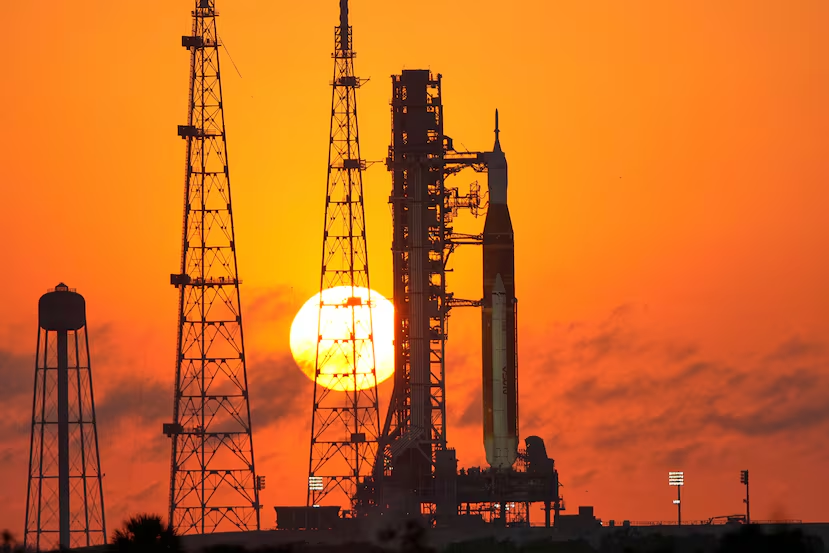
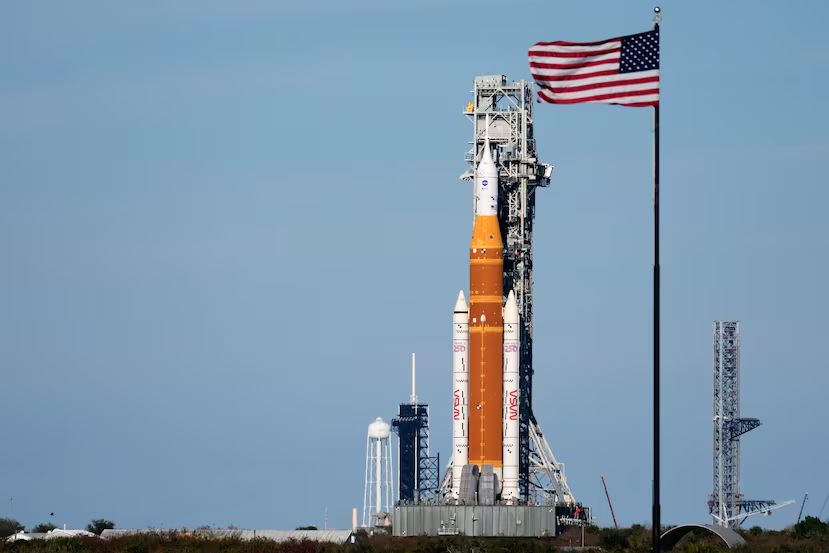
He is very focused on doing “our best race to be able to pass the baton to the next stage”: a docking mission in orbit around the Earth in 2027 between an Orion capsule and one or two lunar landers. The very important moon landing would take place in 2028 with another group of astronauts.
Mission Specialist Christina Koch
The last time Koch went to space, he was gone for almost a year, so he’s not worried about a quick round trip to the Moon.
The 47-year-old electrical engineer from Jacksonville, North Carolina, holds the record for the longest individual space flight by a woman: 328 days. During her long stay on the space station in 2019, she participated in the first all-female spacewalk.
More than a specific individual, “it’s about celebrating the fact that we’ve reached this point in history” where women can fly to the moon, she said.
Before her call from NASA, Koch spent a year at a research station in the South Pole. Between that and his stay in space, he believes he has “vaccinated” most of his family and friends.
“So far, I haven’t gotten too many nerves from people. Maybe my dog, but I’ve reassured him that it’s only 10 days. It’s not going to be as long as last time.”
The dog she and her husband rescued is named Sadie Lou.
From the Canadian Space Agency
The Canadian fighter pilot and physicist, Jeremy Hansenmakes his debut in space, something quite stressful, but he is also his country’s first emissary to the Moon.
“I may be naive, but I don’t feel much personal pressure.”
Hansen, 50, grew up on a farm near London, Ont., before moving to Ingersoll and pursuing aviation. The Canadian Space Agency selected him as an astronaut in 2009, and he was named a member of the Artemis crew in 2023.
Only now does he realize the effort it took to send men to the Moon during Apollo.
“When I go outside and look at the moon, it seems like it’s a little further away than it used to be,” he says. “I understand in the details how much more difficult it is than I thought by watching videos of it.”
The dangers continue to lurk, something he has shared with his college-aged son and twin daughters. “The most likely thing is that we will return safely. There is a possibility that not, and you will be able to move on with your life even if that happens,” he assured them.