
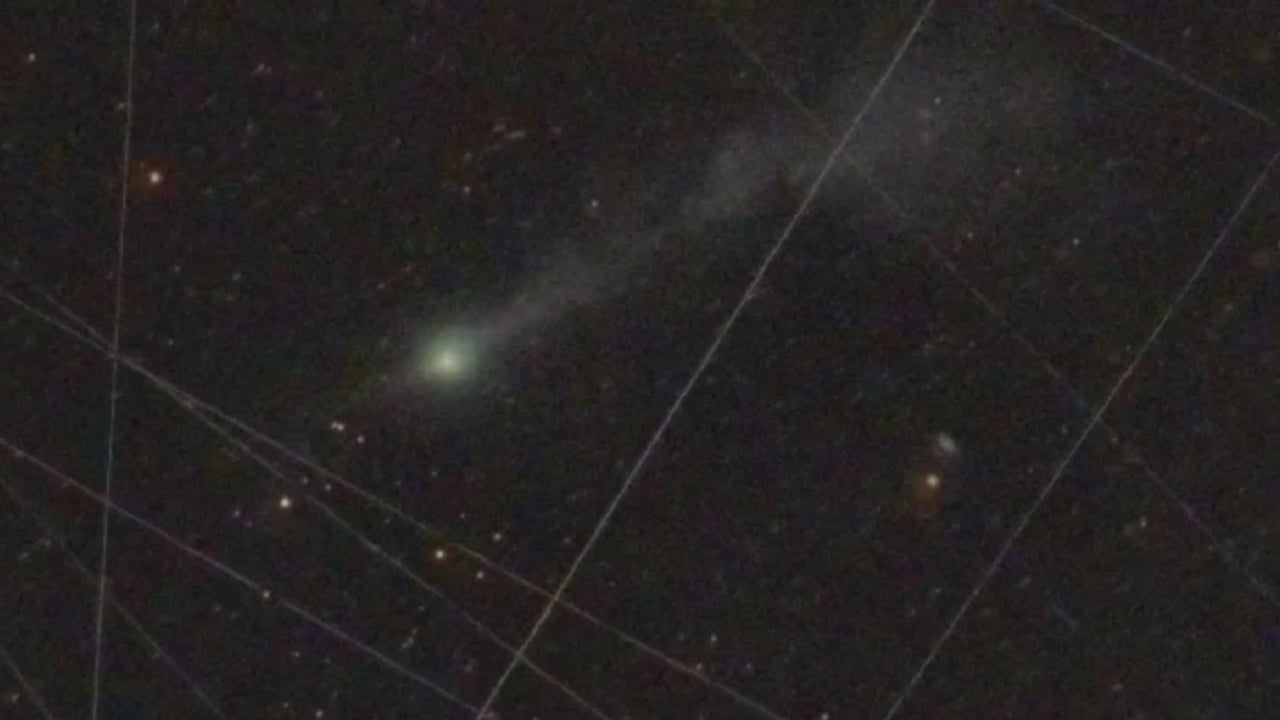
It comes from beyond the solar system, and yet it’s making its mark right in our cosmic neighborhood. Comet 3I/ATLAS, the third interstellar object identified after ʻOumuamua (2017) and 2I/Borisov (2019), was detected this year while passing through the inner solar system on a hyperb trajectoryeitherlica, that is, a route that confirms that it does not belong to our family of planets and asteroids. His passing has sparked interestands of astroeitherus from all over the world because it offers an opportunity orunique to closely observe the matter that formed around other stars, in other planetary systems, billions of years ago.
In recent days, astrophysicist Avi Loeb, from Harvard University, has analyzed new images of the comet and suggests that it could be experiencing its most dramatic moment: a massive fragmentation as it approaches the Sun. According to Loeb, the observations obtained on November 9, 2025 show several jets of material extending up to a million kilometers towards the Sun and about three million in the opposite direction, indicating that part of the core has disintegrated, expelling fragments and vapors at enormous speed.
The scientist’s preliminary calculation suggests that 3I/ATLAS could have lost up to 16% of its mass during this process. And here the first great contradiction appears. In Loeb’s words: “Houston, we have a problem with the natural comet hypothesis! The necessary surface area of 3I/ATLAS to explain the mass loss inferred from the last post-perihelion image is at least 16 times larger than the upper limit derived here from its July 21, 2025 Hubble image.” In other words, the amount of material released can only be explained if the comet is much larger than estimated or if it does not, in fact, behave like a natural comet.
Loeb also compares the intensity of the process with the known physics of comets: “Chemical rockets are propelled with an exhaust velocity of 3 to 5 kilometers per second, ten times greater than the maximum ejection velocity of volatiles. sublimated by sunlight on the surfaces of natural comets.” If the speed of the gases released by 3I/ATLAS is close to these figures, it could be a more violent phenomenon or even a different composition than expected for a conventional comet.
The scientist also observes an extreme behavior in the mass loss rate: “When the Webb data were obtained on August 6, 2025, 3I/ATLAS lost only 150 kilograms per second. The mass loss at perihelion, derived above, is four orders of magnitude largerapproximately 2 million kilograms per second. “This is a dramatic increase, requiring a power-law dependence of mass loss on distance from the Sun with an index of −10.5, consistent with the rapid brightness increase at perihelion of 3I/ATLAS reported here.”
This extreme difference between mass loss before and after perihelion It is unprecedented in known comets. If confirmed, it would imply that the core of 3I/ATLAS reacts to solar heat in a much more sensitive way than any other observed object, or that we are dealing with a body with a radically different structure.
Beyond the numbers, the relevance of this phenomenon is enormous. If the body is indeed disintegrating, we are observing for the first time how an object formed around another star reacts to the heat and forces of the Sun. It is, in a way, a natural experiment on the resistance of interstellar materials. Furthermore, its behavior, an acceleration not explained only by gravity and a large loss of mass in a few daysmight force us to revisit some models of how these visitors behave.
For now, Loeb’s interpretation is a hypothesis that must be tested with new observations. In the coming months, when 3I/ATLAS moves away from the Sun and can be observed again by ground-based telescopes, it will be possible to confirm whether it has completely fragmented or whether it retains an intact core. Whatever the outcome, This interstellar traveler has already earned a special place in the history of astronomy: to remind us that, even among the stars, nothing is eternal and everything can break when touching the light.