
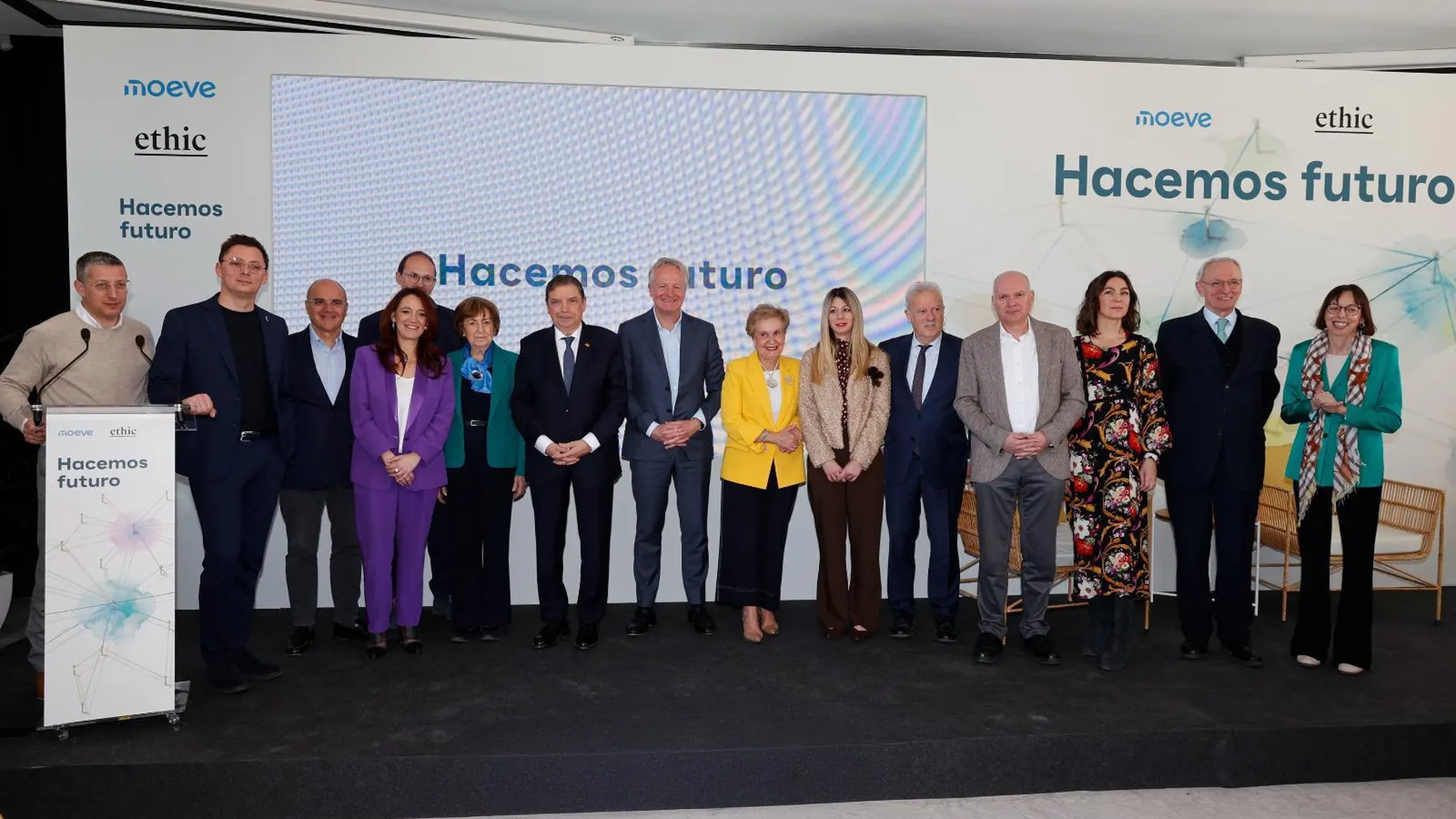
Neither empty nor emptied: the rural world is very alive. This is demonstrated by data such as rural employment growth of 4.9% between 2021 and 2023, according to the Secretary of State for Demographic Challenge. “Rural areas have not stopped growing for seven years,” said Manuel Campo Vidal, founder and president of Next Educación, during the “We Make the Future” meeting. The event, held this week at the Círculo de Bellas Artes in Madrid, brought together institutional representatives, companies, social fabric and rural development agents, organized by Moeve and the magazine Ethic. The objective: promote dialogue for a fair energy transition that promotes the social and economic development of the territories. The formula, repeated from the first intervention, was clear: collaboration and dialogue as levers to face the challenges and opportunities of the rural environment.
But what is the current situation?
The demographics of Spain leave no room for doubt: 85% of the population lives in less than 16% of the territory and there are more than 5,000 municipalities with less than 1,000 inhabitants. The day began with an x-ray of the rural world. The V Study “Perception of Advances in Rural Spain”, prepared by Next Educación, indicates that 51% of the rural population already knows of some entrepreneurial initiative in sectors such as agri-food or tourism that has generated employment in its territory. However, despite these advances, the report reveals that 63% of people identify institutional lack of coordination as the main brake on rural development. Although in recent years the gap between the city and the rural environment has narrowed somewhat, some challenges remain. “Complaints from the rural world no longer focus as much on connectivity as they did five years ago,” Campo Vidal pointed out, “but rather on bureaucratic slowness.” In this sense, he insisted that there is a growing interest in living in rural areas, but it is necessary to facilitate this process with effective measures, such as access to housing.
During the meeting, the key role of the energy transition was highlighted, “without which there is no ecological transition”, as some speakers emphasized, as an opportunity to energize the territory. The emeritus professor of Human Geography at the Complutense University explained that renewable energies represent a way to rebalance the relationship between urban and rural, a dichotomy generated by decades of intensive growth that “forgot the social or environmental costs. A change that has also been produced thanks to the European Union,” she stated, while defending the need to make activities in the territory compatible to avoid social conflicts or “encountering protest banners for certain projects.” In this sense, during the morning European policies, innovation and transversal cooperation were advocated as key elements to strengthen territorial cohesion and guarantee equal opportunities.
In the table moderated by Jorge Barrero, general director of the Cotec Foundation, the roadmap was recalled with 50 measures of its renewable project in the territory and “20 cases of good practices that can be replicated in other places to ensure that the benefits of these projects revert to local communities.” Carlos Barrasa, director of New Energies at Moeve, and Marta Ares, director of REDS, agreed to highlight the role of the energy transition as a driver of development. “At Moeve we believe that the energy transition is played as a team and that Collaboration is the basis for promoting projects with positive impact in rural areas.”Barrasa said.
As an example, he cited the green hydrogen project in Palos de la Frontera (Huelva), which aspires to be the largest in southern Europe, as well as the dismantling process of the Santa Cruz de Tenerife refinery. “We are in a phase of dialogue between actors to define what the city of the future will be like,” he explained, stressing that the key is to generate trust through active listening to the communities.
For their part, representatives from the social and institutional sphere – such as Juanjo Manzano (AlmaNatura), Carmen Quintanilla (Afammer), Tania Solans (FEMP), Francisco Javier Sánchez (REDEX) and Juan Diego Requena (Congress of Deputies) – debated the need to address the different demands of young and old to generate real opportunities for entrepreneurship, roots and social cohesion.
In another conversation, political scientist Cristina Monge, Maarten Wetselaar (CEO of Moeve) and Antón Costas (president of the Economic and Social Council) highlighted the role of companies as drivers of investment, employment and innovation, as well as their responsibility in promoting a fair energy transition. The Minister of Agriculture, Fisheries and Food, Luis Planas, closed the day by emphasizing that the rural world is a fundamental pillar to move towards a more sustainable, competitive and balanced model. “The great transitions – energy, technological and productive – represent an opportunity to promote economic development in rural areas, attract young talent and promote entrepreneurship,” he stated.
Along these lines, he highlighted the Government’s commitment to generational change and valued the role of the agri-food sector in territorial cohesion. For his part, Diego Canga, acting deputy director general of the Directorate-General for Agriculture of the European Commission, announced that there will be no cuts in the Common Agricultural Policy (CAP). Spain will have 46,000 million euros between 2028 and 2034, 800 million more than in the previous period. The main novelty, he explained, will be greater flexibility in the distribution of funds, allowing governments to allocate them to priorities such as water or depopulation. In addition, he highlighted the promotion of the bioeconomy as a way to diversify income in the agricultural sector, through the production of goods such as textiles, cosmetics or medicines from agricultural waste.
Future paths
The event also served to present Moeve’s Social License strategy, “We Make the Future”, focused on territorial development and collaboration with local agents. In this framework, the project was announced “Paths of the Future”, an initiative that seeks to value the natural, historical and cultural heritage of different rural areas to boost tourism and economic activity. The first five itineraries are already underway in Calamocha (Teruel), Cumbres Mayores (Huelva), Anaga (Tenerife), Navas de Oro (Segovia) and the Arán Valley (Lleida).