
For decades, dark matter has been one of the biggest enigmas of modern cosmology. We know that it does not emit, absorb or reflect light (which is why it remains invisible) but we also know that it exerts a decisive gravitational influence on the way galaxies rotate and clump together. Its presence is so dominant that more than 80% of the matter in the universe cannot be seencan only be inferred by how it curves space and guides the movement of the stars and galaxies that do shine.
Until now, astronomers had found signs that many galaxies had large halos of dark matter that acted as “glue” to hold them together. But what they have recently detected is different: a ghost galaxy so dominated by dark matter that there are almost no stars, an object whose brightness is so faint that it would have gone completely unnoticed without very sensitive techniques.
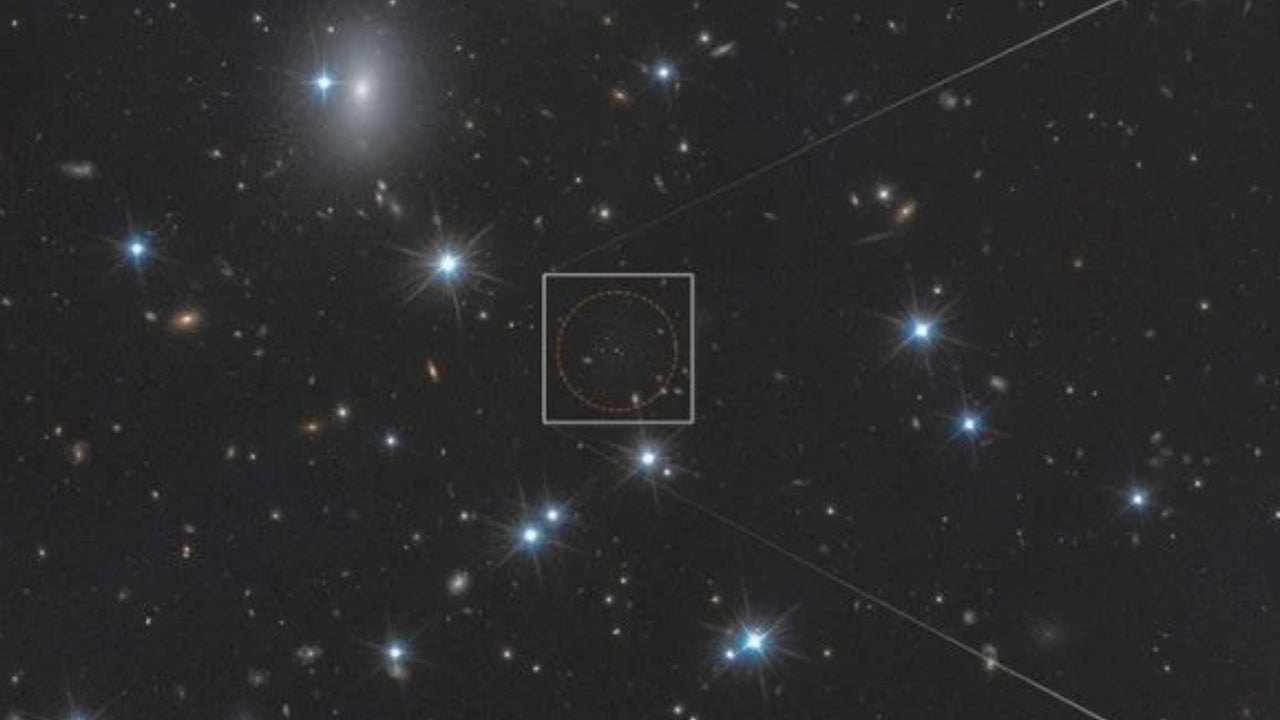
The galaxy, named CDG-2, is located in the Perseus galaxy cluster, about 300 million light years away. The extraordinary thing is that almost all of its mass (around 99% according to preliminary analyses) appears to be dark matter, while ordinary matter, in the form of stars, gas or dust, is practically nonexistent or extremely faint compared to other common galaxies.
The detection of CDG-2, published in The Astrophysical Journal Letters, was not easy. Astronomers harnessed the combined power of three of humanity’s most advanced observatories: the Hubble Space Telescope, the Euclid Space Telescope, and the Subaru Telescope in Hawaii. Instead of searching for starlight directly, the authors, led by Alex Stringer, located an unusual grouping of four globular clusters.compact spherical spheres of hundreds of thousands of ancient stars orbiting galaxies. It was the pattern of these clusters that pointed scientists toward CDG-2.
After identifying these clusters with Hubble, data from Euclid and Subaru revealed a faint diffuse glow around them, confirming the existence of an underlying galaxy. According to Stringer’s team, these four clusters represent, under conservative assumptions, the entire globular population of the galaxy. The combined light from CDG-2 is comparable to that of a few million stars like our Suna ridiculously low figure compared to the hundreds of billions that make up a large galaxy like the Milky Way.
Why is this galaxy so strange? Scientists propose a plausible explanation: during its history, gravitational interactions with neighboring galaxies within the Perseus cluster would have stripped off its gas, the essential ingredient for forming stars. Without gas, new stars cannot be born.s, and those that existed may have dispersed or remained confined in the clusters that are still detected. What remains is essentially a huge halo of dark matter with barely any visible remains.
According to Stringer’s team, this discovery could be a turning point in our understanding of dark matter and galaxy formation. Until now, evidence of the existence of dark matter had been obtained indirectly, measuring how gravitation affects the rotation of galaxies or light coming from more distant sources. Finding an object almost completely dominated by this invisible material offers a natural laboratory to study how dark matter behaves under extreme conditions.
Besides, This type of “ghost” galaxy could be much more common than we thought, but they have simply gone unnoticed because their light is too dim. With telescopes like Hubble and Euclid now exploring deep regions of the universe, a new window opens to find and study these extraordinary objects.