
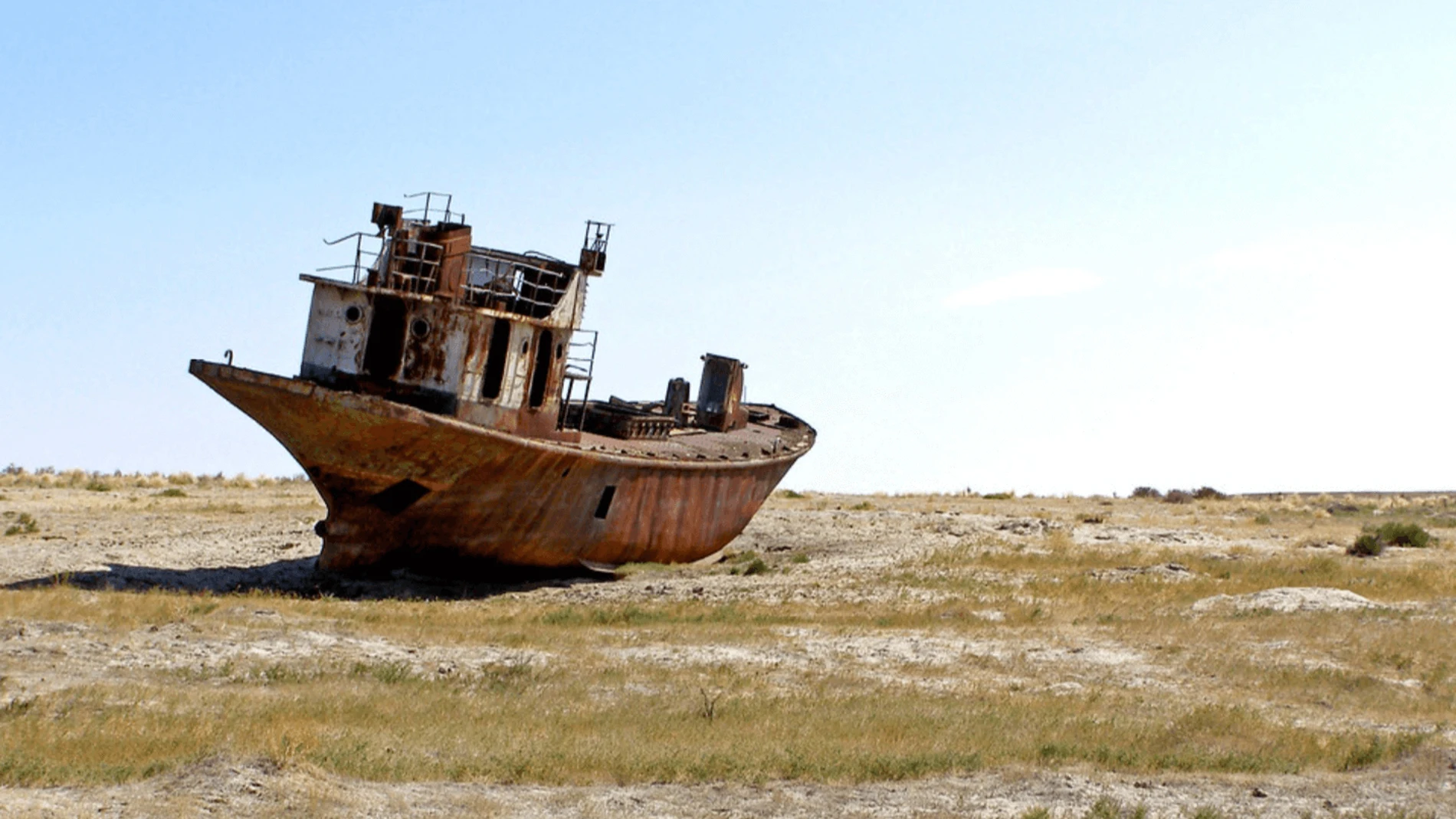
The balance of ecosystems is so fragile that a simple decision such as abandoning a small group of goats on a Caribbean island can lead to the complete disappearance of its forests. A lesson well known to the inhabitants of Kazakhstan and Uzbekistan, who had to deal with the desertification of the was the fourth largest lake in the world: the Aral Sea.
To understand the magnitude of this story, it is necessary to go back to the 1960s, when the Soviet Union decided divert the course of the Amu Darya and Syr Darya riverswhich fed the Aral Sea with their waters. At that time, this lake extended over an area of 68,042 square kilometers and had an approximate capacity of 1,100 cubic kilometers of water.
The main objective of this decision was to allocate the flow of the rivers to irrigation canals that led to a massive cotton plantation. Something that multiplied the production of this material, becoming what they called ‘white gold’, but also caused a drastic reduction in the lake’s capacity.
The diversion of rivers caused a loss of 91% of their capacity
Specifically, and due to this deviation, the Aral Sea ended up divided into two parts in the 1980s and experienced a loss of water of about 91% by 2004. This is how the youngest desert in the world emerged, the Aralkum, which was formed on the dry bed of the ancient lake and which It currently occupies approximately 38,000 square kilometers located between Uzbekistan and Kazakhstan.
The main problem caused by the presence of this desert in both countries is toxic dust storms that form due to the agricultural chemicals and fertilizers present in the soil. Toxins that end up traveling hundreds of kilometers, contaminating the air of nearby cities and available drinking water sources.
Because of this issue, both Kazakhstan and Uzbekistan began searching for a solution that would reduce both soil erosion and the presence of toxins, although they chose different methods. The Kazakh country chose to try to recover the lakecreating a dam that would divert water to the area. A measure that managed to increase its capacity by several meters and reduce its salinity.
They used a native drought-resistant plant
For its part, Uzbekistan decided to maintain the irrigation system for the cotton plantations and opted to allocate part of the desert to planting a species of shrub native to Central Asia. Specifically, they used saxaul, a plant belonging to the Amaranthaceae family, which is capable of resisting the most arid terrain thanks to its deep roots.
This species is characterized by a robust bark capable of retaining moisture for long periods of time, as well as roots between ten and fifteen meters in length with which it manages to extract water from the deepest basins. Likewise, its resistance allows it to withstand the presence of high levels of salinity and toxins, reaching a survival rate of between 50% and 70% in rainy periods and 30% in the driest months of the year.
Some characteristics that were already proven in the Taklamakan Desert, in China, and with which the government of Uzbekistan has managed to extend the vegetation on more than 1.73 million hectares. A mission for which they also used other similar species such as tamarisk, salsola or ephedra, to improve floral diversity in the area. Thanks to this, and according to institutional figures, it has been achieved reduce arid land from 30% to 25% in four years.
A project that is being imitated by Kazakhstan
To achieve this, the government assigned 360 tractors to plow the land, creating furrows with a depth of one meter and at intervals of ten meters. Subsequently, a fleet of planes was dedicated to dropping the seeds from the air. However, the process was not limited to the plantation, but they sent 150 forestry professionals to ensure the survival of the plants, especially in the Karakalpakstan region, one of the most affected by toxins.
Likewise, its effectiveness has been observed and replicated by Kazakhstan, a country which has begun to plant another variant of the species, the black saxaul, on 275,000 hectares. A land that they hoped to expand to 1.1 million hectares by 2025. However, despite the efforts of both nations, drought and water scarcity continue to be a problem for the region, threatening the effectiveness of the project.