
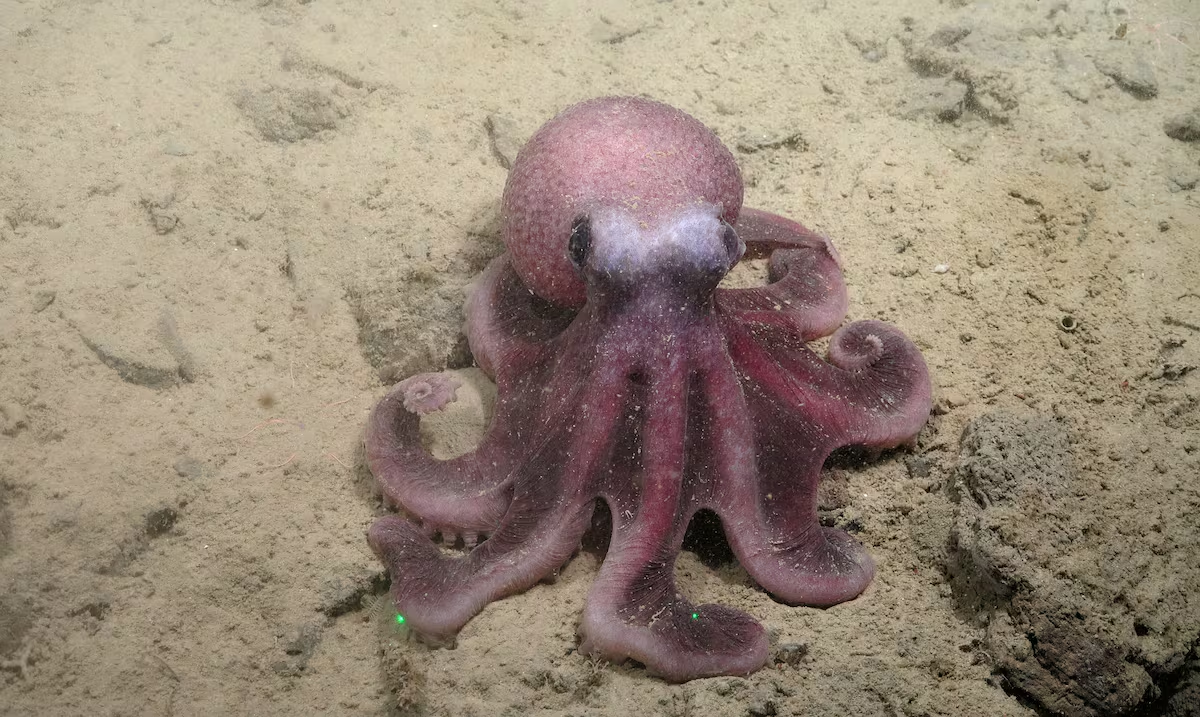
Academics and researchers from the Department of Ecology and Biodiversity of the Andrés Bello University (UAB) of Chili have discovered a new species of deep-sea octopus native to the southeastern Pacific, a finding published in the ‘Journal of Marine Sciences and Engineering’.
The new species belongs to the genus ‘Graneledone’according to its discoverers María Cecilia Pardo and Christian Ibáñez, who baptized it with the name ‘Graneledone Sellanesi’ in honor of Javier Sellanes, an academic from the Universidad Católica del Norte (Chile) who was a researcher at the Center for Ecology and Sustainable Management of Oceanic Islands.
According to statements published by Ibáñez on the UAB website, a new species of ‘Graneledone’ had not been discovered for 25 years and, with the discovery, the genus “It now has 11 species recognized worldwide”which reaffirms the importance of the Southeast Pacific as “reservoir of marine biodiversity”.
The discovery was achieved through the identification of several specimens in biological collections of German, North American, New Zealand and Chilean museums, where “They were waiting for someone to look at them carefully and interpret them in their right dimension”since there are records of ‘Graneledone’ between 1980 and 1997 in southern Chile.
At least seven specimens had been collected by the National Museum of Natural History in Santiago de Chile and had never been identified, to which must be added another case in 2007 that appeared among the catch of a cod fishery and had remained unclassified until now.
These elements were “clue”points out Ibáñez, to “confirm that “we were facing a new species of octopus”points out Ibáñez.
The most surprising thing for researchers are the visible phenotypic traits, beyond their genetic constitution, since the warts that cover the octopus’s skin vary in number and arrangement between species, an aspect that ends up being decisive for “understanding that we are facing still being unique,” added Pardo.