
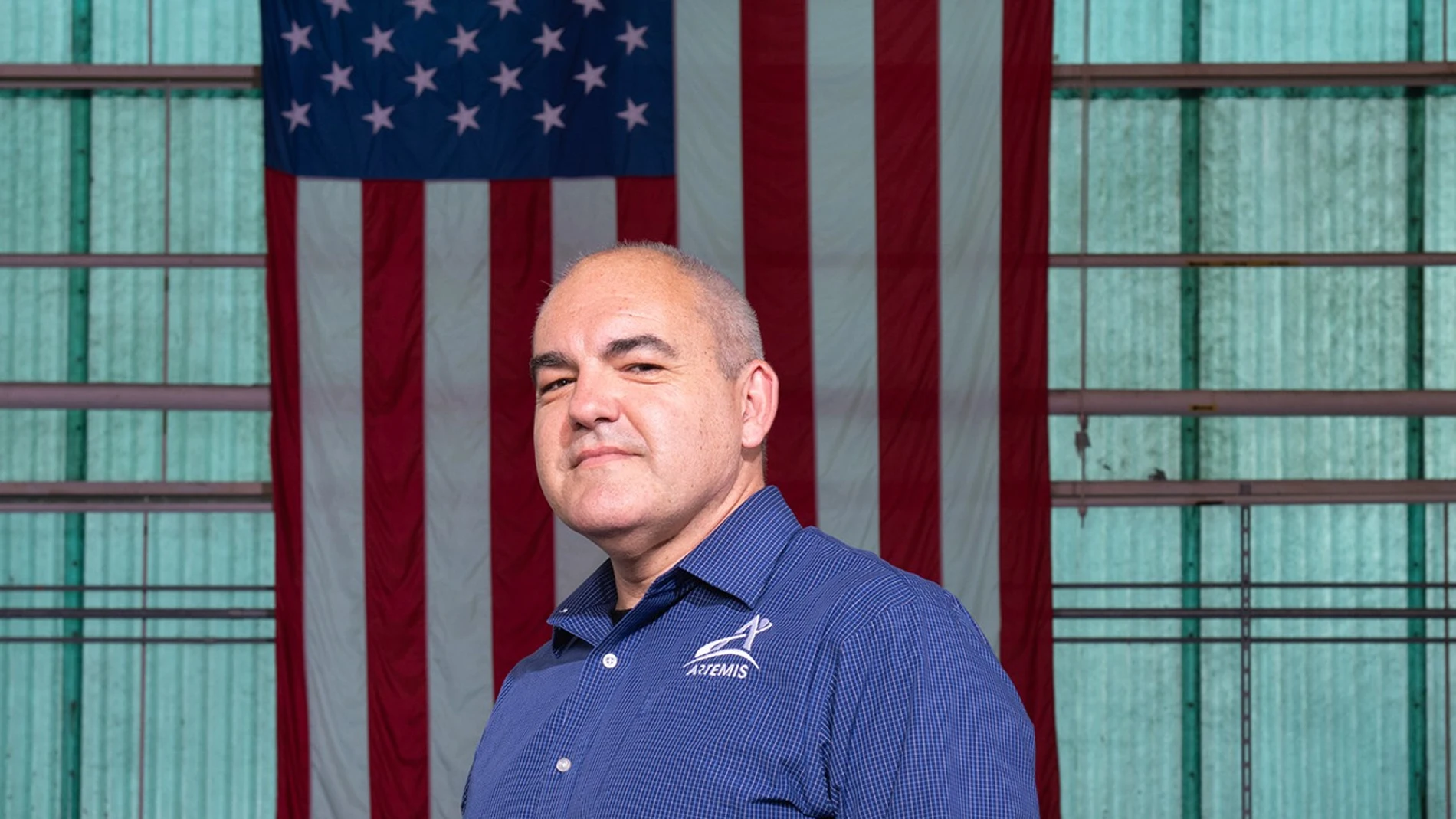
The majority of the world’s population had not been born when Apollo 11 made history and, just a few hours before Artemis II takes off, humanity is holding its breath, knowing that it will mark a milestone. Artemis II won’t touch the Moon, but it will take four astronauts where no human has gone in more than half a century. What happens tonight will have an impact on future missions and whether Artemis IV can land on the moon in 2028. This is explained by NASA engineer Carlos García Galán, who has given an interview to this medium. With more than 27 years of experience in the US space agency, he is one of the key figures of the Artemis program and, as of a few days ago, the Executive Program of the project Moonbase.
Q: You have been involved in the development of this project and especially of the Orion ship in which the four crew members will travel. We can’t sneak into the rocket to experience this milestone like one of them, but we can ask you to describe it to us.
The experience begins with the countdown, but the astronauts will already have been sitting with their belts tightly adjusted for three or four hours, while the fuel is loaded and the entire final sequence is completed: closing of Orion systems, hatches and departure of the personnel who helped them enter the capsule. During that time they are completely alone on the ship, preparing themselves for what is about to happen.
Then the launch takes place, which lasts about eight minutes. There are different phases and they will be very focused on everything that is happening. In the first two hours, they separate from the third stage of the rocket, perform a demonstration of the spacecraft’s controls and enter an Earth orbit for about 24 hours. That orbit allows us to verify all the data and make sure everything is working correctly before sending it to the Moon.
The interior of Orion is like that of a van with the seats removed. Even so, it has a bathroom, kitchen and space to exercise. It’s not much, but everything is designed to make the most of it.
During the trip to the Moon, which lasts three or four days, the astronauts carry out different scientific experiments. While one is exercising, another may be taking pictures or checking systems on the monitors. They also test ship systems, such as laser communications, which is experimental on this mission.
When passing through the far side of the Moon, they will spend about four hours without direct communication. They will see the Moon more or less as if you were holding a football in the palm of your hand, with your arm outstretched. During that time they will take images and perform experiments, especially related to radiation and observation. It will be incredible, because we haven’t had humans in that situation for more than 50 years.
On the return, they will be especially focused on the last 20 minutes, when the ship enters the atmosphere and the parachutes deploy. At that time they must remain seated, monitoring the parameters, but prepared to intervene if something is not working correctly.
Q: That’s precisely why I want to ask you: “if something doesn’t work well”… On February 25, the Aerospace Safety Advisory Panel published a report which questioned the safety of the Artemis III mission and the work environment in general. Since then, NASA has announced changes to subsequent Artemis missions. How did you receive the report?
Any mission that sends humans to the Moon carries inevitable risk. You can do everything you can in terms of design and testing, but that risk never completely goes away. In the case of Orion, for example, the first mission we carried out did not have a crew, and in it we found several aspects that we had to correct for the final design of the ship.
This mission, in particular, is not especially demanding for the systems, although it is for the crew. The fact that there are people on board makes it more complex, but from a technical point of view, propulsion, electrical system… it is not a particularly stressful mission.
It’s not even for the reentry heat shield. In fact, we have not changed the design or materials of the heat shield, because we can adjust the reentry trajectory to avoid subjecting it to the conditions that raised concern after analyzing the data from the first mission.
We also detected a problem in the electrical system, which we have mitigated through software and operational procedures. Even so, that problem will be completely corrected in the next mission. There are aspects that we know are not perfect, but taking into account the design of the mission, the trajectory and the protocols planned in case of failure, we are very confident that the spacecraft is safe, the mission is safe and that it will be successful.
Q: Apart from the technical challenges, the aerospace sector has a geopolitical dimension. China is the other major competitor in the lunar race and hopes to put an astronaut on our satellite before 2030. To what extent does this influence the decision-making, objectives and deadlines of the Artemis program?
I have participated in all these decisions and at no time has it been considered taking a different path because another country is trying to get to the same place we want to go.
It is important to arrive first, for several reasons. The main one, for me, is that there are international agreements: if we arrive in an area with high scientific interest, there cannot be other countries that land nearby. Whoever reaches those strategic places first will block the rest
Even so, we have never made decisions that compromise the safety of the crew for that reason. We know that we have to take certain risks. If we didn’t take them, we would never have reached the Moon nor would we return now.
We seek the balance between having everything perfect and flying. If you try to have everything perfectly controlled before going…You never fly. And, on the other hand, a lot of time passing between missions also affects security. So there are a lot of things to balance and the decisions we have made have been thinking about the design, the mission and the safety of the crew.
Q: And speaking of time between missions, it’s been 50 years since humanity last sent people beyond low-Earth orbit. Had we forgotten how to get to the Moon? In half a century there is time to forget many things and there are trades whose excellence depends on details that can only be passed from masters to apprentices.
We have experienced that from day one. An example is communication with antennas in deep space. When we did the Apollo program, we learned a lot about what kinds of things could go wrong, how many parts you had to have on hand so you could fix it quickly, and with Artemis I, we realized that we had lost that kind of knowledge and we had to learn it on a mission.
Three years have passed since then and, in the simulations, at the beginning we saw how people had lost a bit of the cadence of operations, of communication… All of that influences.
That is why it is important to build a lunar base, which is the project for which I will be responsible. Before going to Mars we have to take that operations memory, learn how logistics works, know what systems we are going to need, how they fail, how we can recover that knowledge and develop new ones.
The first time something happens to you, it takes you five times longer to solve it than when it’s the tenth time it happens. You already know what you have to do, what procedures to follow… That’s why we have new objectives now that we have a new administrator at NASA. For example: we hope to go to the Moon twice a year to continue building that knowledge and that “muscular” memory that allows us to do, later, much more important things.
DON’T MISS IT:
- Although China is the other great superpower with a clear plan to establish itself on the Moon, its objectives are not the same as those set out by NASA. The Chinese proposal is less ambitious, although perhaps for that reason, more achievable in the short term. In any case, in a context where space law allows the exploitation of resources wherever a country has established its infrastructure, arriving earlier is key to building a not-so-distant future where looking into space will not be optional, but mandatory.
REFERENCES (MLA):
- Space Launching System Reference Guide for Artemis II. NASA, Jan. 2026, https://www.nasa.gov/wp-content/uploads/2026/01/sls-5558-artemis-ii-sls-reference-guide-final-review-508-012026.pdf?emrc=342194
- Meet NASA’s Orion Spacecraft. NASA, https://www.nasa.gov/missions/meet-nasas-orion-spacecraft/#section-1
- Aerospace Safety Advisory Panel 2025 Annual Report. NASA, Mar. 2024, https://www.nasa.gov/wp-content/uploads/2024/03/asap-2025-annual-report-tagged.pdf