
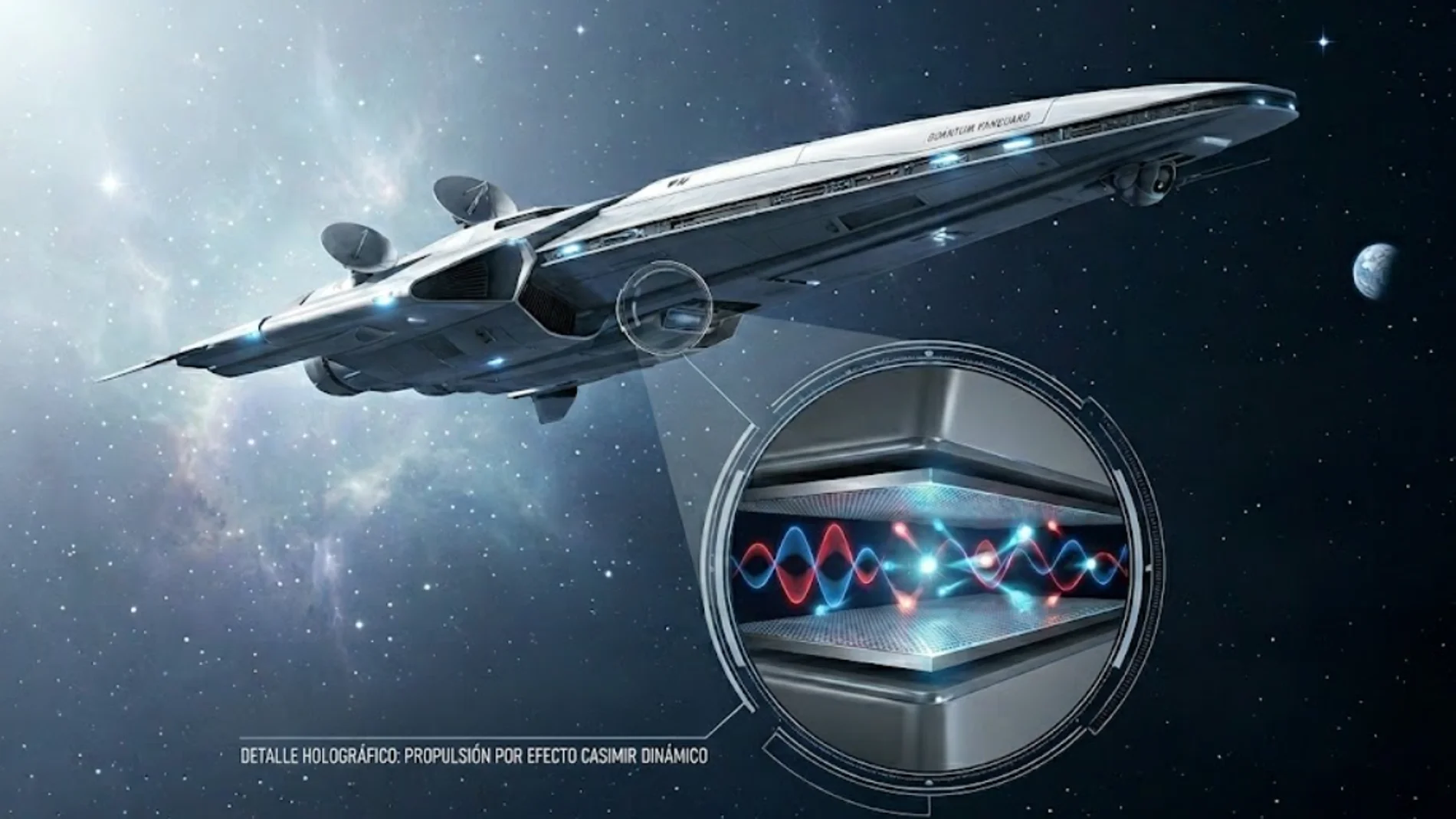
There is an idea deeply rooted in our way of understanding space: to move, you have to push something. Expel gas, burn fuel, throw particles back. It is the logic of the rocket, the same one that has taken humanity to the Moon. It is Newton’s third law of motion: every action generates an equal and opposite reaction.
But what if none of that was needed? This is the question Aisha Mustafa asked herself when, as a physics student, she proposed a radically different propulsion system. Not based on expelling mass, but on interacting with something much more elusive: the vacuum itself. Because the void, in reality, is not empty. In classical physics, a vacuum refers to a region where there are no atoms, radiation, or energy. This type of vacuum can be simulated in laboratories and satisfactorily explains many everyday phenomena.
However, quantum physics introduces a much deeper perspective. It tells us that all particles are the result of fluctuations in invisible fields that extend throughout space. These include the electromagnetic field, the electronic field, and a field for each known particle. In short: even when there are no particles in a region, fields still exist there.
Due to the uncertainty principle in quantum mechanics, these fields are never completely at rest. They always fluctuate to some extent. These fluctuations give rise to effects that would be impossible in a truly empty classical vacuum. AND This is where the key to the development proposed by Mustafa appears: the Casimir effect.
This phenomenon is what confirms that “empty” space contains energy, as fluctuating fields create measurable forces. Mustafa suggested that, if this activity exists, perhaps it can be used. In scientific terms, Mustafa proposed using two extremely thin and reflective plates, placed very close to each other. By moving them precisely, These plates interact with that “sea” of quantum particles. This movement generates a small difference in energy, an asymmetry. And in physics, an asymmetry can be translated into something very concrete: a force.
Now, in understandable terms and continuing with the simile of the “sea of particles”. In this ocean there are invisible waves (the fluctuation of energy) that constantly rise and fall. If we put two ships (the metal plates) very, very close to each other in that sea, we could see how most of the waves of all sizes hit the sides of the ships, but in the small, minimal space between them, only the smallest waves enter. Obviously the larger waves will win and the boats will get hopelessly closer. This movement generates a small difference in energy, an asymmetry. And in physics, an asymmetry can be translated into something very concrete: a force. One that Mustafa proposes using to propel the ships.
There’s something about the idea that makes it immediately attractive: it doesn’t need fuel. And that, in the spatial context, changes everything. Today, much of a rocket’s mass is fuel. Getting it into space is expensive, complex and greatly limits what we can do. Even more advanced systems, such as ion engines, still rely on fuel.
A system like Mustafa’s, at least in theory, would eliminate that need. It could enable lighter satellites, longer missions and significantly lower costs. Furthermore, its design points to relative mechanical simplicity. Fewer moving parts, less wear, fewer potential failures.
The problem is that in theory everything is correct, but in reality there are many obstacles. The main one is the scale of the force generated. Quantum effects like Casimir are real, but extremely weak. Detecting them is already complicated in the laboratory. Using them to move a spaceship is a whole other level. Added to this is a deeper problem: experimental validation.
Many “fuel-free propulsion” concepts have been proposed in recent decades, but few have been unequivocally demonstrated to work outside of highly controlled conditions. The scientific community tends to be, rightly, cautious about these types of proposals.
In Mustafa’s case, the prototype was patented, but has not yet been developed. Among other things, due to limitations in funding and scientific infrastructure. Still, what’s interesting about Mustafa’s work is not just the device itself, but the direction in which it points: the possibility that space is not simply a passive setting, but a medium from which to extract energy or impulse.