
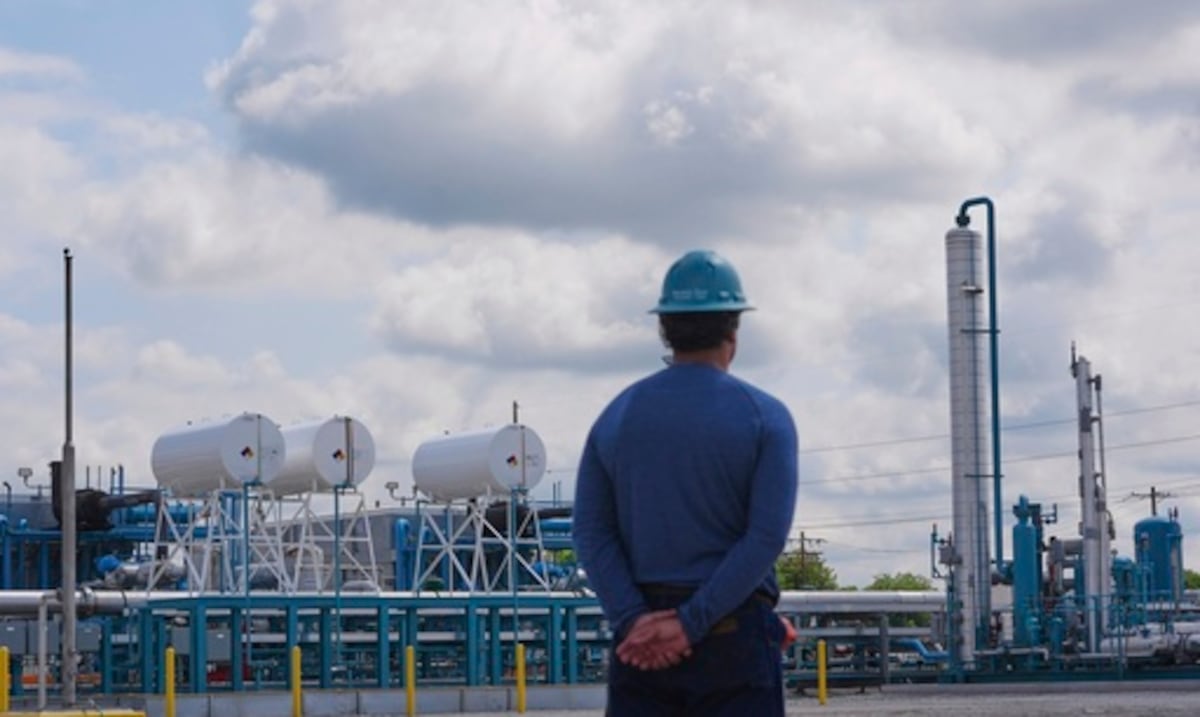
Energy plants and industrial facilities emit carbon dioxidethe main driver of global warming, expect the United States Congress Keep tax credits to capture gas and store it in the depths of the subsoil.
The process, called carbon capture and kidnapping, is seen by many as an important way to reduce pollution during a transition towards renewable energy.
But he faces the criticisms of some conservatives, who say he is expensive and unnecessary, and of environmentalists, who say that he has not constantly managed to capture as much pollution as promised and is simply a way for fossil fuel producers such as oil, gas and coal to continue their use.
Here is a more close look:
How does the process work?
Carbon dioxide is a gas produced by burning fossil fuels. Catch heat near the ground when the atmosphere is released, where it persists for hundreds of years and increases global temperatures.
Industries and energy plants can install equipment to separate carbon dioxide from other gases before the fireplace. Then, carbon is compressed and sent, usually through a pipe, to a place where it is injected into the depths of the subsoil for long -term storage.
Carbon can also be captured directly from the atmosphere using giant vacuum cleaners. Once captured, dissolve with chemicals or is trapped by solid material.
Lauren Read, Senior Vice President of BKV Corp., who built a carbon capture installation in Texas, said the company injects carbon at high pressure, forcing it almost 3.21 km below the surface and in geological formations that can contain it for thousands of years.
Carbon can be stored in deep salt formations or basalt and non -exploitable coal veins. But approximately three quarters of the captured carbon dioxide is pumped again to the oil fields to increase the pressure that helps extract reserves of more difficult access, which means that it is not permanently stored, according to the International Energy Agency and the United States Environmental Protection Agency (EPA).
How much carbon dioxide is captured?
The most used technology allows facilities to capture and store about 60% of their carbon dioxide emissions during the production process. Anything above that rate is much more difficult and expensive, according to the IEA.
Some companies have predicted carbon capture rates of 90% or more. “In practice, that has never happened”said Alexandra Shaykevich, research manager of Oil & Gas Watch of the Environmental Integrity Project.
That is because it is difficult to capture carbon dioxide from each point where it is emitted, Grant Hauber said, Strategic Energy Advisor and Financial Markets of the Institute of Economy and Financial Analysis of Energy.
Environmentalists also cite possible problems to keep it on the ground. For example, last year, the agronegocios company Archer-Daniels-Midland discovered an escape to approximately 1.6 km underground in its place of carbon capture and storage in Illinois, which led the state legislature this year to prohibit carbon kidnapping above or below the Mahomet aquifer, an important source of drinking water for approximately one million people.
Carbon capture can be used to help reduce emissions from industries difficult to reduce, such as cement and steel, but many environmentalists argue that it is less useful when it extends the use of coal, oil and gas.
A 2021 study also found that the carbon capture process issues significant amounts of methane, a powerful greenhouse gas that is of shorter duration than carbon dioxide but catches more than 80 times more heat. That happens through leaks when the gas is taken to the surface and is transported to plants.
Around 45 carbon capture facilities operated on a commercial scale last year, capturing a total of 50 million metric tons of carbon dioxide, a small fraction of the 37.8 gigatons of carbon dioxide emissions only of the energy sector, according to the IEA.
It is an even lower proportion of all greenhouse gas emissions, which amounted to 53 gigatons by 2023, according to the latest report of the Emissing Database of the European Commission for Global Atmospheric Research.
The Institute of Economy and Financial Analysis of Energy says that one of the largest carbon capture use and storage projects, the Exxonmobil Shuita Creek installation in Wyoming, captures only approximately half of its carbon dioxide, and most of it is sold to oil and gas companies to pump the oil fields again.
The future of US tax credits is not clear
Even so, carbon capture is an important tool to reduce carbon dioxide emissions, particularly in heavy industries, said Nepal School, technology specialist at the carbon capture coalition.
“It is not a substitution of renewable energies … it is just a complementary technology”Said Nepal. “It is a piece of a puzzle in this wide fight against the Climate change”
Experts say that many projects, including ammonia and hydrogen plants proposed on the United States Gulf coast, will probably not be built without tax credits, which, according to the executive director of the carbon capture coalition, Jessie Stolark, have already promoted a significant investment and are crucial for the global competitiveness of the United States.
They remain in the draft conciliation bill of the Senate Finance Committee, after another version was approved by the House of Representatives, although the carbon capture coalition said that inflation has already reduced its value and could limit the projects.