

The comet 3I/ATLAS It is the third interstellar body detected, the largest and, with about 7 billion years behind him, the oldest known, prior to the formation of the Solar system which is now crossing. This makes it an object of enormous interest, but also of speculations. The last one, published this Monday by the well-known scientific and technological information medium Futurism, indicated that 3I/ATLAS could have exploded when passing behind, in relation to the Earth, the Sun.
The information was based on the observations made by the Harvard astrophysicist Avi Loeb on an image of the comet captured last Sunday, November 9, by astronomers Michael Buechner and Frank Niebling. In it, jets of material can be seen coming out of 3I/ATLAS, which led Loeb to calculate that the comet came from outside the Solar System had lost much of its mass. The title of his blog post explaining his theory was ‘Did 3I/ATLAS just disintegrate near the Sun?‘.
But Loeb – who has a resume that spans from being director of the Harvard University Department of Astronomy until current director of the Galileo Project from the same university, which searches for extraterrestrial intelligence- is being increasingly discussed. In the aforementioned article he again speculated that 3I/ATLAS could be an alien spacecraftsomething that he has been doing since shortly after his discovery and a theory that at the time he defended with 1I/’Oumuamua in 2017, the first interstellar body detected.
What the scientific community thinks
Another thing is what the astronomical community thinks, the POT and the rest of the space agencies, all agree that 3I/ATLAS is a natural comet. And no, no one other than Loeb has indicated that the comet could have disintegrated.
‘All the pictures I’ve seen show a fairly normal comet and in good condition. There is no sign that the core has fragmented‘, he explained Qicheng Zhangastronomer Lowell Observatory who is also studying the comet, told Live Science.
What happens to a comet when it approaches a star like the Sun
3I/ATLAS, detected on July 1 by the observatory ATLASreached his perihelionclosest approach to the Sun, on October 29. Passing behind the Sun, the comet briefly escaped terrestrial observation instruments, but not space ones. When comets approach stars, the heat causes the ice on their surface to it sublimes -changes state-, turning into gas that researchers can detect and analyze. It’s a phenomenon typical of comets.
That newly released gas can escape through the comet’s surface in huge jetsform a cloud around it called comaor be blown by the solar wind forming a long line. All of these elements become brighter due to solar radiation, allowing even amateur astronomers to study them under the right conditions.
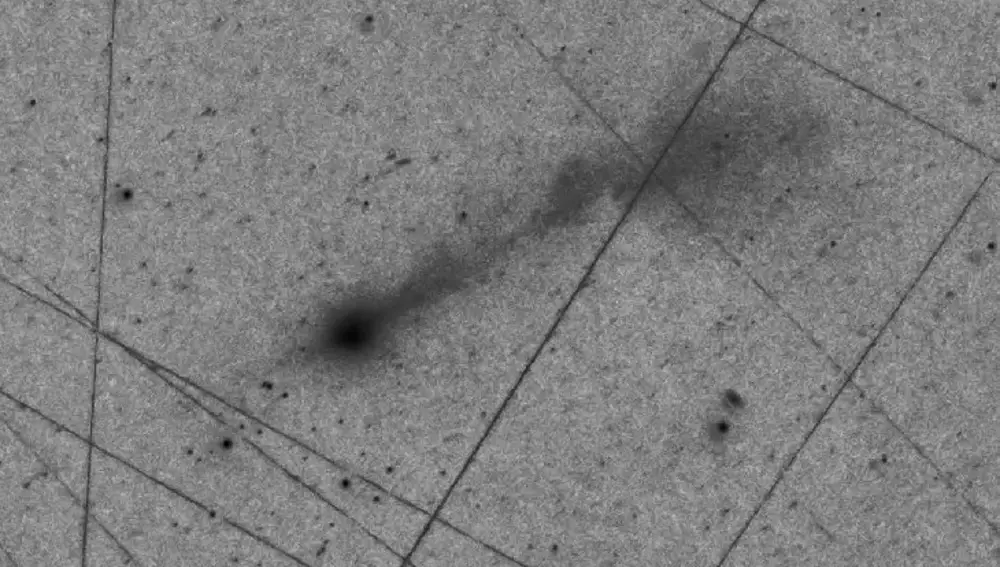
Based on the new image, Loeb has estimated the amount of material ejected and, from there, calculated its mass to reach the conclusion that, if it were a natural object, would need to have a much larger surface area than observed.
Another theory of the astrophysicist is that the comet should have fragmented into at least 16 parts. Therefore, if in future observations it is found that this is not the case and that the core maintains its integrity, it will be because it is not a natural comet. The aliens, again, something with which the rest of the scientific community does not agree.
Without going any further, last week telescope astronomers MeerKAT they reconfirmed the natural origin of 3I/ATLAS after detecting a radio signal in the comet, a typical phenomenon when they approach a star.
Criticism of Loeb
Zhang noted about the Harvard astrophysicist that ‘I have read Avi Loeb’s blog, and it seems that has built a house of cards on his unfounded claim about the acceleration of the cometwhich is a seriously erroneous interpretation of its orbital parameters that anyone who has calculated the orbit of a comet would immediately recognize as flawed.’
Jason T. Wrightprofessor of Astronomy and Astrophysics at the Pennsylvania State Universityhe wrote in his blog, the same day that Loeb proposed that the comet had exploded, that there were no indications that 3I/ATLAS was an alien spacecraft and dismantled one by one ten of the supposed ‘anomalies’ of the comet described by Loeb. He also questions his competence and criticizes his posts and articles.
‘In these works and in his blog he usually demonstrates a lack of knowledge of well-established concepts of planetary science, misinterprets studies and reaches erroneous conclusions‘Writes Wright.
David Barradoastrophysicist and research professor at CSIC in it Astrobiology Centergave his opinion on Loeb’s theories in a recent interview in Vozpópuli: ‘His argument is that he has no arguments. The trajectories of such a body are governed by Kepler’s laws, which are very precise. This object, like previous ones, shows small accelerations that do not fit exactly with Keplerian laws. That, Loeb interprets it speculatively as if it were a ship that slows down.. But what really happens is that comets, when they approach the Sun, cause volatile materials – water ice, methane, CO₂ – to sublime and transform into gas. This gas is ejected, just like the exhaust of a rocket, and this slightly modifies its movement.‘.
In the opinion of the CSIC astrophysicist, ‘a lot of attention is being paid to this researcher because of the previous prestige he has had, but his ideas long ago left science behind. Honestly, I think it’s about gain notoriety with this. When the comet passes behind the Sun and continues its orbit, everyone will forget these speculations‘.