
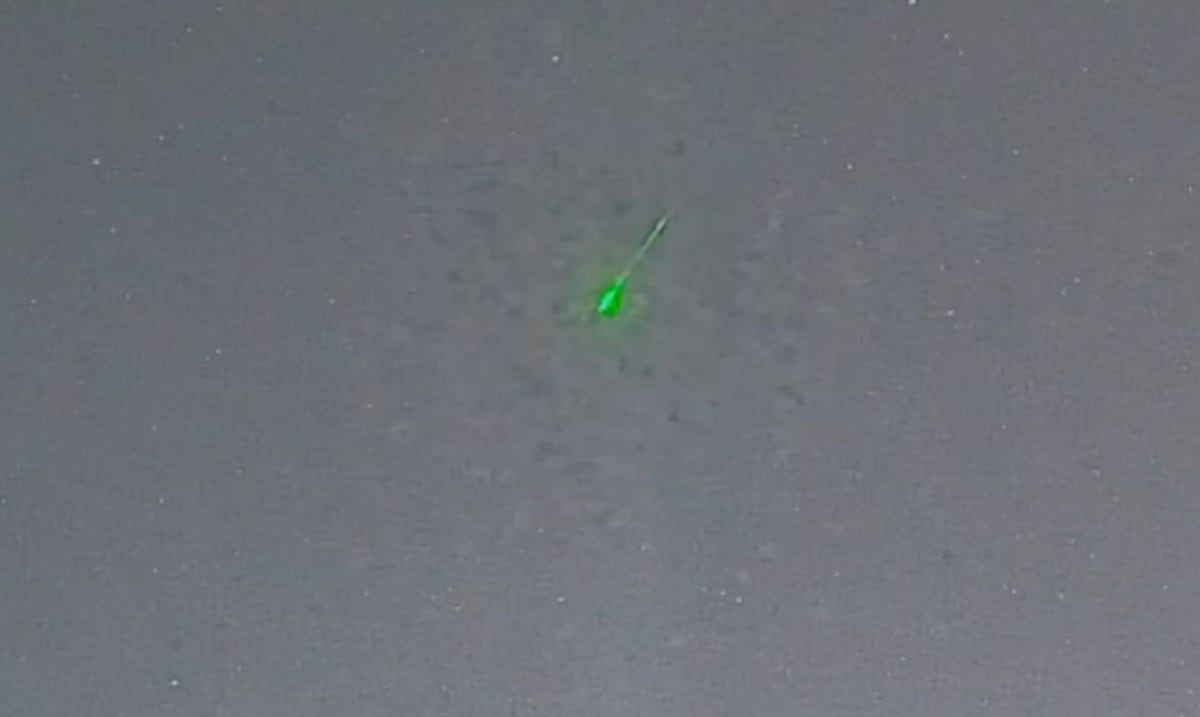
At 3:24 am on Tuesday, a green flash furrowed the sky: a meteor illuminated the sky for a few seconds and it was not about any light blue body, but a fragment of the legendary comet Halley, known as The first “newspaper” comet of history.
According to the Caribbean Astronomy Society (SAC), the meteor’s trajectory showed that it belongs to the rain “ETA Acuáridas”originated by fragments of comet 1p/Halley.
“It showed a remarkable green color due to the metallic content of the fragment, But something very striking of this meteor was how fast the direction of the smoke left, ”said the SAC in written statements.
The educational entity explained that this phenomenon is due to the interaction of the remaining smoke with strong winds that were in the high atmosphere at the time of the event.
According to the SAC, these days, the Earth has been moving in its orbit through an area where waste released by Halley is found.
You may be interested: a cave in the south of Puerto Rico collects a heavenly story about the passage of the Halley comet in 1910
The nonprofit organization added that several additional rainfall “ETA Acuáridas” They could be visible until May 27.
Why is it called Halley and when will it be visible again?
According to the National Aeronautics and Space Administration (NASA, for its acronym in English), until the time of the English astronomer Edmond Halley (1656-1742), it was thought that these celestial bodies only passed once through our solar system.
However, in 1705, the astronomer found similarities in the orbits of three comets that were visible in the 1531, 1607 and 1682. At that time, Halley suggested that the trio really was a single comet that made periodic trips and predicted, correctly, that he would return in 1758.
According to NASA, the comet Halley was baptized in his honor and, from that moment, the celestial body has been related to old observations that date back to more than 2,000 years.
“In each orbit around the sun, a comet the size of the Halley loses between three to 10 feet of material from the surface of its nucleus. Thus, as the kite ages, its appearance darkens and can lose all the ice of its nucleus. The tails disappear at that stage, and finally becomes a dark mass of rocky material or perhaps dissipates powdered,” reports the federal entity.
After the 1910 event, Halley was received with more enthusiasm around the world when he was again sighted in 1986. His next visit near Earth will be in the summer of 2061.