
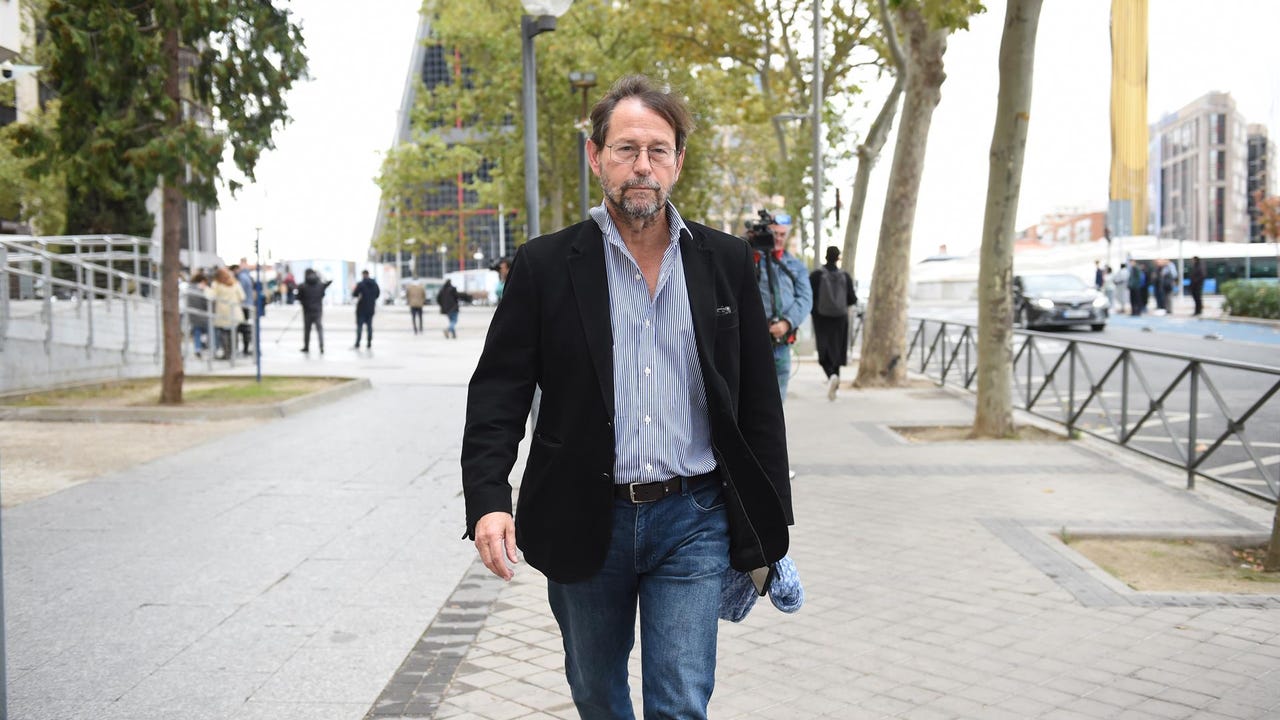
The journalist investigated for his alleged role as a collaborator of the alleged PSOE sewers asks the judge to close the proceedings against him that are being pursued for the crimes of influence peddling and bribery.
Pere Rusiñol addresses a letter to the instructor, to which LA RAZÓN has had access, in which he admits that he handed a paper to prosecutor José Grinda to ask him if he had offered information about irregularities that his boss in Anti-Corruption, Alejandro Luzón, had committed in exchange for obtaining a posting in Bolivia, which had recently been denied to him.
He assures that “it is flatly false” that he had not read the paper he gave to Grinda during the meeting they held, on February 27, 2025, on the terrace of the Barceló Hotel, located on the street of the same name in Madrid.
Rusiñol maintains that he gave him what was a report in which it was stated that “he was in a compromised personal situation due to the emergence of alleged irregularities in his professional performance” in charge of some judicial files.
As well as that these alleged illegalities would have been revealed in one of the sessions of the commission on “Operation Catalonia” of Congress. For all this, it was said in the paper, this member of the Prosecutor’s Office would be trying to find a way out, going abroad for a time on a service commission to the Bolivian country.
According to the accused journalist in the document, in exchange for receiving support to move away from the media spotlight, Grinda was willing to offer information about the aforementioned “alleged irregularities” within the Public Prosecutor’s Office.
The version offered in the document is that during the meeting this prosecutor, after reading and analyzing the paper, denied that he had requested that “help” to leave Spain, but did acknowledge that he had made calls to the then State Attorney General, Álvaro García Ortiz, and to the former president José Luis Rodríguez Zapatero.
Rusiñol maintains that he told him that he had taken these steps to be able to appear before the Lower House and thus have the opportunity to deny the irregularities that he was attributed to having committed in cases that he promoted.
As this journalist relates, Grinda also denied that he wanted to provide “critical information” about Luzon, defended his work as a civil servant and stressed that he was the victim of a “smear campaign.”
Rusiñol assures that, based on this, his interlocutor asked him not to publish anything due to the “gravity and defamatory nature” of the data contained in the report. He also maintains that he offered to keep the document, but he did not want to and, after ending the meeting cordially, he destroyed it.
Because he disintegrated the paper, he points out that he cannot comply with the offer made by Judge Arturo Zamarriego to provide some evidence that would disprove Grinda’s statement. For the accused, this involves identifying the “usual” source that provided him with the document, which he then handed over to this prosecutor. It warns, in this sense, that it is protected by the constitutional right not to reveal the source.
“As has been said, the purpose of that meeting was to inform Grinda of the existence of this document and compare the data on record,” he insists, to defend that there is no criminal evidence in these events and that, therefore, he should be left out of the case that is progressing in the Investigative Court number 9 of Madrid.
He also understands that in this judicial process “the object of discrepancy” turns out to be the content of a document “that is impossible to verify.” Through her lawyer, former Esquerra Republicana deputy Gemma Calvet explicitly dissociates herself from the alleged maneuvers against the UCO and the attempted bribery reported by Ignacio Stampa for which both Leire Díez and Javier Pérez Dolset are being investigated. “Without affecting the continuation of the process with respect to the rest.”
He does not hide that the version offered by Grinda when he testified in court “involves important divergences” with the version he offered in his appearance as a defendant. Rusiñol, to reinforce the verisimilitude of his version, alludes to the fact that Grinda, currently and for three years, is assigned to the school for judges and prosecutors in La Paz (Bolivia) in a program of the Foundation for the Internationalization of Public Administrations.
This fact would coincide – according to his lawyer – “with the information that was conveyed to his client” and that within the framework of his journalistic work he says he wanted to contrast directly with him.
He also uses in his favor that he maintained contact and the same type of relationship with Grinda after their meeting: both continued to have conversations via WhatsApp about that same meeting in an absolutely cordial and friendly tone.
Rusiñol defends that he lent credibility and verisimilitude to the document that was given to him about Grinda (which he then handed over to Grinda), since it contained data or extremes that he had previously known as a consequence of the professional relationship – as a source – that united him with the Anti-Corruption prosecutor.
As he explained in his statement, he insists that he is able to prove that he provided Grinda with the contact of a minister from the Bolivian country in relation to his desire to go to that country.