
The International Space Station (ISS) has been operating continuously in orbit for more than 25 years: about 290 astronauts from 26 different countries on about 411 round-trip missions. We may have become accustomed to this movement after so many flights, but if we think about it for a moment, it is an extraordinary achievement that has allowed generations of astronauts to live and work in space, evaluating technologies and conducting scientific experiments that could one day take us to the Moon and Mars.
Yesterday four new astronauts arrived the ISS after a 34-hour journey since its launchrestoring the crew to the full number of seven people and marking the start of a long-duration mission.
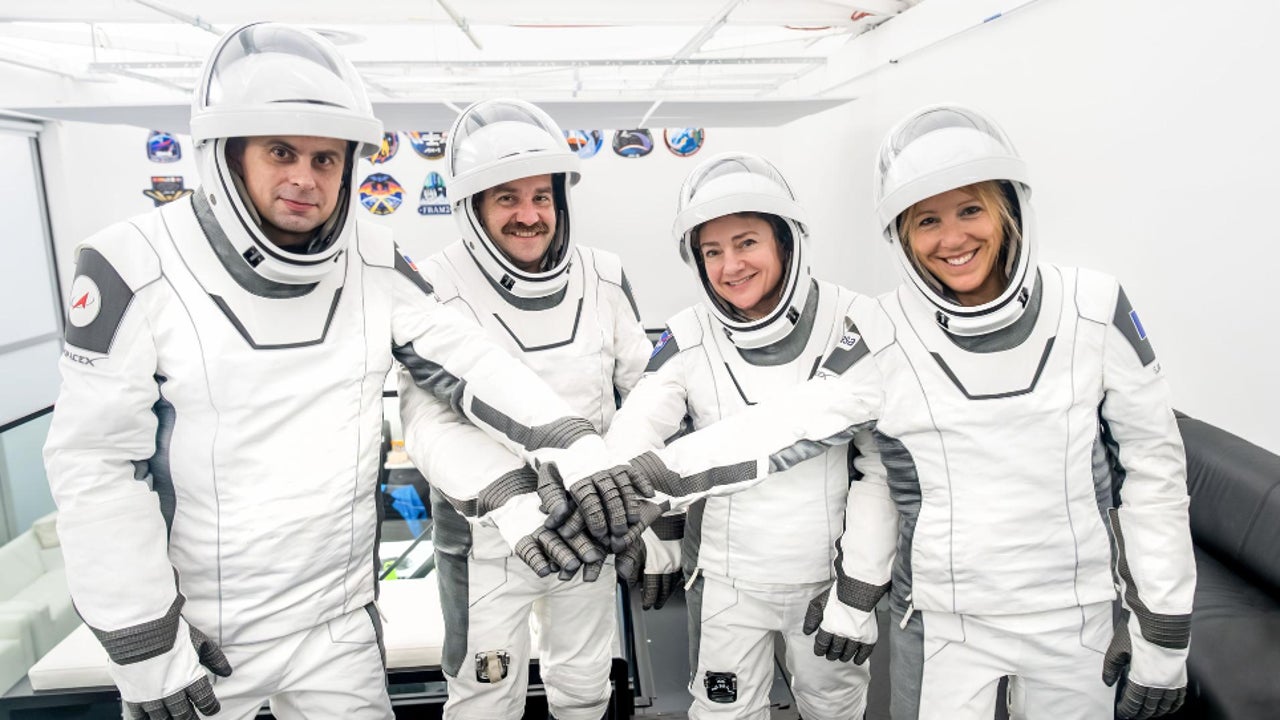
The four members of the mission, known as Crew-12, traveled aboard the Dragon “Freedom” capsule launched by a Falcon 9 rocket from the Cape Canaveral Space Force Station in Florida on February 13, 2026 and docked with the ISS Harmony module on the afternoon of the 14th.
Leading the mission is the veteran American astronaut Jessica Meirwho serves as commander. Meir is not new to the station: she participated in Expeditions 61/62 and the first all-female spacewalks, and her experience will be key to overseeing the team’s work over the next eight months. At his side is the mission pilot, Jack Hathaway, also from NASAa more recent astronaut whose strong US Navy background and military flight training bring a combination of operational discipline and quick adaptation to changing situations.
They complete the quartet Sophie Adenot, European Space Agency (ESA) astronaut and mission specialist, and Andrey Fedyaev, cosmonaut of the Russian space agency Roscosmos and also mission specialist. Adenot, an engineer and helicopter pilot, is one of the few French women to have reached space, while Fedyaev returns to the ISS after a previous mission, bringing valuable experience in orbital operations.
The arrival of Crew-12 comes after an unusual episode in the history of the ISS: the early return of the previous mission, Crew-11, due to an unprecedented medical evacuationwhich temporarily left the station with a reduced crew of just three people.
Although this type of mission may sound routine, the reality is that each astronaut ascent to the ISS represents a gigantic challenge. Orbital physics imposes strict launch windows, any weather delay can force takeoff to be postponed, and each automatic docking maneuver with the station must be executed with millimeter precision to avoid impacts or pressure errors between the ships. Additionally, the conditions of space, including microgravity, increased radiation, and the lack of Earth’s atmosphere, make each operation an exercise in extreme adaptation for astronauts.
The docking of a ship to the International Space Station is, in appearance, a simple gesture: a capsule that slowly approaches until it “fits” into a circular port on the ISS. But behind that silent choreography there is one of the most delicate maneuvers of the entire mission.
We are before two “vehicles” the size of a bus moving at about 28,000 kilometers per hour around the Earth. The key is that it is not about braking to a stop, but about extremely precisely matching speed and orbit. The ship (for example, a SpaceX Dragon or a Soyuz) performs a series of engine firings for hours to adjust its trajectory until it is within a few kilometers of the station.
From there the final “link” begins. The ship activates laser sensors, radars and cameras that measure the distance and angle with respect to the ISS. Everything is automated, but under constant supervision from the Ground and from inside the station. The approach is made, literally, at pedestrian speed: the last meters are traveled at just a few centimeters per second.
The critical moment comes when the guidance system perfectly aligns both coupling rings. The ISS has standardized ports (the International Docking Adapters) designed to absorb the initial contact. First, what is called soft capture o soft capture: hooks or sticks cushion the minimum impact and keep the two structures together. Afterwards, motors and locks reinforce the joint in the installation phase. hard capture or hard capture, sealing the connection so that the pressure between both ships can be equalized. Only then do the hatches open.
But, despite controls, precautions and previous experiences, everything does not always go as planned. Over the decades there have been attempts aborted at the last minute due to software problems, faulty sensors or discrepancies in navigation data. In 2019, for example, a Soyuz MS-14 spacecraft had to retire after failing to achieve proper automatic docking due to a problem in the guidance system; days later it was repeated successfully in another port. There have also been occasions when a SpaceX Dragon aborted the approach due to anomalous readings on its sensors, moving away safely to try again later.