
When we think of particle accelerators, almost all of us imagine CERN. Its 27 kilometers of tunnels under the border between France and Switzerland have allowed the discovery of the Higgs boson, study some of the most elementary particles in the universe and test the fundamental theories of modern physics. For decades (since its creation in 1952) it has been the great world reference for accelerator research.
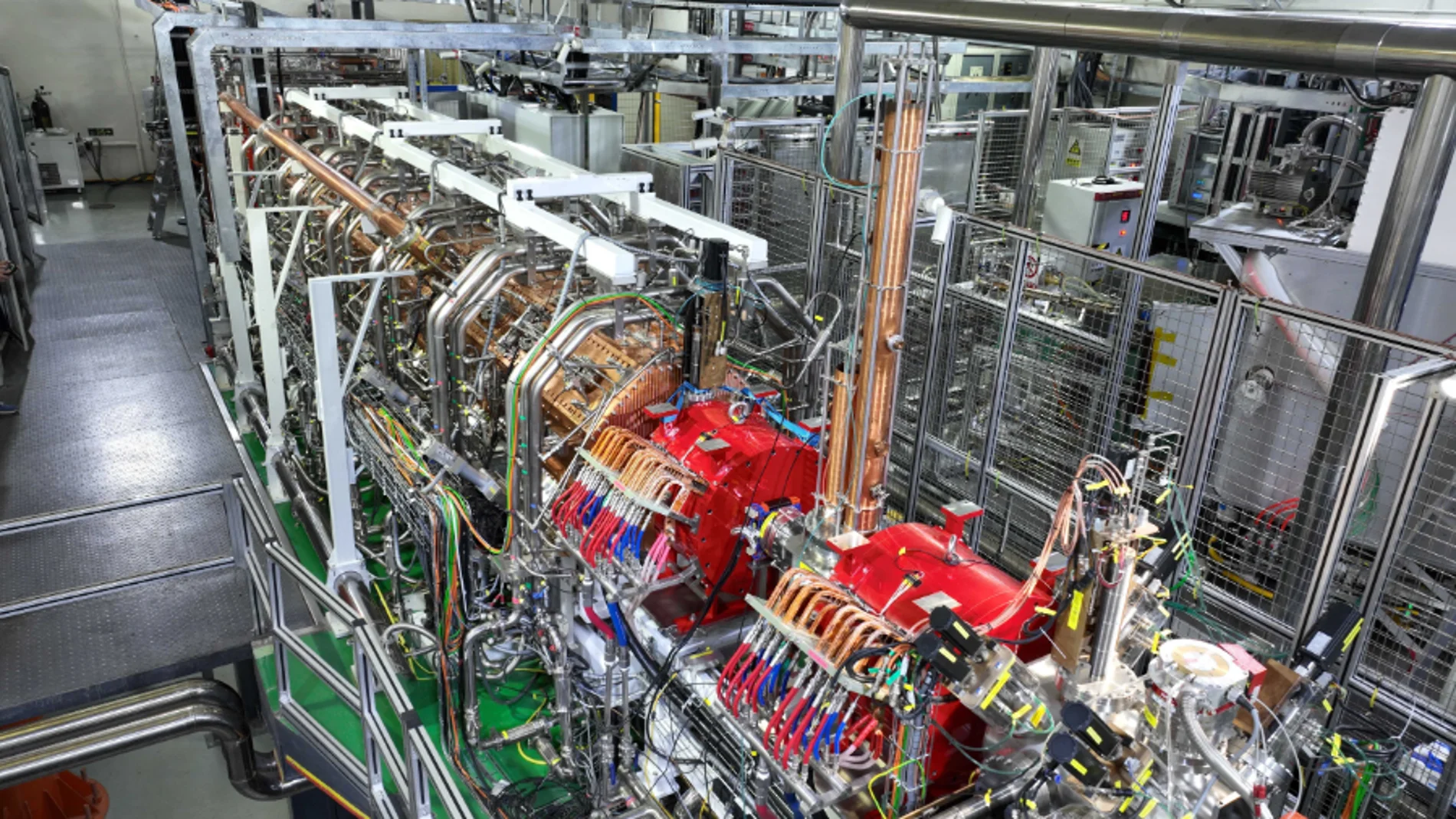
However, the scientific map is beginning to change. China has just launched the High Intensity Heavy-ion Accelerator Facility (Heavy Ion Accelerator Facility of High Intensity or HIAF), a gigantic scientific infrastructure located in Huizhou, in the south of the country, which has just begun its experimental operations after passing all technical tests. And he has done it breaking several world records for beam intensity, a key parameter for this type of installations.
Although comparisons with CERN are inevitable, both laboratories pursue different objectives. The Large Hadron Collider (LHC) mainly accelerates protons to speeds close to the speed of light and makes them collide head-on. These collisions recreate conditions similar to those existing a fraction of a second after the Big Bang and allow us to study the most fundamental particles in nature.
HIAF, on the other hand, works with heavy ions, that is, atomic nuclei much larger than a simple proton. It can accelerate from hydrogen to uranium and produce thousands of extremely unstable atomic nuclei that barely exist for fractions of a second. That turns the Chinese accelerator into a kind of nuclear time machine. Many of the elements that make up our body (calcium in the bones, iron in the blood, oxygen in the lungs or fluoride in the teeth) were born billions of years ago inside giant stars or during supernova explosions.
However, many of these “elementary births” and their nuclear reactions still remain a mystery. The HIAF will allow part of these processes to be recreated under controlled conditions to understand how the heaviest chemical elements in the universe are formed. It will also help explore one of the big questions in nuclear physics: how far the existence of an atomic nucleus can go before it is no longer stable. Therefore, it is not surprising that the HIAF scientists themselves describe it as a super microscope. Its main advantage lies not only in the energy achieved, but in the enormous number of particles that can be accelerated in each pulse.
During initial tests it achieved record intensities for oxygen and bismuth beams, even exceeding the specifications with which it had been designed. Furthermore, scientists managed to measure with unprecedented precision the mass of a very unstable isotope (a “cousin” of a chemical element: it has the same number of protons, but a different number of neutrons) of the gold and detected two new isotopes, demonstrating the sensitivity of the system.
In science, having more particles is often equivalent to obtaining better statistics. It is similar to trying to identify an animal species: observing ten specimens provides information; Studying millions allows us to discover invisible patterns. Although these facilities are usually associated with the most basic research, their applications frequently end up reaching everyday life. Heavy ion beams are already used to develop new materials, study the behavior of components subjected to space radiationinvestigate biological processes and even improve some cancer treatments through particle therapy.
More than replacing CERN, HIAF symbolizes a much deeper change. For much of the 20th century, the large scientific reference laboratories were concentrated in Europe and the United States. Today China is investing billions of euros in telescopes, fusion reactors, quantum computing and particle accelerators, with the aim of becoming one of the main scientific poles on the planet. The HIAF is part of that strategy.
CERN will continue to be, foreseeably for many years, the great world reference for high-energy particle physics. But the inauguration of the Chinese accelerator shows that frontier research no longer has a single center of gravity. As with artificial intelligence, space exploration or quantum computing, 21st century science will be increasingly multipolar.