
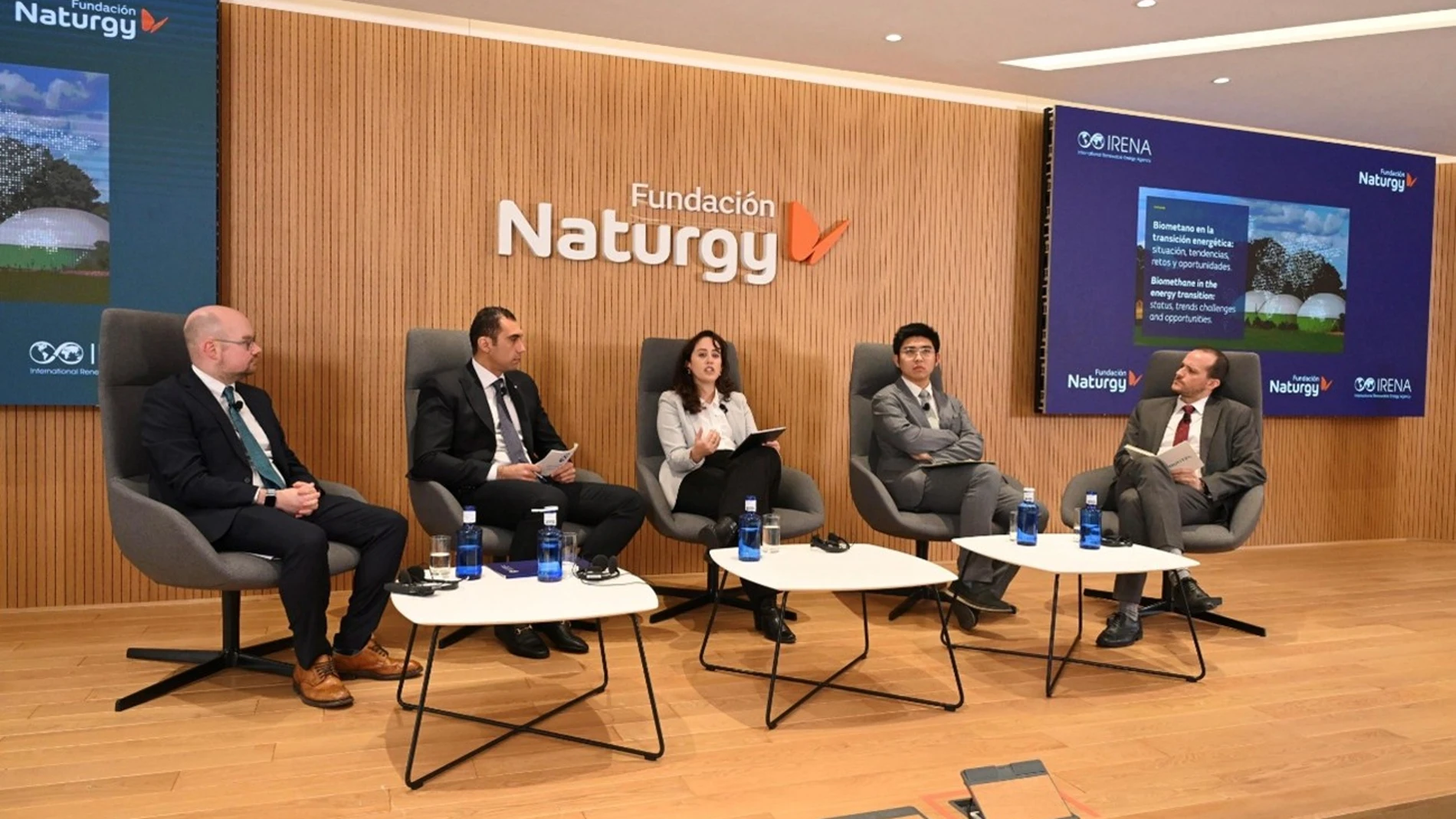
Naturgy Foundation and the International Renewable Energy Agency (IRENA) have recently held a meeting on the role of biomethane in the energy transition that has made it possible to analyze both the current situation and also exchange points of view on trends, challenges and opportunities in the sector. The meeting has also brought to the table the growing interest and relevance of biomethane in the global decarbonization process.
The participants in the conference have highlighted the importance of establishing clear objectives, strengthening international cooperation and promoting innovation and investment so that biomethane takes its rightful place in the global energy mix.
The consensus among experts suggests that sustainability, collaboration between sectors and countries and public support will be decisive in overcoming the challenges and taking advantage of the opportunities of biomethane in the energy transition, thus contributing to a more circular and sustainable economy.
The event has brought together representatives of institutions, associations and companies from various countries, focusing on the challenges and opportunities that this renewable fuel presents in the current scenario of massive electrification.
Renewable electricity mastery
During the opening, James Walker, Renewable Gases leader of the IRENA Innovation and Technology Center, pointed out that, although in 2024 more than 90% of the new installed electrical capacity was renewable and that technologies such as solar and wind have established themselves as the most economical, the growth rate is still insufficient to meet international climate commitments. Walker stressed that to achieve the decarbonization goals set for 2050, renewable capacity must triple by 2030 and multiply by nine in 2050 compared to 2022 levels.
In this context, biomass and sustainable fuels are evolving towards strategic uses, opening new industrial opportunities, especially in economies with developed bioenergy markets and abundant renewable resources. The integration of green hydrogen and sustainable carbon into emerging value chains and the development of solutions for sectors that are difficult to electrify, such as heavy transportation and certain industries, stand out as areas of special interest and potential growth.
Solution for difficult sectors and the circular economy
Biogas and biomethane are emerging as fundamental alternatives for the decarbonization of sectors where direct electrification is complex or expensive. This was expressed by Karina Navarro, Policy Analyst at the World Biogas Association, who stressed that “the circular economy and renewable energies are not optional, but essential for decarbonization efforts.” The success of biomethane markets, according to Navarro, depends on good policy and legislative security, where the public sector has a decisive role in establishing objectives, priorities and infrastructure, in addition to attracting investments through regulations and market incentives.
The importance of having solid regulatory frameworks and government support was a constant in the interventions. For Walker, financing, technological innovation and the development of business models adapted to local contexts are key to driving growth in the sector. The expert emphasized the need to improve coordination and overcome the dispersion of efforts to guarantee efficient and maintained facilities, fundamental challenges for the sustainable development of biomethane.
China and the Mediterranean advance
The debate included relevant testimonies from different regions. Yu Yuan, deputy secretary general of the China Bioenergy Industry Promotion Association, highlighted the growing interest in biomethane and biomass in his country, pointing out that “biomethane will be increasingly interesting” in the future and that Chinese industrial users are betting on decarbonization through this resource. Additionally, Yuan mentioned the demanding green energy targets for industrial parks, as part of the Chinese government’s construction policy.
For his part, Mohamed Alaa, energy expert from the Union for the Mediterranean, shared the regional perspective, differentiating between the north, where biomethane is strategic for energy security, and the south, where waste treatment strategies are prioritized. Alaa identified Egypt, Morocco, Turkey and Jordan as countries that already incorporate biomethane into their strategies, although still in the initial phases, and stressed the need for greater public-private cooperation to guarantee security and attract investments.
During the opening of the day, Rafael Villaseca, president of the Naturgy Foundation, insisted that “the role of renewable energies is key to accelerating the energy transition and meeting climate objectives.” Villaseca highlighted the value of biomethane as an indigenous resource, its storage capacity and its contribution to waste management, closely linked to the principles of the circular economy.
For his part, Francesco La Camera, director general of the International Renewable Energy Agency (IRENA), wanted to highlight in relation to the day that “the session comes at a particularly opportune time. The objective is to promote a balanced conversation about the essential role of biomethane in the energy transition and its application in different sectors. Biogas and biomethane are solutions that for a long time have received less attention than other renewables despite their enormous potential.” The general director of IRENA has stressed that “by 2050, it is expected that more than half of the energy demand will be covered by electricity, with an approximate share of 91% from renewable sources. To achieve these objectives, we will have to analyze the available economic alternatives and also consider other critical elements of the system. Our analyzes show that bioenergy, including biomass, plays a very relevant role in meeting the needs of different sectors.”