
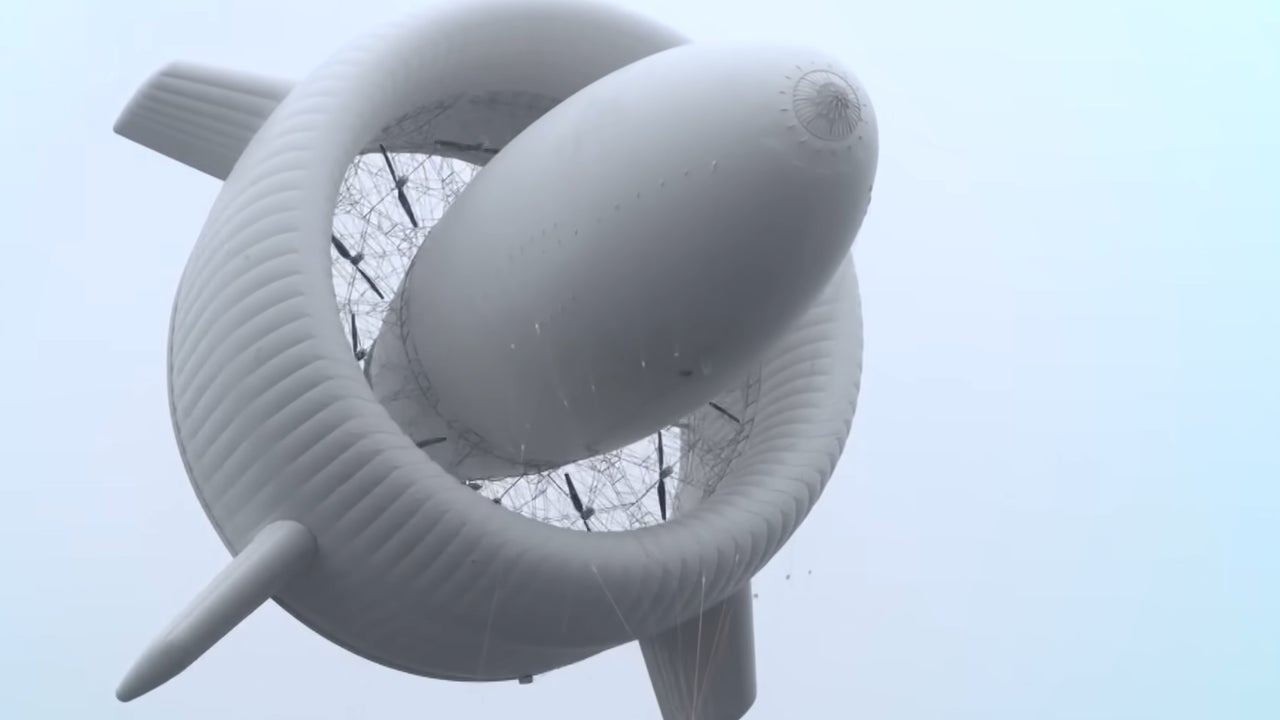
Wind energy has been, for decades, one of the great promises of renewable energy: clean, abundant and free. Traditionally, wind turbines have been anchored to the ground or the seabed, with gigantic blades that transform the force of the wind into electricity. But now, Chinese scientists and engineers have taken the technology a step further: have tested the world’s first megawatt-class “flying” wind turbine, capable of generating energy directly from the air without being fixed to the ground.
Basically it is a kind of giant kite or drone that never lands, which rises hundreds of meters in the sky where the wind is stronger and more constant. That’s the basic idea: put a turbine in the air, where wind currents are more powerful and less turbulent than near the groundand link it to a generator using a cable. The turbine rotates thanks to the wind and transmits that energy to the ground to convert it into useful electricity.
This concept breaks with the classic design of giant wind turbines with fixed blades on cement towers: By flying higher, you can capture more stable and energetic windwhich increases electricity production without the need to build huge structures on the ground.
The recently tested Chinese flying turbine, The S2000 belongs to the “megawatt” category, which means that its maximum power can exceed 1,000 kilowatts. (1 MW). To put it in context, a European home uses approximately 20 to 30 kilowatt-hours (kWh) per day. That equates to 600–900 kWh per month. According to early results, the S2000 generated enough energy to power a home for about two full weeks with a single day of continuous operation under favorable conditions.
These calculations are not definitive, because production depends on wind conditions and the specific efficiency of the device, but They give an intuitive idea of the scale of energy that can be captured when harnessing wind at higher altitudes.
One of the key questions is why is it important that it is “flying”? Wind near the Earth’s surface is usually slower and more turbulent, affected by buildings, hills or vegetation. On the other hand, at higher altitudes, hundreds or even thousands of meters, the wind is more uniform and usually blows with greater force. That means a turbine that can fly freely over obstacles can capture more energy with less structural material and, potentially, at a lower cost per unit of electricity. In addition, these devices have logistical advantages. For example, They generate less impact on the terrain, can be moved and do not generate visual or physical interference.
Although the concept is promising, there are still challenges to overcome. It is essential to keep the turbine in the optimal position without it moving or stagnating due to bad weather and the cable that carries electricity from the turbine in the air to the ground must be resistant and light, without losing efficiency. And, finally, we have the safety and regulations section: it cannot interfere with air traffic, wildlife or already established networks. Something that could affect the ideal height to place them. The aerospace group Omnidea estimates that at altitudes between 100 and 2,500 m, Wind energy density increases by approximately a factor of six, with an average wind speed of more than 50 km/h.