
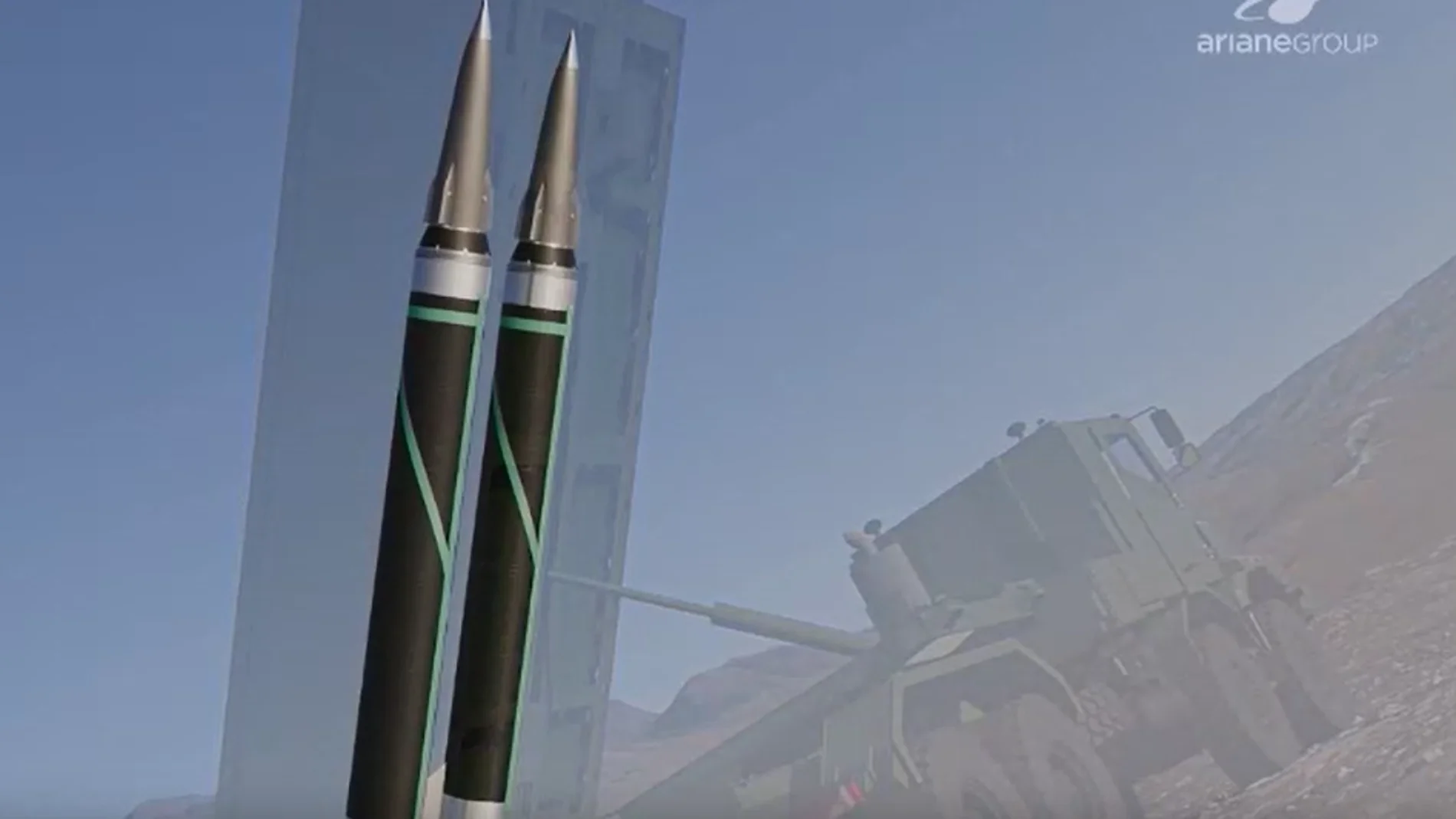
A ship can travel at more than 30 knots, change course and disappear for a few minutes under the protection of its electronic systems. Locating it is complicated; Hitting it from hundreds of kilometers is even more difficult. To reduce this margin of reaction, the European industry is exploring an unusual technology in naval combat: ballistic missiles. The French company ArianeGroup has presented a naval version of the B-Strike 1000, a weapon that, According to the announced performance, it could reach targets located more than 1,000 kilometers away and exceed speeds of Mach 10.
The proposal expands a family of conventional missiles that ArianeGroup had unveiled in June, during the Eurosatory fair, together with Thales and Soframe. That first presentation was focused on long-range ground attack systems. Now, the company extends the concept to the naval field and attributes to the B-Strike 1000 two missions: attacking targets on land and hitting moving ships. In his official statement ArianeGroup confirms 1,000 kilometer range and new anti-ship capability.
The difference with the cruise missiles that usually star in this type of news is fundamental. A cruise missile, such as the American Tomahawk or the French MdCN, It flies aerodynamically, powered by a motor for much of its journey and following a relatively low trajectory. A ballistic missile, on the other hand, receives an initial boost from a rocket and then continues for much of its journey following a trajectory of ascent and descent, before returning to the atmosphere and heading toward the target. This trajectory allows reaching much higher speeds, although it also poses different challenges for locating and tracking the target.
In the case of the B-Strike 1000, the characteristics released during Euronaval describe a solid fuel missile, about seven meters long, capable of exceeding Mach 10 and reaching altitudes greater than 120 kilometers. These are announced design and performance figures, not results of a public test of the naval system. The missile would also incorporate a maneuverable reentry head, known by the acronym MaRV (Maneuverable Reentry Vehicle), which can modify its trajectory during the final phase of the flight.
This last characteristic is especially important when the target is not a fixed installation, but a ship. During the ten minutes that the journey could last, A boat sailing at 30 knots would travel more than nine kilometers. That is why it would not be enough to know its position at the time of launch: the system would need to update information about the target and correct the trajectory during the approach. The maneuvering head is designed to address this problem, although its real effectiveness against moving ships will have to be demonstrated.
Speed also reduces the time available to react. A subsonic missile traveling 1,000 kilometers may take around an hour, while the advertised flight time for the B-Strike would be around ten minutes. This difference does not make the weapon impossible to intercept, but it does force defensive systems to detect, identify and respond in a much narrower time window. Additionally, reentry warhead maneuvers can complicate interception calculations.
ArianeGroup has shown several launch possibilities: from warships, through mobile land platforms and, as the most striking option, from unmanned vessels. In the presentation images even the French frigate Amiral Ronarc’h as a possible integration platform. However, these are proposed configurations, not approved installations. by the French Navy. The company has also not announced a procurement contract for the naval variant or a service entry schedule.
The B-Strike 1000 still has to overcome the decisive step between a model and an operational weapon: finance its development, validate its performance and demonstrate that it can locate and reach a ship that does not remain still. But its presentation makes one trend clear: The race for naval range is no longer limited to making cruise missiles that fly farther. It also contemplates ballistic weapons capable of traveling great distances in a few minutes and turning the ocean into a much broader threat scenario.