
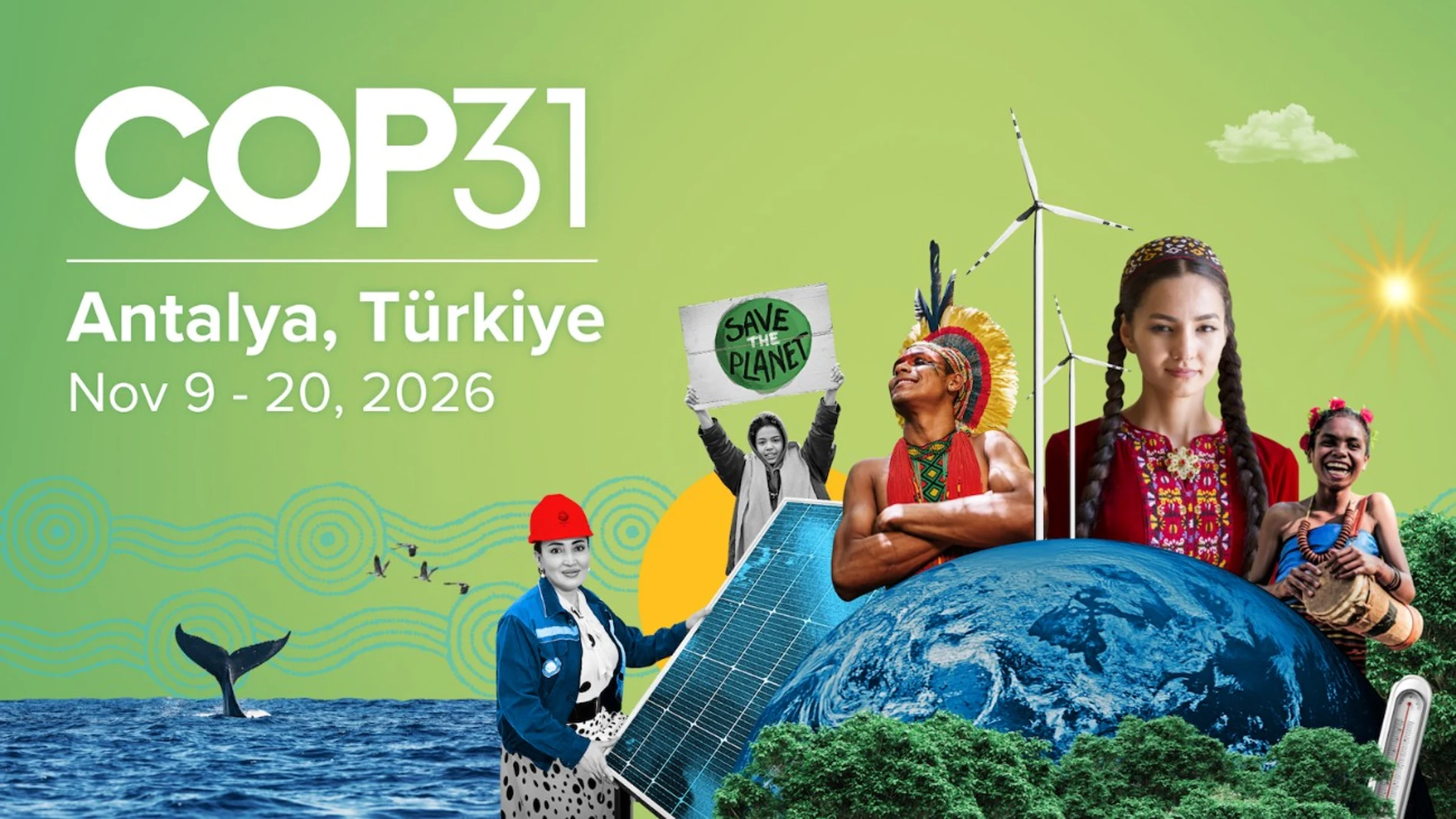
COP31 has been held since November 9 in the city of Antalya, in Türkiye, with the aim of trying to move from climate commitments to their execution. On the opening day, Simon Stiell, head of Climate Change at the United Nations, warned that “progress is not even remotely close to being sufficient or fair.”
A summit with two rudders
Türkiye and Australia aspired to organize the summit, and the dispute was settled at the 30th Conference of the Parties, held in Belém, with an unprecedented co-presidency formula. Turkey hosts the conference and chairs it through its Environment Minister, Murat Kurum, while the Australian Minister of Climate Change and Energy, Chris Bowen, leads the negotiations with the Pacific islands. Kurum has dubbed the event the “implementation summit.” According to the minister, “our decisions must take shape in the infrastructure of a city, in the land of a farmer and in the production chain of a factory.”
A year of extremes
The summit is held after a 2026 marked by floods in Nepal, fires in Indonesia, heat waves in Europe and a drought in Bolivia that has killed more than 75,000 heads of cattle. An El Niño that could be one of the most intense since 1950 threatens to aggravate the situation. Science now considers it inevitable to exceed, at least temporarily, the 1.5°C limit, and current policies aim for around 2.8°C. Added to this is adverse geopolitics, since the United States’ war with Iran has made oil more expensive and the Trump Administration has not sent official representatives.
Ministers in charge
With some 160 agenda items, the first week left drafts on almost all technical fronts, except agriculture, postponed to the next session in Bonn. The Australian Bowen has opted to build a “cover decision” from day one, the political text that summarizes the summit, despite the reluctance of Russia and some emerging economies. It is the ministers who negotiate it. “Our job is to close those differences and provide the most ambitious, results-oriented decision that the consensus allows,” Bowen explained.
The money, once again
Financing is once again at the center. Baku set a 2024 goal of mobilizing at least $300 billion annually for developing countries by 2035, but the South is demanding subsidies and not loans, and the European Union warned that there is no will for new commitments. Africa, for its part, is fighting to triple adaptation financing to 120 billion annually in 2035 and has managed, despite European resistance, to get the proposal back on the table.
The problem is also the price of money. According to Selwin Hart, special advisor to the United Nations, financing a solar park in a developing country costs several times more than in a rich one. In fact, in 2025 emerging economies, excluding China, received only 18% of global investment in clean energy. “We need financing solutions that do not increase debt,” insists Hart.
Electrify or abandon fossils
Turkey’s big bet is to raise electricity from 20% to 35% of global energy consumption in 2035, an objective to which the European Union asks to add the adjective “clean.” Spain, with Sara Aagesen leading its delegation, supports the goal and comes with the endorsement of 55.5% renewable generation in 2025.
But what really divides the summit is fossil fuels. Dubai agreed to abandon them, while Belém did not mention them. In Antalya, Brazil has delivered a voluntary roadmap for this transition and the Arab Group rejects imposing objectives on specific energy sources.
The just transition mechanism agreed in Belém to protect workers and communities remains to be closed. Health has also gained weight. According to the World Health Organization, up to 3.6 billion people live in areas that are highly vulnerable to climate. “Almost all heat deaths are actually preventable,” recalls Joy Shumake-Guillemot of the World Meteorological Organization.
COP31 will not end global warming. His proof is more modest, but no less, to demonstrate that multilateralism still works. As the president of the United Nations General Assembly, Khalilur Rahman, summarized, “COP31 cannot be judged by the promises we repeat, but by the people we protect.”