
Wow, I remember them… I had the Sports and the WM-10, two of the most iconic Sony walkmans of the 1980s. For those born in the 21st century, there was a time when listening to music on the street was almost an act of rebellion. There was no need for a screen, an internet connection or a subscription. All it took was a small player, some carefully selected tapes and headphones that, for many, ended up becoming an extension of their own personality. In 1979, Sony put that future within reach with the Walkman. Almost half a century later, the Japanese company wants to recover some of that magic with the MDR-3R. And it does so by looking to the past to connect to the present.
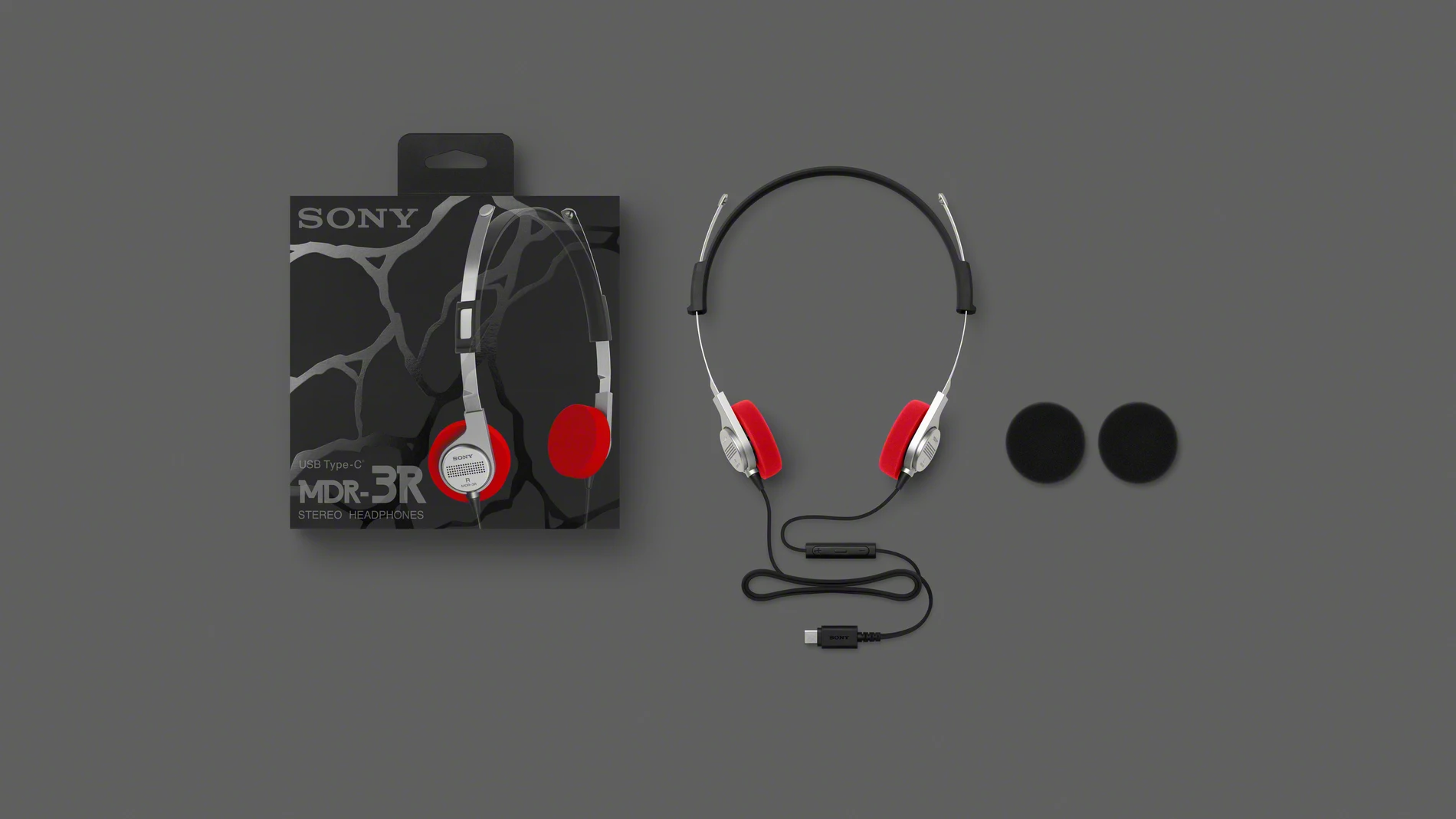
The new MDR-3R are a reinterpretation of the headphones that accompanied the first Walkman, the TPS-L2. This is not an archaeological reproduction or a museum piece: Sony has preserved the original lines, its lightness and even the characteristic blue and orange interchangeable pads, but has replaced the connection from that time with a USB-C port. A way to recover the aesthetics of the eighties without forcing us to search in a drawer to find an adapter.
The choice of that design is not accidental. When the Walkman appeared in 1979, listening to music ceased to be an activity tied to a place. Until then, portable music relied on radios or bulky players. Sony’s small device made it possible to carry a collection of songs in your pocket and listen to it while walking, traveling by train or exploring the city. The soundtrack no longer depended on the environment: each person could build their own.
That revolution also had an aesthetic dimension. Headphones stopped being just a technical accessory and became a sign of identity. The recorded tapes, the covers, The buttons on the player and the cables that poked out of the jackets were part of a culture that cinema, television and fashion (Back to the Future, The Goonies, Madonna, Michael Jackson…) ended up becoming iconography. The eighties were also that: a decade in which technology began to be worn.
The MDR-3R recover precisely that visual language. They maintain the open and light design of the originals, designed to offer comfort during long sessions, and use 23 millimeter transducers, like the MDR-3. Yesony assures that it has respected its acoustic configuration to preserve a balanced sound signaturewith natural voices and emotional richness, although it has introduced small adjustments to adapt it to current preferences. They do not seek to compete in specifications with large wireless noise canceling headphones, but rather to recover a simpler and more direct experience.
Because, in a world where almost everything requires a battery, an app or pairing, the cable is beginning to have something of an unexpected and quiet modernity. The MDR-3R connects via USB-C and works with compatible devices without needing to charge, sync, or update firmware.. They incorporate a microphone and a remote control in the cable itself to manage calls and playback. It is plug-and-play technology in the most literal sense: plug and play. Of course, they require compatibility with USB Audio Class 1.0 and Sony warns that it does not recommend using them with a Walkman. A small irony for a product that was born precisely from that family.
The nostalgia is completed with a special edition linked to Stranger Things. The Netflix series has turned the popular culture of the eighties into one of its main protagonists: bicycles, cassette tapes, arcades, synthesizers and an aesthetic that has found new admirers among those who lived through that decade and those who only know it through the screen. The special version of the MDR-3R takes as reference the style of Max’s headphones and the disturbing universe of the Upside Down World. Includes exclusive details, the engraved series logo and personalized packaging. It is not just a color variation: it is a small collector’s item for those who have made that decade a part of their imagination.
The MDR-3R will be available from November for 59 euros, while the edition Stranger Things It will cost 69 euros. Almost fifty years later, the Walkman no longer needs to carry a cassette to remind us what it meant. Just put on some headphonesconnect a cable and let the music do the rest. Perhaps that is the most interesting part of this return: in an era obsessed with the new, Sony recovers an object with a more social than technological value. If I carried the Sports down the street today, maybe my daughter wouldn’t look so bad at me… Nostalgia for an aesthetic that was better.