
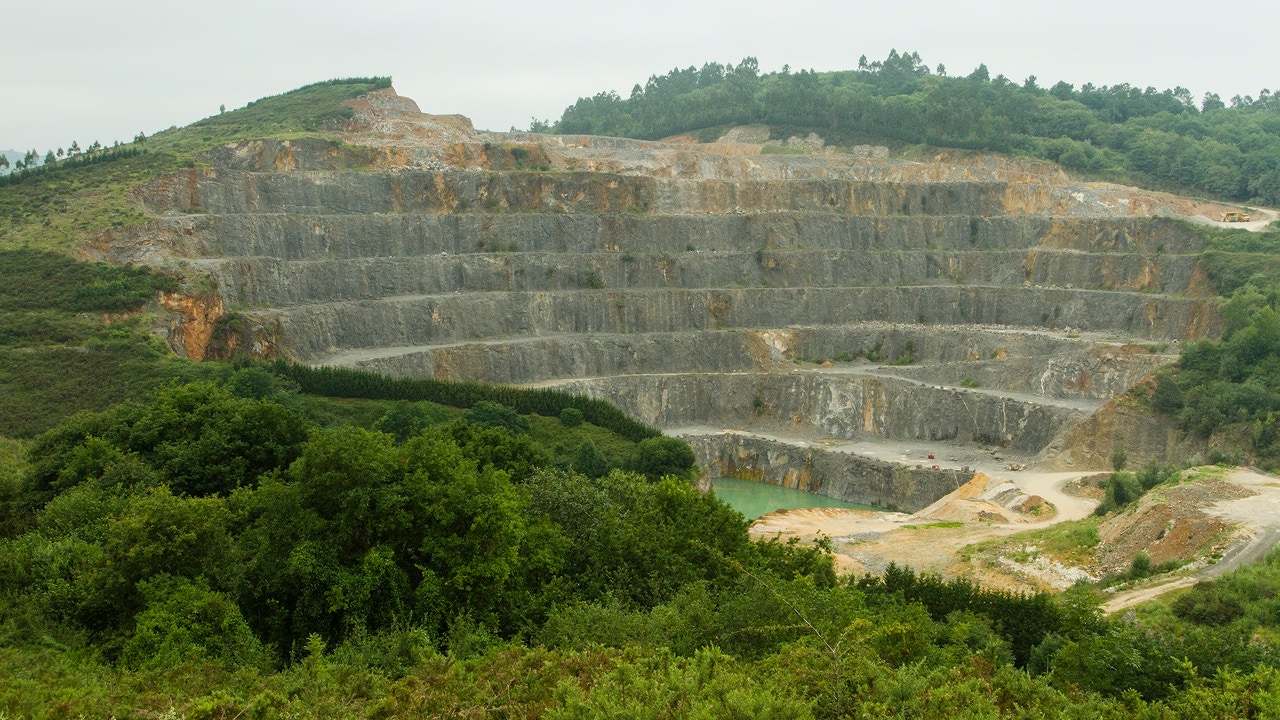
There is not even a week of time between the publication of the list of strategic mining projects selected by the European Commission and which is considered the most important mining accident in Spain in three decades. The safety of the activity or possible irregularities committed by the company are discussed these days and in part they revive the debate around a controversial activity also for its environmental impacts. The extraction of coal (such as that of the Cerredo mine in Asturias) is already residual in Spain. Practically In 2018, most of the mines were closed (they lost public aid) within the reorganization process of the mining sector agreed with the EU, which in 2010 It established that the policy of promotion of renewables and a low carbon economy no longer justified support for non -competitive coal mines. Seven years later, the EU is willing to support, and finance, new extraction projects in its territory, but not coal, but of the new minerals considered strategic for energy transition, digitalization and defense.
“The Chinese lithium should not become the Russian gas of tomorrow,” said the vice president of the European Commission and Commissioner for Prosperity and Industrial Strategy, Stéphane Séjourné, announcing the list of the first 47 projects aimed at extracting, treating or recycling minerals such as wolframium, nickel, zinc, copper, lithium or stronc. These new projects will allow access to 14 raw materials identified by Brussels, which began to take stock in 2008 of all the minerals he consumed and that fundamentally imported from China. If in 2011 he identified 14 minerals as fundamental, in 2023 the list reached 23. The objective of Europe is that in 2030 at least 10% of the consumption of fundamental raw materials is extracted in the EU and that 40% are processed here. Also that 25 % proceeds as recycling and that no third country concentrates more than 65 % of a supply. «We have the need to extract our own essential minerals for the economy. At this time, the press stands out for Trump’s interest in the resources of Ukraine or Greenland, etc., but there are interest for years. Many countries do not have any of these elements, but in Spain we have great mining potential in elements such as Wolframium, which is used to manufacture electrical resistance or cutting tools. It has many applications that range from the instrumental of the dentist to defensive shields. Lithium, above all, is used for electricity batteries, ”explains Ester Boixereu Vila, researcher at the Geological Mining Institute of Spain. Cobalt and nickel are also necessary for electricity batteries, while wind turbines also consume large amounts of aluminum or copper.
The commission received 170 proposals and has chosen 47 in a first round and promises “Simplified” approval processes To move from the current 10 average to start an extraction at 27 months and 15 in cases of processing or recycling. In addition, although the EU hopes that most of the projects will be profitable for themselves reserve 22.5 billion euros of the European Bank for Investments for Loans, Capital Participations or Loan Guarantees.
Projects throughout the EU
Thus has chosen two lithium projects in Portugal and Germany and rare earth processing in Poland and Sweden. This country in turn will extract graphite for batteries. In the Czech Republic, two projects for the extraction and processing of lithium and manganese have been chosen. «In the Finnish Lapia, two copper and polymetallic projects, of which a part is located in a protected area … France obtained consent for lithium extraction projects, four processing of various materials and two recycling. In Greece, projects for the extraction and processing of bauxite, aluminum or gallium were selected », the Euroactiv French medium clarifies. In Italy, there are four recycling projects and In Spain, six of them are extractive and one recycling. Our country, it is already according to the Miteco archives, the only strontium producer (used in permanent magnets) and Sepiolita in Europe; the first plaster producer and the second of copper, magnesite and potassium salts. In the world it is the first producer of Pizarra de Techa and the second of ornamental rocks or marble.
Where are the new mines?
In Ciudad Real, the Wolframium site of El Moto in Abenójar has estimated resources of 91 million tons of mineral (some estimates talk about the fact that it could cover 20% of the European demand). Three others are in Extremadura: it is the Aguablanca project, which implies the reopening of a mining exploitation (nickel, copper and cobalt, among others) in Badajoz; The Lithium Mining Project in Las Navas (Cáceres) and the reopening project of a Wolframio mine in Almoharín (Cáceres).
The only circular recycling project in Huelva closes the list, centered on copper, nickel and metals of the platinum group; The Las Cruces Copper Extraction and Processing (Seville) and a Lithium Mine in Doade (Galicia). Boixereu points out some details: “There are mines such as Doade or Lithium in Cáceres that have already worked. The opening of new mines will allow to restore debris that would not have to be there, but that were left without restoring because the mines were closed before the 80s when the companies began to be forced to make restorations. One of the minerals that we need most if we want to electrify the economy, which is what has been decided in Europe. Andalusia is the most important mining area in Spain At this time by the Piritic Strip. ”In fact, the AA CC now concentrates 34% of national production (far ahead of other historical regions in the mine such as Asutiras that barely provides 4.5% of the total). In the case of lithium, the researcher recalls that there is no possibility of recycling because it is a mineral that until 15 years ago was practically not used.
How much do we need?
This is what Adriana Espinosa, responsible for natural resources and residues of land friends. The organization presented to the European Commission and the Government an analysis -registered together with environmental and BirdLife Ecologists -, in which it indicates the opacity of both organizations during the selection process, already whatand “even the number of total projects that were presented is unknown.” These three organizations ask that projects are not approved near special protection areas such as the Natura 2000 Network or that permits are not granted to suspicious companies or convicted of malpractice.
They even go one step further, stating that in reality the amounts of minerals that will be needed before deciding how many mines have to be opened, it has to be opened to open. «We have analyzed the objectives of plans such as the famous PNIEC or those related to the electric vehicle and have taken into account the amount of minerals used in different technologies. For giving some data, Lithium we would be talking about 226.2 kilotons; of copper of more than 4,000 kilotons, and of aluminum, of about 7,000 kilotons. The electric car is undoubtedly the great mineral devourer, ”says Espinosa.
From Earth’s friends they warn that it would be necessary to know how many, but also desirable to know why. “A debate is needed, because the population may not agree that minerals go to the electric car or are used to make pumps.” One of the proposals of these organizations is reduce consumption and bet on recycling, which would cover 67% of demand They say. «We propose measures such as extending the life of technology. A mobile lasts for average two years and contains 35 fundamental metals. We also believe that we must bet on public transport and bet on recycling; The recovery industry is undecided and little investigated ».
A problem with water
From Brussels it is ensured that the selected projects meet the “environmental, social and governance” criteria, but some organizations in the third sector do not think the same. A recent study by the New Water Culture Foundation, carried out in collaboration with the University of Seville and the Pablo de Olavide University, affirms that the opening of new mines will compromise drinking water in Western Andalusia. «Expanding extraction will double the discharge of wastewater and metals that has already been performed in the Guadalquivir. In addition to what they contaminate during their active period, the waste that will remain, will affect the estuary and the Doñana National Park, ”said Joan Corominas, manager of the Foundation considered in the presentation of the report.