
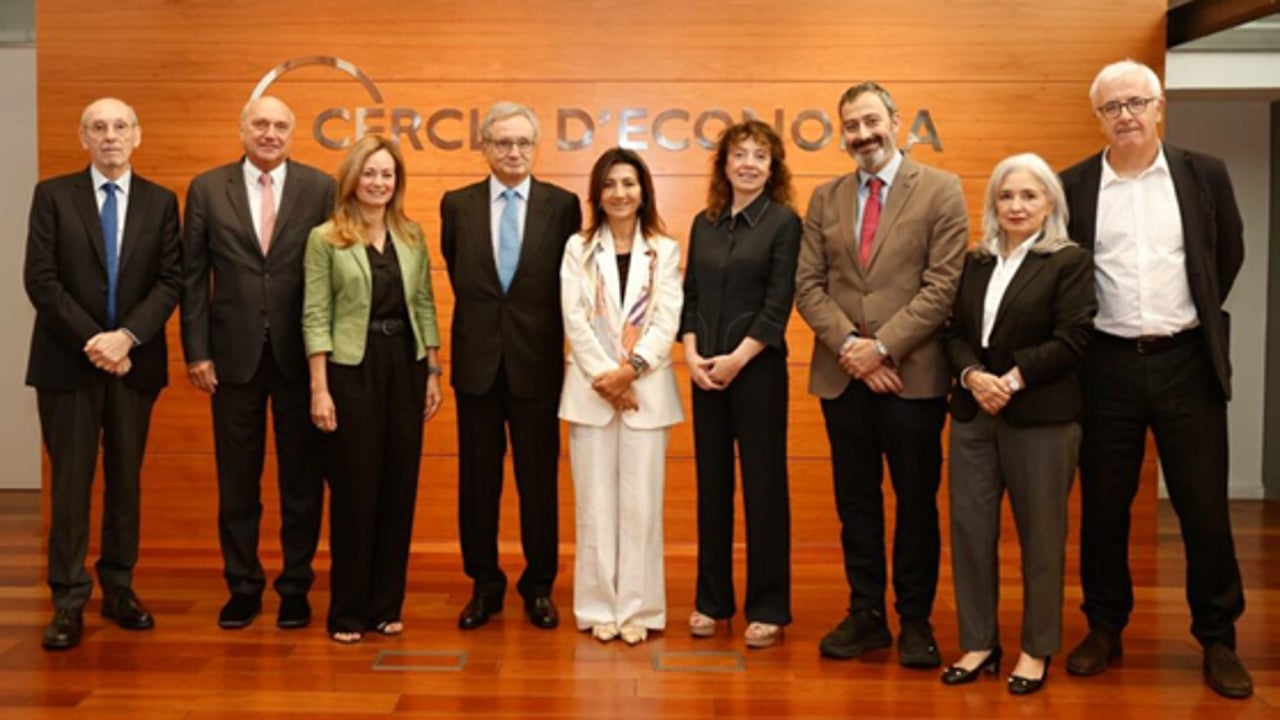
The Naturgy Foundation and the Cercle d’Economía,They have organized a day to analyze in depth the situation of the energy sector in the complex international situation that is being experienced, from a national and European perspective, with the aim of providing a comprehensive vision of the future of the energy system and its impact on the economy and geopolitics.
In the opinion of the experts who participated in this Conference, it is key to streamline administrative processes and create a competitive, predictable and aligned framework with Europe so that the industry can be the protagonist of the energy transition.
For the director of the Esade Center for Global Economy and Geopolitics, Angel Saz-Carranza, “we are living in a world where the institutions that supported globalization are being surpassed by the United States, which has important implications for Europe and for Spain.”
Change of era
In his opinion, “we are entering a stage in which disputes are resolved based on power and not rules, which generates distrust and barriers for companies and the global economy.” Saz-Carranza recalled that since 2010 we have witnessed a “slow globalization” marked by commercial stagnation and a decline in the political will for integration. “The rise of China, populism and the defense of national sovereignty largely explain this change of era, where multilateral institutions lose weight and geopolitical competition intensifies,” emphasized Saz-Carranza.
He also stressed that this phenomenon has a direct impact on energy, a sector that “has become a central space of strategic rivalry, with China dominating a large part of new technologies thanks to its model of state capitalism.” He concluded by warning that “the energy transition, far from being just an environmental challenge, is becoming an area of global dispute, where tensions emerge over costs, access to raw materials and distribution of responsibilities between countries.”
For his part, Klaus-Dieter Borchardt, former Director General of Energy of the European Commission, placed emphasis on how Europe must face a transformed energy landscape through the “Clean Industrial Deal”, which combines decarbonization, competitiveness and innovation. “Measures are being proposed to make energy cheaper, promote clean demand markets, make electricity management more flexible, improve efficiency, simplify the regulatory framework and mobilize large public and private investments.” For Borchardt, this European strategy “seeks to guarantee affordable, safe and sustainable energy, while reducing dependence on the outside world and redefining geopolitical alliances.”
Urgent and pragmatic decisions
In his speech, Mariano Marzo, emeritus professor of Stratigraphy and Historical Geology at the University of Barcelona, highlighted that the energy transition in Spain has been “more additive than substitutive, with the only exception of coal and, therefore, technologies such as nuclear continue to be key.” He recalled that “the commitment to electrification and renewables has not given the expected results and, without storage, up to 35% of generation could be wasted in 2026.” He also warned of the challenges represented by digitalization and mobility, with the continuous supply of resources required by data centers or the expected increase in electric vehicles.
In March’s opinion, the National Integrated Energy and Climate Plan (PNIEC) has “technological biases, greater ambition than the European objectives and puts industrial competitiveness at risk.” That is why he demanded, “a realistic roadmap that combines sustainability with competitiveness, accessibility and security.” “Spain and Europe need urgent and pragmatic decisions to guarantee industrial viability and the success of the energy transition,” he concluded.
The business vision was provided by Elisabet Alier, president of ALIER, SA, “energy is a strategic factor for the industry, since it can represent between 30 and 50% of its costs.” These costs “place the Spanish industry at a competitive disadvantage compared to the United States, China or even other European countries, where prices are lower.” In his opinion, this represents “a real risk of loss of competitiveness, relocation, less capacity to attract investment and greater vulnerability to market volatility.”
Alier defended that “the industry is committed to decarbonization and promoting renewable energy, but “we need to simplify and accelerate permits, align renewable planning with industrial planning, modernize the network and facilitate investment in storage.”
The price of electricity
At the opening of the day, the general director of the Cercle d’Economia, Miquel Nadal, highlighted that “the price of electricity in Europe is three times higher than in the United States and double that in China.” A reality that he has attributed to the fact that “Europe is a continent poor in fossil resources, historically dependent on third countries, and which has also lacked a solid energy policy and sufficient interconnections between States.”
For Rafel Villaseca, president of the Naturgy Foundation, “no one doubts the urgency of acting on climate change or the need to advance sustainability, but there has been a tendency to oversimplify the costs and real implications of renewables. “The transition, far from being cheap, has an enormous impact on industrial sectors and citizens, in a context of budgetary limitations and tensions “geostrategic on critical raw materials”.
For her part, Maria Eugenia Coronado, general director of the Naturgy Foundation, defended the importance of dissemination to raise awareness about its impact on competitiveness, security, sustainable development and compliance with decarbonization objectives, which “we will hardly achieve before 2050.”
The lever of innovation
At the close of the day, the vice president of the Cercle d’Economia and corporate general director of Colonial, Carmina Ganyet, highlighted that “the energy transition requires multiple and diversified solutions”, hence the importance of combining the so-called “energy mix”. In this scenario for Ganyet, “innovation is the lever that can transform these solutions that today are expensive or immature into viable and competitive options.”
Finally, David Lizoain, general director of Economic Analysis and Foresight of the Generalitat of Catalonia, pointed out that “when we talk about energy, we are talking about security” and that “if the main duty of public administrations is to guarantee security, energy inevitably becomes a country priority.” For Lizoain, “sustainability is absolutely fundamental for human security and the costs of not acting will be much greater than those of investing in prevention, adaptation and resilience.”