
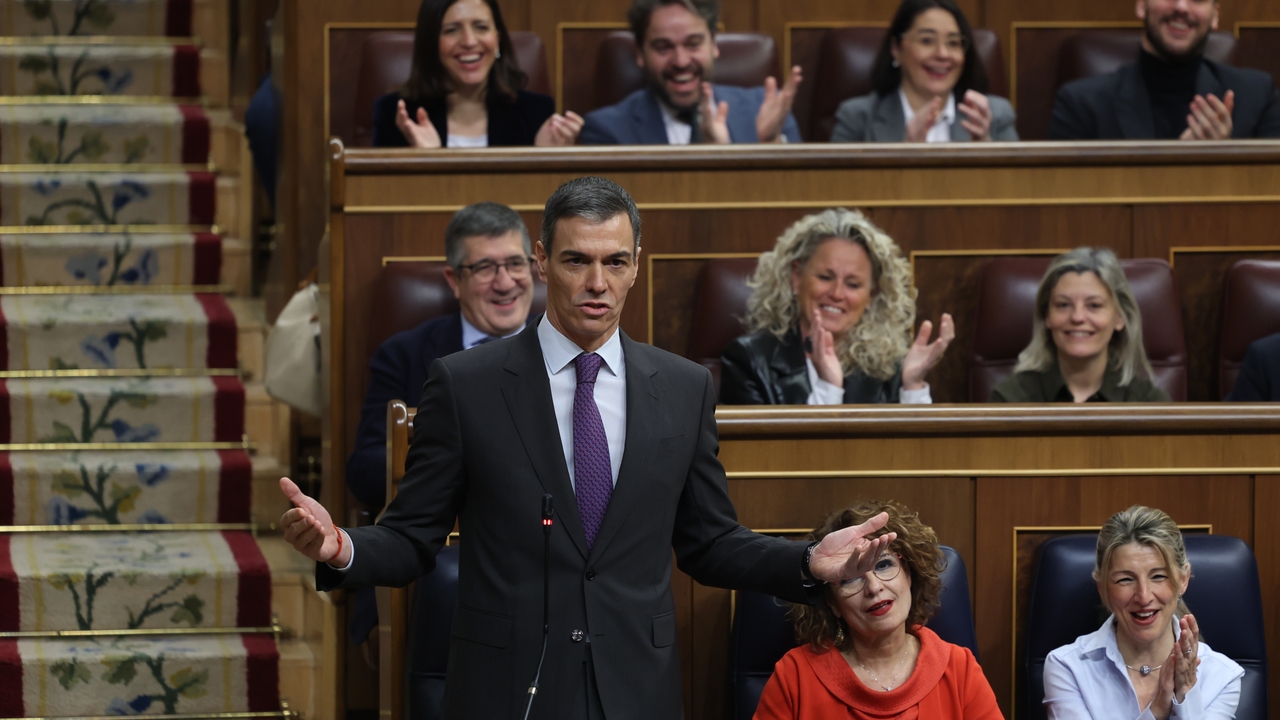
The hordes of young Spaniards were singing Cara al Sol in the streets of Spain, rushing through the last hours before the government opened their eyes with the declassification of 23-F, when a fight (yet another) control session started in the chamber where Tejero spent his last bullets.
In the same way that Minister Elma Saiz sees Falangist children on the sidewalks, the scriptwriters clearly identified the cliché of the morning. It was time to attack with the word declassification and the opposition leader devoted himself to the task with all the ingenuity and memory possible. Above all, a lot of memory, which is what is needed to not leave out any of the dark corners that adorn the life and miracles of Sanchismo. Núñez Feijóo demanded the declassification of the Budgets, the Falcon’s trips, corruption, the Adamuz accident… and thus an enormous string that delighted Pedro Sánchez.
The president has reached a point where he experiences a sordid pleasure when someone reminds him of all the controversies he has survived. Each one of them would have knocked down any Portuguese prime minister, but the Moncloa tenant smiles and puts on a “here’s the guy” face.
It was one of those mornings in which the president’s outburst mutates into a crude condescension reminiscent of the high school bully who bullies his peers. There is a Sánchez who intends to be especially hurtful towards Feijóo with that air of an immature teenager who seeks collective laughter against his opponent by accusing him of reading too much into the interventions or working too little on the answers.
If Elma Saiz is worried about young Francoists, Sánchez usually gives free rein to the young boy who once was. That young man who, even knowing that current young people are fed up with precariousness, allows himself the luxury of reiterating in Congress that “Spain is going like never before.”
The dowsers of the story have recently detected two small developments. One has to do with Sánchez and his idea that Spain is doing well and that if it is not doing better it is because of the evil businessmen who do not pay what they should. It is a small adjustment to the rocket theory, knowing that the middle class is beginning to be tired of so much disconnection with reality. The other plot novelty has to do with Feijóo and the concept of ungovernable Spain. Now that they have begun to imagine a future with Vox, the popular ones seem resigned to the fact that the inheritance they will receive will be a country on their shoulders.
Then came a very Spanish moment for us. Of three questions that the president had to answer, two thirds were going to be consumed by two groups that did not even reach 3% of the votes: Junts and Bildu, who asked about their things. Míriam Nogueras explained to us that Catalan highways are becoming Spanish because, apparently, the signs are written in Spanish.
In addition to this first world drama, Nogueras attacked Sánchez for including shielding of squatters in the social shield. As Puigdemont’s subordinate took the opportunity to bring ERC into the equation, Sánchez mocked her by telling her that this was not the window to oppose Junqueras’s men. What’s more, he invited Rufián to respond to his countrywoman.
“El Rufi” laughed happier than a piglet in a puddle, because the joke sounded like a slap in the roof of his mouth. It gave the impression that the president has overcome the initial shock of finding himself without the votes of Junts and that he has learned to live with that added lack.
Once the Catalan noise was over, the pro-ETA tirade arrived. Mertxe Aizpurua returned to the declassification of 23-F to demand that the same be done with episodes that are of particular interest to the nationalist world: “We Basques have the right to know the truth.”
That phrase uttered by someone with Aizpurua’s past, when the ETA members and their entourage continue without collaborating in the clarification of 379 murders, further strained the atmosphere. How would things be for the very restrained Sara Aagesen to bring out her tribune side to refute the criticisms about the blackout with which Mazón and the extreme right did. Politics is capable of poisoning even well-educated people.
In any case, to piss off, that of Yolanda Díaz with Jaime de Olano. The popular deputy accused the second vice president of living like a rich communist who nourishes the union caste. She didn’t refute the idea of living like a rich communist, for whatever reason. But calling her Pepe and Unai a union caste unnerved her greatly. Later we learned that Díaz was especially sensitive because she was preparing to announce that she will not repeat as a candidate.
Unclogged plug to the left of the left, in a game that has yet to be completed. And all on a morning in which, when the disqualifications stopped, the declassifications began. Journalists clustered together, reading diagonally. Headlines and gatherings dominated by 23-F. Sánchez smiled sardonically. Another day saved.