
The torrential rains recorded in different parts of Spain in recent years have highlighted a growing challenge: water management can no longer rely solely on physical infrastructure, but also on the ability to anticipate increasingly unpredictable phenomena.
The meteorological extremes derived from climate change directly impact water resources. Episodes of intense rainfall coexist with prolonged periods of drought, forcing us to rethink how hydraulic systems are planned and managed. In this context, digitalization and AI are key tools to improve the sector’s capacity for anticipation and response.
The water field is thus undergoing a profound technological transformation aimed at strengthening the resilience of hydraulic infrastructures. In Spain, one of the companies that has been promoting this evolution for years is Facsa, a company with more than a century and a half of experience in managing the integral water cycle and presence in numerous territories of the country.
The climate context largely explains this need for adaptation. Spain is one of the European countries most exposed to extreme weather events. According to the latest study prepared by Facsa together with the consulting firm Red2Red, 74% of the national territory is at risk of desertification. In addition, the country is among those most affected by extreme climate events, ranking fifth in the world in 2022 and eighth in the period 1993-2022 according to the Germanwatch Climate Risk Index.
At the same time, rainfall episodes have exceeded 700 liters per m2 in certain areas, a magnitude capable of collapsing hydraulic infrastructure and causing serious damage to urban drainage networks or treatment stations.
From physical to digital infrastructure
For decades, water management has been based mainly on physical infrastructure: catchments, reservoirs, distribution networks or treatment stations. Today, along with that traditional hydraulic base, a new, equally relevant layer is emerging: digital infrastructure.
Sensors in supply networks, smart meters, remote control systems or weather stations generate continuous information about facilities, water quality or consumption patterns. The challenge is to transform that volume of data into useful knowledge.
Facsa has been betting on advanced data analysis and artificial intelligence for more than a decade to improve the efficiency of water services. These technologies allow large volumes of information to be processed in real time and detect patterns that would be invisible using traditional methods. Thanks to this analysis, it is possible to anticipate incidents, optimize the operation of infrastructure and improve maintenance planning and deadlines. One of the most immediate applications is the improvement of efficiency in supply networks. In many distribution systems, part of the water produced is lost before reaching the consumer due to leaks, breakdowns or unrecorded consumption. Data analysis systems make it possible to identify anomalous behavior on the network and detect possible incidents early.
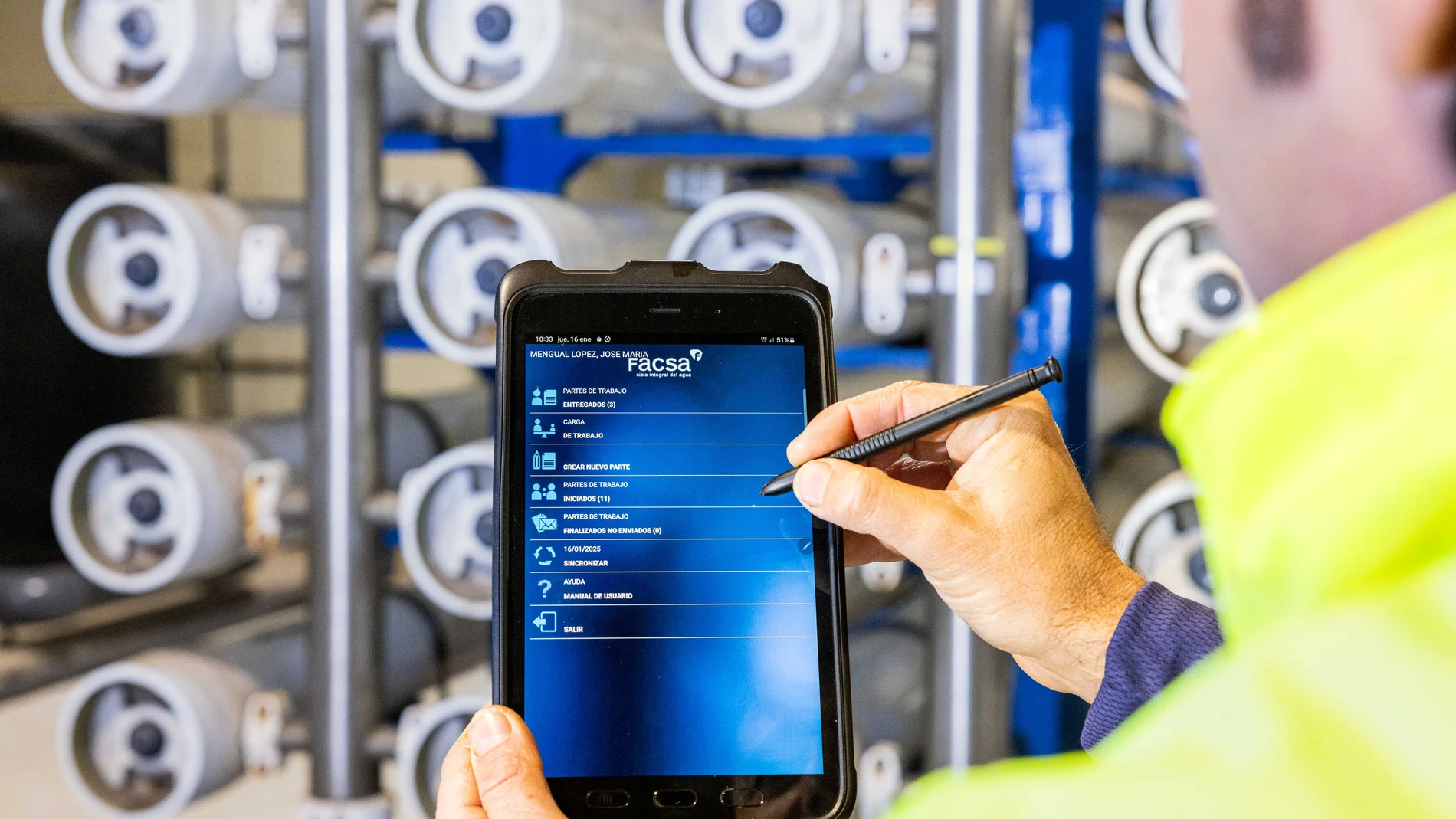
Facsa applies this type of solutions through sensors, remote control platforms and analysis systems that monitor the state of the networks in real time and warn of possible anomalies.
Predictive maintenance
Another line of innovation that is gaining prominence is predictive maintenance. Based on the analysis of historical data and the behavior of hydraulic systems, artificial intelligence makes it possible to estimate when a breakdown is most likely to occur in a pipeline, a pumping station or a treatment plant.
In this way, interventions can be planned before the problem appears, reducing costs, avoiding service interruptions and prolonging the useful life of the facilities.
This approach represents a significant change in water management, moving from a reactive model – acting when an incident arises – to a preventive strategy based on data.
In addition, digitalization also opens up new possibilities for dealing with extreme weather events such as torrential rains.
Among the most advanced tools promoted by the company are the so-called digital twins, virtual replicas of networks and hydraulic infrastructures that allow their behavior to be simulated in different scenarios. These models allow us to recreate the operation of supply networks or urban drainage systems and analyze how they would react to episodes of intense rain, floods or changes in demand.
Facsa uses hydraulic models and digital and advanced simulations to study in complete detail the specific behavior of infrastructures and evaluate possible flood scenarios, which makes it easier to plan mitigation measures and improve the management of critical facilities.
Technology to anticipate an uncertain climate future
Climate change introduces a new variable in water management: uncertainty. Traditional hydrological patterns, on which planning systems have historically been based, no longer fully reflect current climate reality. Therefore, it is essential to incorporate tools capable of anticipating risks and analyzing future scenarios.
In this context, companies like Facsa are promoting the integration of technologies such as the Internet of Things, big data analysis, predictive models or artificial intelligence to improve water management and reinforce infrastructure security.
The evolution of the sector points towards a model in which physical and digital infrastructures work in an integrated manner, allowing problems to be anticipated, optimization of resource management and preparation of cities for an increasingly complex climate scenario.