
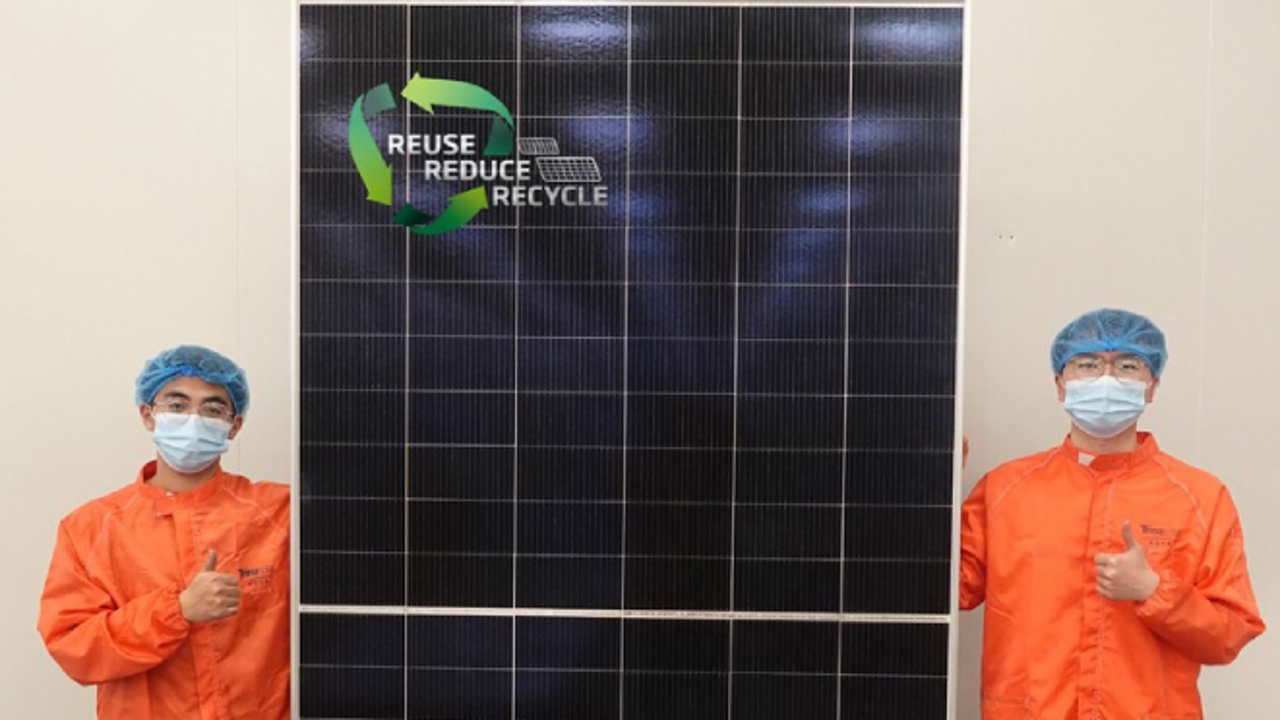
The Chinese company trinasolarspecializing in the production of solar panels, photovoltaic energy systems and energy storage solutions, has introduced what it claims to be ‘the world’s first fully recycled crystalline silicon module’. It is a solar panel with an efficiency of 20.7% and a power greater than 645W.
He Academy Research Center of Trinasolar has achieved this advance with self-developed recycling technologyusing materials including silicon, silver, aluminum frames and glass recovered from discarded modules, the company says in a statement.
Gao JifanPresident and CEO of Trinasolar and Director of the Central Research and Development Institute, said that the production of the world’s first fully recycled photovoltaic module is a demonstration of Trinasolar’s determination in promote sustainable development in the photovoltaic industry and contribute to the global energy transition.
Trinasolar has been successful in recycling all high-value material components of solar panels. This was achieved through a variety of techniques – Trinasolar has patented 37 recycling technologies to carry it out – which allow not only silicon and aluminum to be separated and reused, but also other valuable materials such as silver. These include the use of interlayer separation reagents, chemical etching technology, wet chemical silver extraction technology and others.
The recycled photovoltaic module uses the technology n-type TOPCon. This type of panels have fewer problems with manufacturing defects than those of type pmost common on the market, and have a greater resistance to degradation caused by light and temperature.
The technology, despite the achievement, still has room for improvement. The efficiency of 20.7% is below, although not by much, 25% achieved by conventionally manufactured TOPCon panels.
The European Union Waste Electrical and Electronic Equipment Directivepublished in 2012, requires that the 85% of waste panels are collected centrally and the 80% of materials are recycled.
The life cycle of a solar panel ranges between two and three decades of useperiod after which its performance degrades and it is necessary to replace it. With this advance, it will be possible to recycle a photovoltaic module in its entirety and reducing dependence on the extraction of new resources to manufacture them, a milestone for sustainability.