
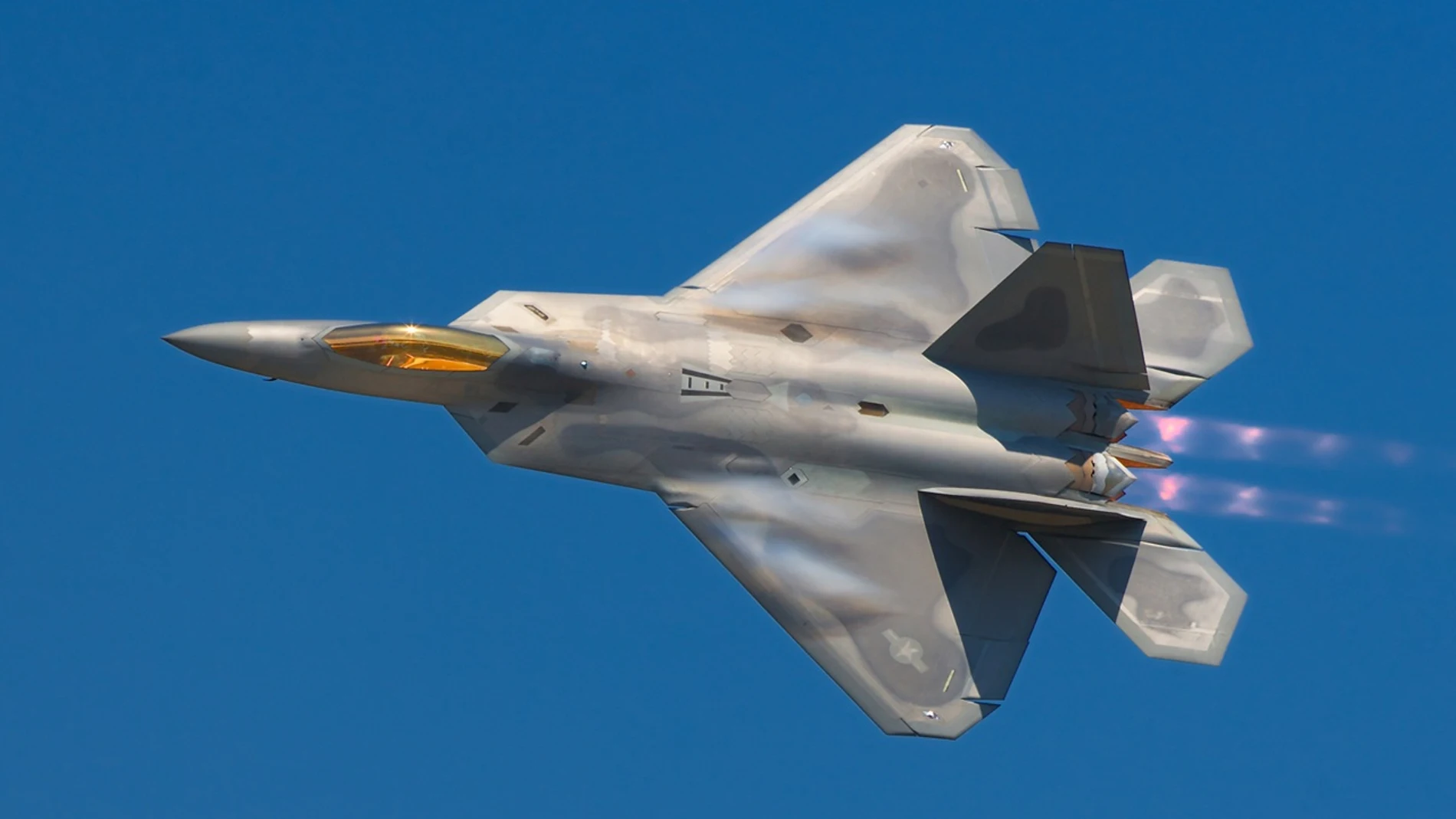
Chinese research has developed an artificial intelligence model optimized to operate with few resources and capable of recognizing the infrared signatures of the F-22 and F-35 stealth fighters. The work has been carried out by researchers from the Beijing Institute of Technology and the Chinese Airborne Missile Academywhich intend to install the model in the infrared vision systems of future air-to-air missiles, reports South China Morning Post.
The infrared signature is the pattern of thermal radiation that an object emits and that can be detected by specialized sensors. In a fighter it comes mainly from the exhaust gases, the engines and the heating of the structure when moving at high speed through the atmosphere. Its intensity and shape vary depending on the angle of observation, distance and environmental conditions.
Infrared guided missiles must not only locate a heat source, but determine what is causing it. Fighters can launch countermeasures such as flares that burn at very high temperatures to create multiple thermal targets and confuse the projectile. The missile seekerwhich is the set of sensors and processors responsible for tracking the target, You have just a few moments to decide if you are seeing the plane or one of those decoys.
The team trained their model with 3,245 images obtained through an infrared scanning system installed on a missile. The set included three categories of air targets, including Simulated representations of the F-22 and F-35, plus a loitering munition. This type of weapon can remain in flight until it locates a target and attacks it.
During laboratory tests, the model achieved a maximum accuracy of 97.1% in image classification. Another test focused on the objectives that represented the two fighters obtained a rate close to 90%. Researchers have not published results from tests with real aircraft because that information remains classified.
The main obstacle was not only getting the artificial intelligence to recognize the targets correctly but adapt the model to the limited calculation capacity, electrical consumption and space available inside a missile. A conventional deep learning model, made up of millions of parameters that adjust its operation, would require too many resources to operate within a compact projectile.
The researchers scaled the system down to with 16.1% of the parameters used by previous methods and reduced their calculation needs to 19.2%. They then developed a specific accelerator, a small processor optimized to execute the repetitive operations that artificial intelligence uses when analyzing each image.
Tests performed with this hardware achieved an accuracy of 96.4% and processed each image in approximately 1.5 milliseconds. The team also managed to limit total consumption to about 2.2 wattswhich would allow execute reconnaissance directly inside the missile without relying on external systems.
The results they do not demonstrate that Chinese missiles can identify and attack operational F-22 or F-35 in real conditions. The tests were carried out with simulated targets and decisive factors such as detection distance, behavior in bad weather or its resistance to more advanced countermeasures still remain to be known. The research does show how a compact system can harness the heat that even stealth planes are unable to completely hide.