
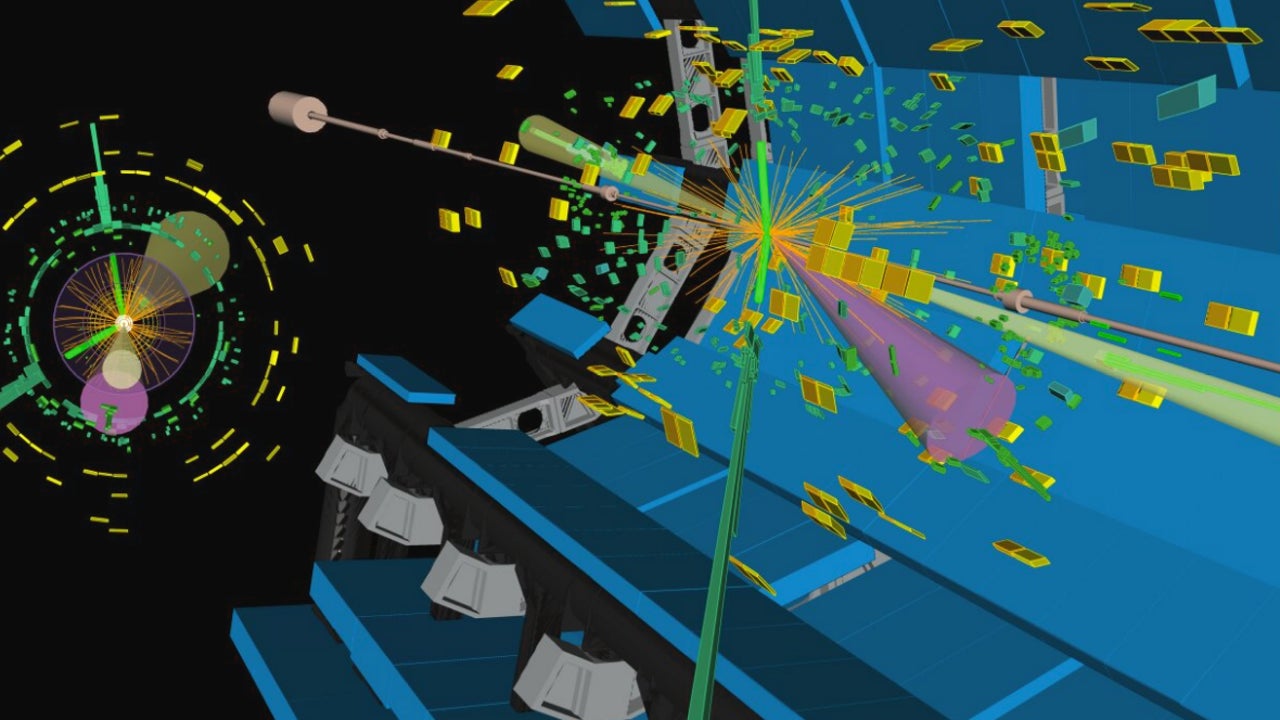
It was undoubtedly one of the greatest discoveries of science and CERN: the Boson of Higgs. But what exactly is this particle? We go in parts. The Higgs field is a theoretical energy field that is throughout the universe and He is responsible for giving mass to elementary particles. In this way, the particles gain mass by interacting with this field: the stronger the interaction, the heavier the particle is.
The Higgs Boson is the physical manifestation of the Higgs field, so to speak. Its existence was confirmed in 2012 in the great Hadron collider of CERN and is essential to understand why some particles have mass and others not … that is: Help explain why we have the basic components of matter as we know them. Without it, most particles would not have a mass and the universe would be very different.
The problem is that Higgs boson is inherently unstable and does not exist for much time in nature. It disintegrates in other more stable particles. But he does not do it in A specific order: some are strangest than others. And there are very, very rare.
These disintegrations, in which the Higgs boson is transformed into a couple of muons (h→μμ) or in a boseithern z and a photoeithern (h→Zγ), are so scarce that only occur in one of every few thousand bos disintegrationseitherN Higgs.
Now, a New study I could give Keys for the discovery of unknown particles and help us reveal the various mysteries associated with “the particle of God.”
Discovering these rare disintegrations was not easy. The Atlas collaboration, a group of scientists who work in the Great Hadron Collider (LHC) of CERN, dedicated years to collecting data from their experiments. The first challenge they faced was the rarity of these events.
Higgs boson disintegration in Mones It occurs only in approximately one in 5000 disintegrations of the hyggs. Therefore, the team had to look for a tiny sign in the midst of a great background noise caused by the interactions of other particles.
To optimize the search, scientists combined data from executions 2 and 3 of the LHC, which provided them with a more complete image. With these improved data, the authors of the study They used advanced techniques to filter background noise and focus on the events that showed indications of the rare disintegrations of Higgs.
In the case of H→μμthey looked for a littleñTo protuberance in the mass of the pair of muons, just to 125 GEV, the known mass of the Higgs. On the other hand, the disintegrationeithern h→Zγ presenteither A challenge aorn greater. New mandall to improve the sensitivity of BorSqueda del Bosón Z that occurs in this disintegration only disintegrates in pairs of electrons or muons approximately six percent of the time, and photons are notoriously difficult to distinguish of particle jets created in other processes.
In this context, Atlas developed new analysis methods to improve the sensitivity of its search. When categorizing the events according to the way in which the Higgs occurred and refine its selection criteria, the team could observe a clearer signal.
And the work paid off: for disintegration h→μμthey achieved a significance of 3.4 deviations esttoNdndar, what It means that it is very unlikely (one between 3000) that the result is a casualtyYoStica
This represented a significant improvement with respect to above results, which only showed an indication of disintegration at a level of two standard deviations. For disintegration H→Zγthe team foundeither one señat excessive with 2.5 deviations esttondndar, what alsoandn representeither An important advance in comparisoneithern with previous results.
These advances couldYoto have large -scale implications. Upon discovering rare disintegrations, collaborationeithern atlas Open the door to the explorationeithern of physics beyond the standard model. Unknown particles that contribute to disintegration h→Zγ couldYoto be an indication of an fYosica aorn unexplored.
However, there are still challenges. While these results are innovative, they are not yet definitive. Facing the future, Atlas researchers plan to deepen the rare disintegrations of Higgs with even more data from future LHC executions.
The team expects future data not only to confirm these findings, but also reveal more details about how Higgs interacts with other particles, especially those that have not been studied so much, as second generation fermions.