
When traveling, time (climatic and chronological) is key. It determines everything from what we can do, what we carry with us, to what we experience and how we remember it. The rest is debatable. And staff. That is why one of the essential elements is the luggage we carry.
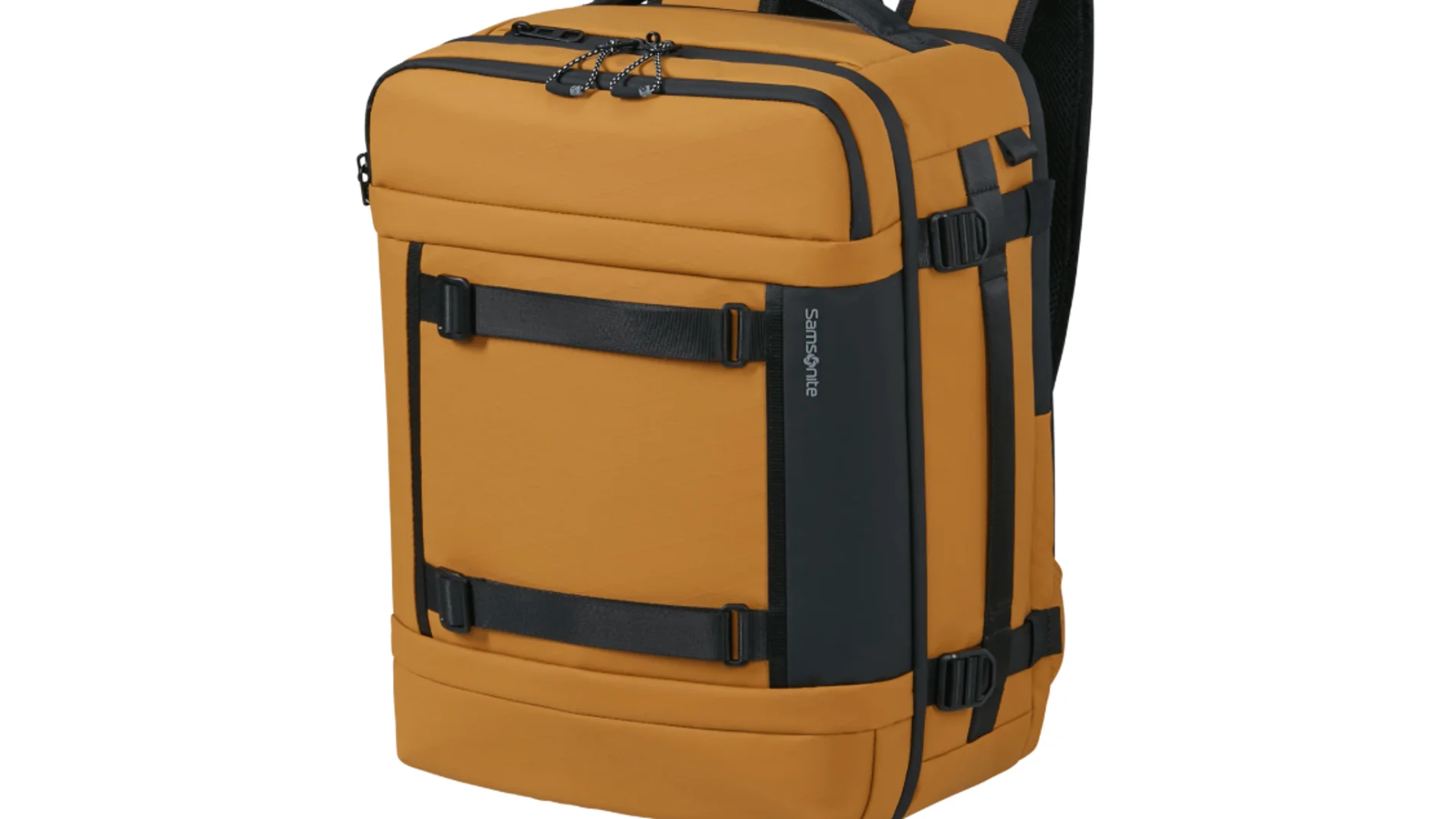
After analyzing the Samsonite Cabin Pack, there are two features that stand out. There is something almost invisible but crucial in its design: the dimensions are not coincidental. The 40 × 30 × 20 cm format is designed to fit exactly into what airlines consider free under-seat luggage. And it’s no coincidence: it’s logistics engineering. Modeling a backpack based on airline regulations means converting centimeters into freedom. Less billing, less waiting, less friction. And that, on a short trip, is gold. Or time. It is not surprising that several of the most “picky” airlines in this regard have approved it to carry on board. Paradoxically, it is a baggage with which we take a weight off our shoulders.
The Cabin Pack also behaves more like a small suitcase than a traditional backpack. Its rectangular structure maximizes volume (29 liters in the compact model and 56 in the large model) and allows loading to be organized with almost surgical logic.. It’s not so much “packing things” as putting together a small portable travel system.
But where this backpack becomes especially interesting is in the material. Mainly if we take into account that it will not only go on board, but due to its capacity it can become our primary (and only) luggage with the demands that this entails. The outer fabric is made with 100% recycled PET from post-consumer waste, and the interior reaches at least 95%. This It’s not just an eco-label: it’s a materials engineering decision.
PET (polyethylene terephthalate) is the same polymer that we find in plastic bottles, but transformed into textile fibers It has very specific properties. It is light, resistant to traction, relatively waterproof and, above all, stable against mechanical fatigue. Translated into real use: it withstands continuous rubbing, pulling, temperature changes and the compression typical of traveling.
Unlike other fabrics, PET maintains its structure even after thousands of loading and unloading cycles. It is not indestructible (no material is), but it is optimized for a very specific type of wear: that of the frequent traveler.
This shows that recycling does not imply fragility. In fact, in many cases the opposite is true. The process of converting recycled PET into fiber allows controlling the molecular orientation of the materialwhich improves its resistance and consistency against daily use. In other words, this backpack tells a double story.
On the one hand, it is an extremely practical object: it fits into the cabin, optimizes space, avoids costs and simplifies the trip. On the other hand, it is an example of how design is beginning to integrate sustainability without sacrificing performance. In a nutshell: We are facing a new hybrid in the travel industry, one that combines compatibility with resistance.