
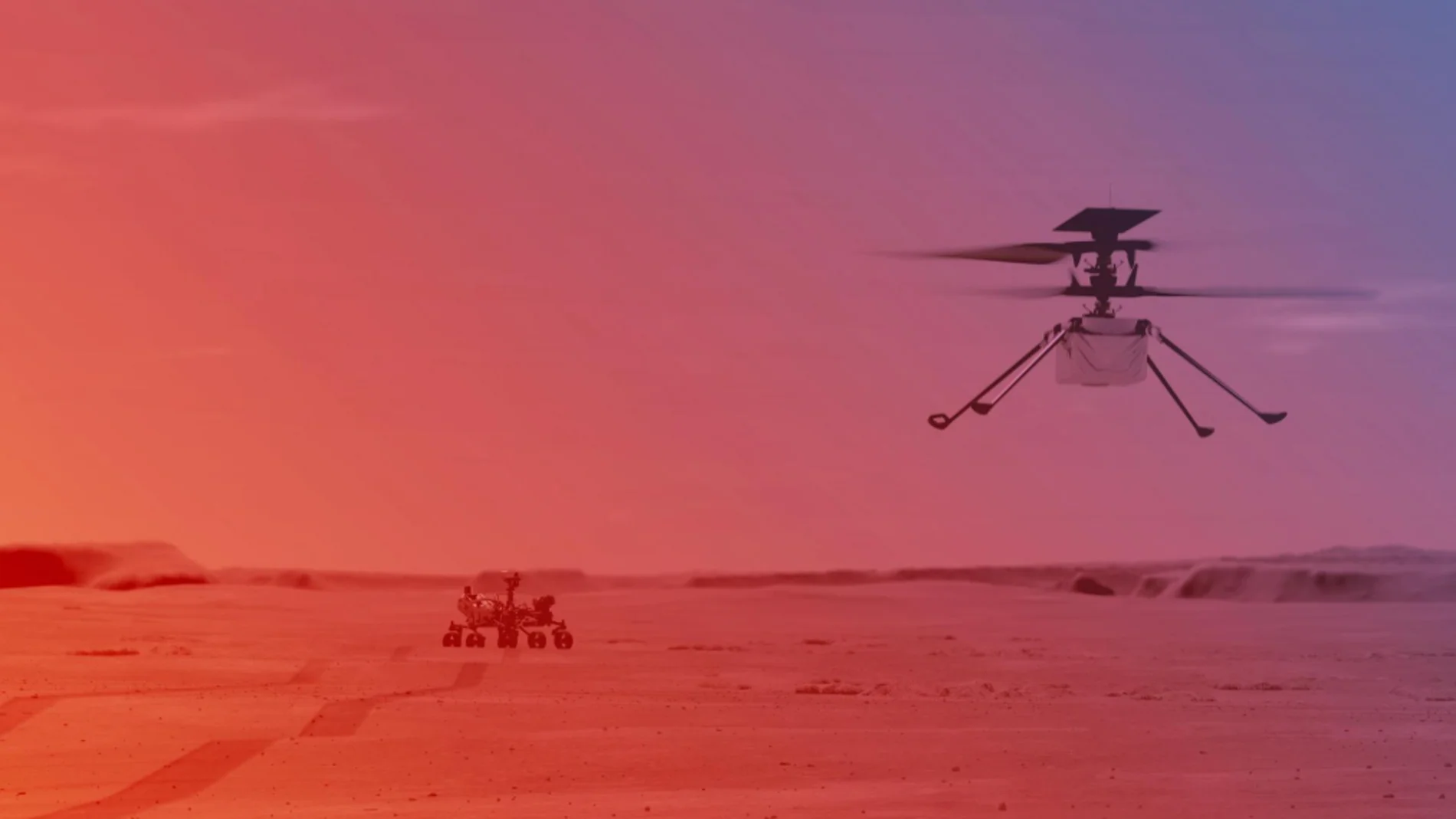
On Mars, breaking the sound barrier doesn’t produce a cinematic boom. There are no spectators, no blue skies, no shock waves sweeping through cities. There is something much stranger: a set of blades spinning in an atmosphere so thin that flying there already seemed almost impossible. And still, NASA has just gotten its new Martian helicopters to exceed Mach 1.
The US space agency has announced that the propellers of its next generation of Mars aircraft managed to exceed the speed of sound during a series of tests carried out at the Jet Propulsion Laboratory (JPL) in California. They did it inside a special chamber capable of recreating the extreme conditions of the red planet: an atmosphere composed almost entirely of carbon dioxide and just 1% of the density of Earth’s air. And that is precisely where the real challenge lies.
On Earth, a helicopter can sustain itself because its rotors push large amounts of air downward. On Mars, however, there is hardly any air to push. It’s like trying to swim in fog. That’s why the small Ingenuity helicopter, which In 2021 he made the first controlled flight on another planet, he needed to rotate his propellers at extreme speeds just to remain stable for a few seconds on the Martian soil. But future missions want much more.
NASA no longer seeks to simply demonstrate that flight is possible, but build aircraft capable of transporting scientific instruments, traveling great distances and exploring areas inaccessible to rovers. And for that, more support is needed. More strength. More speed.
“Flight on Mars is probably one of the most difficult things you can do,” says Al Chen, head of the Mars exploration program at JPL. The atmosphere is incredibly thin, but Mars still has significant gravity”.
The solution is to take the propellers to the physical limit of the Martian air. During tests, engineers spun the rotors until they reached Mach 1.08. That is, 8% above the local speed of sound on Mars. And here appears another fascinating oddity: sound travels slower there than on Earth. While at sea level on Earth Mach 1 is equivalent to approximately 1,225 kilometers per houron Mars it is around 870 km/h due to the extreme cold and the composition of its atmosphere. It may seem like a minor difference, but it completely changes the aerodynamics.
On Earth, approaching Mach 1 generates chaotic turbulence and unpredictable forces. Ingenuity program engineers deliberately avoided getting close to that limit because any unexpected gusts could destabilize the blades. In fact, During Ingenuity’s 72 flights they never allowed the rotor tips to reach supersonic speeds. Now they have done it. And without the propellers disintegrating.
To achieve this, the team used new designs manufactured by AeroVironment and performed 137 different tests inside JPL’s Mars simulator. In some phases, they even reinforced the chamber with metal panels in case the blades exploded during the experiment. The result was an approximately 30% increase in lifting capacity. Translated: Future Martian helicopters could carry larger batteries, more complex scientific instruments, and travel much greater distances. Something that completely changes the exploration of the red planet.
A rover is slow. You must avoid rocks, slopes and dunes. A helicopter, on the other hand, can fly over canyons, volcanoes, lava tubes or regions that are impossible to reach by land. It could also act as an advanced explorer for future human missions, searching for safe routes or ice deposits hidden beneath the surface.
NASA is already studying projects like SkyFall, a conceptual mission based on small autonomous helicopters capable of being deployed on Mars to explore the terrain from the air. In some ways, Ingenuity was just the Martian equivalent of the Wright brothers: a humble demonstration that flight was possible. What comes next is more like the birth of extraterrestrial aviation.
Because until very recently, the idea of breaking the sound barrier on another planet belonged almost entirely to science fiction. Today it happens inside a metal chamber in California, while propellers spin in an artificial atmosphere that imitates the thin air of Mars. We haven’t set foot on Mars yet, but we’re already learning to fly there.