
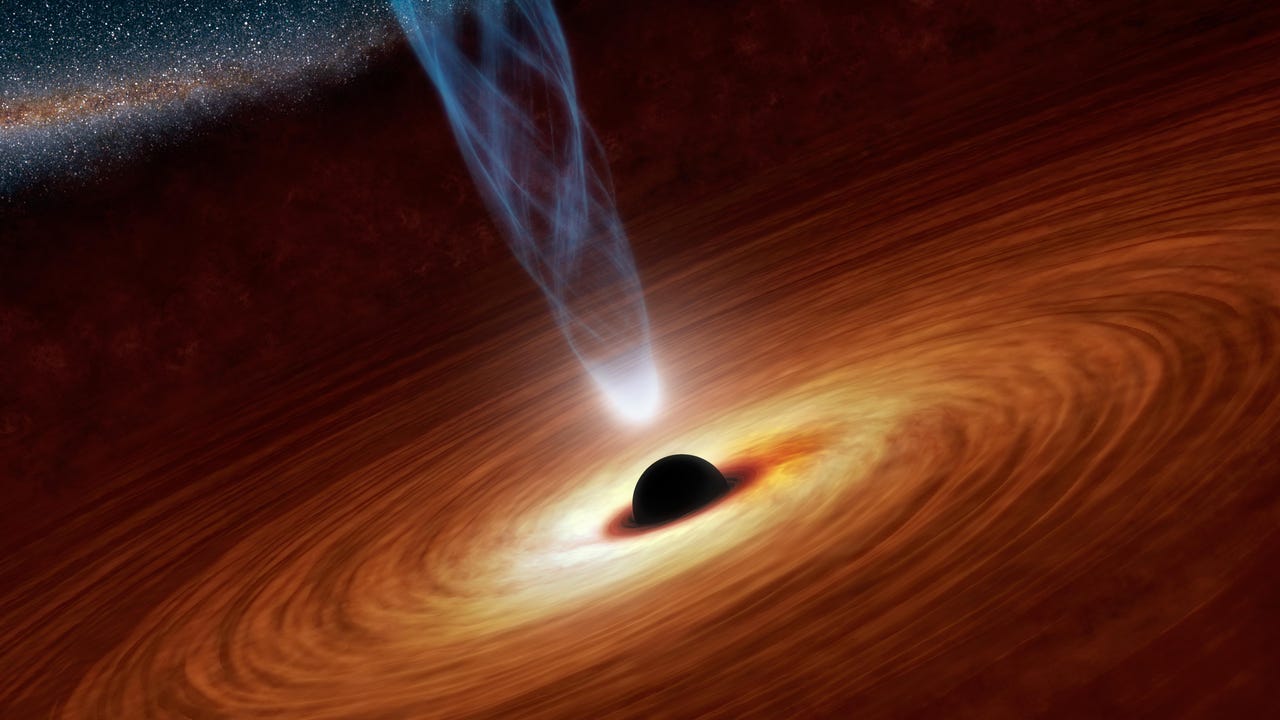
They are one of the most mysterious objects in the universe: black holes. There end the known laws of physics and space/time becomes an “umbrella” under which we could go down to the future or disappear completely at the speed of light. Or even faster. Unfortunately, we cannot visit them: if we get too close to them, “swallow” and we don’t know what happens next.
Therefore, A trip to a black hole looks like science fiction, but for the astrophysicist and expert in black holes Cosimo Bambi, the idea is not so far -fetched. Your proposal? A spacecraft, not heavier than a clip, propelled by a laser beam and that precipitates through the space at the speed of light towards a black hole, with the mission of exploring the very structure of space and time and testing the laws of physics.
In a study published in Isncence, Bambi describes the plan to make this interstellar trip a black hole. To succeed, This mission of a century could provide data from nearby black holes that completely alter our understanding of general relativity and the laws of physics.
“Right now we don’t have technology -says Bambi -but In 20 or 30 years, we could have it”
The mission is based on two key challenges: Find a black hole close enough as to be detected and Develop probes capable of supporting the trip. The previous knowledge about the evolution of the stars suggests that there could be a black hole stalking only 20 or 25 light years of the earth, but finding it will not be easy, explains the study.
Since black holes do not emit or reflect light, they are practically invisible for telescopes. Instead, Scientists detect and study them based on how they influence nearby stars or distort the light.
“New techniques have emerged to discover black holes -explains Bambi -I think It is reasonable to expect that we can find a nearby one in the next decade”
Once the objective is identified, the next obstacle is to reach it. Traditional spacecraft, propelled by chemical fuel, are too rough and slow to make the trip. Bambi points out The nanonaves (grams scale that consist of a microchip and a light candle) as a possible solution. The terrestrial lasers would bombard the candle with photons, accelerating the ship to a third of the speed of light.
At that rate, The ship could reach a black hole at a distance of 20 to 25 light years in about 70 years. The data collected would take another two decades to reach the Earth, which would raise the total duration of the mission to about 80 to 100 years.
When the ship is near the black hole, scientists could perform experiments to answer some of the most urgent questions of physics. Do you really have a black hole, a horizon of events, the limit beyond which not even the light can escape its gravitational attraction? ¿The laws of physics change near a black hole? Is the theory of Einstein’s general relativity in the most extreme conditions of the universe?
Bambi points out that only The development of the lasers would cost today around a billion eurosand technology to create a Nanonave does not yet exist. But in 30 years, costs could go down and technology could catch up with these bold ideas.
“It may seem crazy, and in a sense, almost science fiction -confirms Bambi -. But they said we would never detect gravitational waves because they are too weak. We did it, 100 years later. They thought we would never observe the shadows of black holes. Now, 50 years later, we have images of two. ”A shame that we are not to see it.