
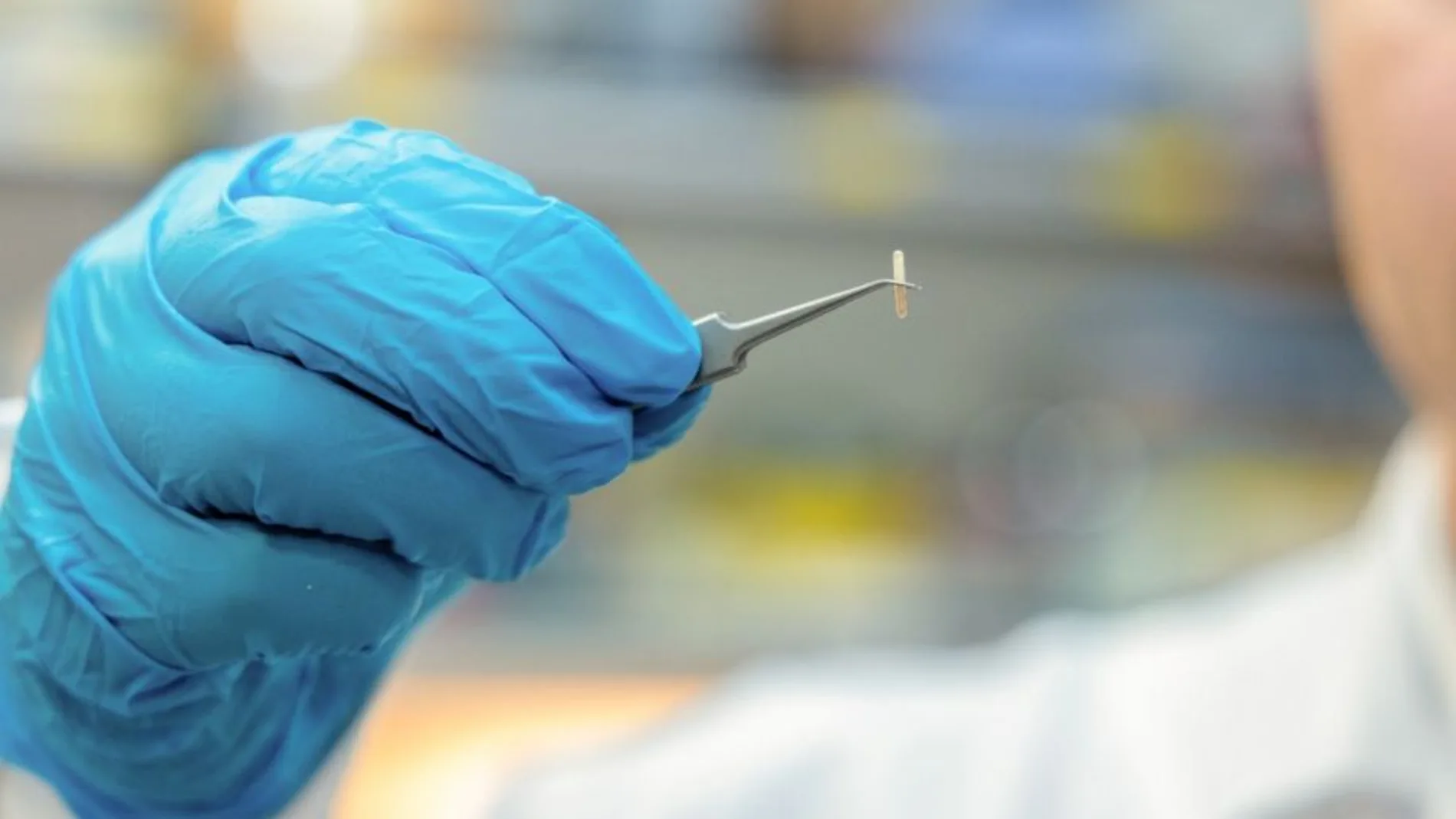
Pain can become a presence that occupies everything: it disrupts sleep, makes walking difficult, affects work and ends up modifying daily life. In Spain, one in four adults lives with chronic pain, according to data from the Ministry of Health. Now, a device the size of a small seed proposes a new way to intervene on the nerves that transmit the body’s electrical signals. It is inserted through a needle, works without a battery and receives energy from outside the body. Its objective is to offer a less invasive alternative to modulate nervous activity, a strategy that could open new possibilities in the treatment of persistent pain.
The device, developed by scientists at New York University Abu Dhabi in collaboration with Cleveland Clinic Abu Dhabi, is described in a study published in Science Advances. Baptized as SEED (seed in English), is the acronym for Stimulating Electrode for Electroceutical Delivery (Stimulation Electrode for Electroceutical Therapies)measures approximately 9 millimeters long and 1.4 in diameter. Its dimensions allow it to be inserted through a standard medical needle, without the need to resort to surgery to place it.
The idea is based on a simple premise: if nerves transmit information through electrical signals, It is possible to intervene on this communication using controlled impulses. Peripheral nerves function as communication pathways between the brain, spinal cord, and the rest of the body. They carry sensory information, including information related to pain, and also commands that allow muscles to move. Modulating its activity can help treat certain disorders, as long as the stimulation reaches the appropriate fibers.
“This device represents a change in our way of thinking about the treatment of nerve-related diseases,” explains Khalil Ramadi, leader of the study, in a statement – by creating a device that can be injected rather than surgically implanted.we make these therapies simpler, safer and more accessible, while maintaining precise control over nerve activity.”
The main novelty of SEED is how it receives energy. Instead of incorporating a battery, it uses an inductive coupling system: an external coil generates a variable magnetic field that allows the small implant to be powered. The device converts that energy into electrical impulses capable of stimulating the nearby nerve. The signal is generated and controlled from outside the body, so that parameters such as the frequency, duration and intensity of the pulses can be adjusted.
The system works at a frequency of 65 kilohertz, a choice that allows energy to be transferred through the magnetic field through the tissues. The design also incorporates platinum-iridium electrodes arranged in a spiral, designed to guide the stimulation along the nerve and limit signal dispersion to nearby tissues. Another advantage is that The device can be located using common imaging techniques such as ultrasound and computed tomography. This would make it possible to guide its placement and then check where it is located, an important aspect when trying to act on a specific nervous structure.
But does it work? Ramadi’s team has carried out laboratory tests, experiments with biological tissues and animal trials. In the latter, the scientists introduced the device near the sciatic nerve of anesthetized rats and verified that they could activate it from the outside. The stimulation produced motor responses synchronized with the electrical impulses, and the intensity of the response could be modified by adjusting the signal parameters.
“This technology has the potential to close the gap between non-invasive therapies and traditional implants – concludes Mohamed Elsherif, co-author of the study -. It opens the door to treatments that are both effective and easy to administer, which could considerably improve patient care.” The goal, in short, is to combine the ability to act on specific nerves with simpler, less invasive placement.
The new device is still far from becoming an available treatment. Experiments have not shown it to reduce pain in humans, nor have they established its long-term safety and effectiveness. Before reaching clinical practice, it will be necessary to check, among other issues, how the implant behaves for prolonged periods and whether it can reliably stimulate the chosen nerves in patients.
If it passes those stages, SEED could expand options for neuromodulation, a family of treatments that uses electrical signals to modify the activity of the nervous system. Its small size and absence of battery or implanted leads offer a promising avenue to simplify the administration of these therapies. It is not yet a solution against chronic pain, but it is a step towards a medicine capable of intervening in nervous circuits. with increasingly smaller devices.