
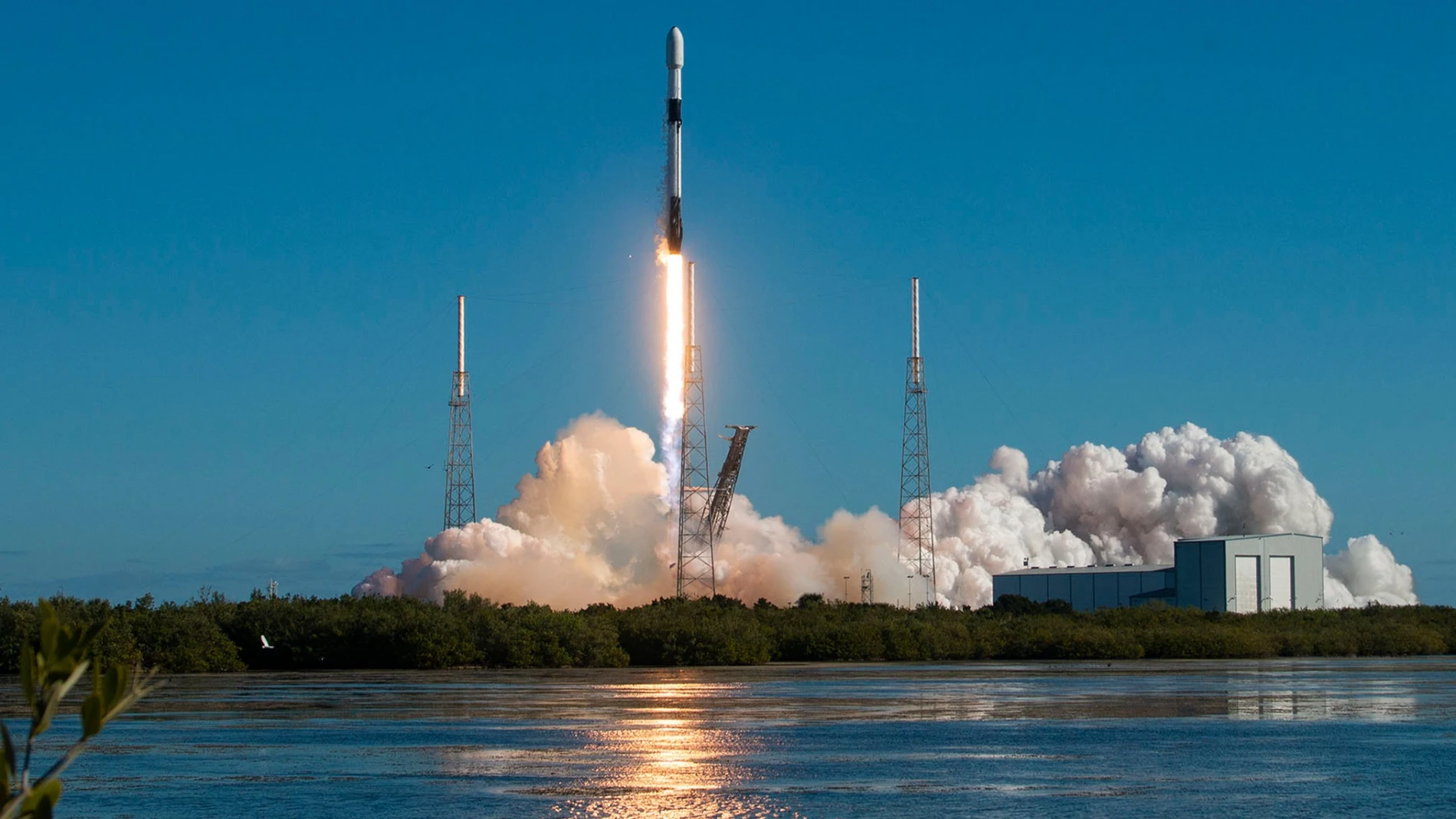
Project Pluto is a project, known among astronomers, that offers software tools such as Find_Orbwidely used to track near-Earth objects. Your developer, Bill Grayamateur astronomer and specialist in orbit determination and object tracking, has published a report on the impact on the lunar surface that is expected to next August 5 at 8:44, Spanish peninsular time. This is not a scheduled mission, but rather the upper stage of a SpaceX Falcon 9 rocket launched in early 2025 and that it should have had another destiny.
At that time, the Moon will be visible from much of the American continent, but Gray points out that the effects of the crash will be too faint to be observed with telescopes from Earthreports Space.com. The Falcon 9 rocket’s upper stage measures 13.8 meters tall and has a diameter of 3.7 meters. Since the Moon has no atmosphere, it will impact the lunar surface intact.
Gray has told the media that he and other astronomers are sure that this object is the second stage of the Falcon 9 rocket that launched two lunar modules, Blue Ghost of Firefly and Hakuto-R of ispaceon January 15, 2025. After the payload was launched, the two modules, the fairing that protected the payload, and the upper stage that had transported them were tracked. Both modules reached the Moon, although only Blue Ghost managed to land successfully, and the fairing re-entered the Earth’s atmosphere..
‘The upper stage, 2025-010Dalso continued to orbit the Earth, but It was a little higher and did not reenter. It has had some close passes by the Moon and Earth, but none close enough for a possible impact. Asteroid surveys observed it whenever it was not too close to the Sun or Moon to be seen. As of February 26, 2026, we had accumulated 1,053 observations of her‘ says Gray.
The astronomer estimates that the upper stage will be moving at 2.43 km per second, 8,690 km/h, seven times the speed of sound, when it hits the Moonin the vicinity of the crater Einsteincreating a new one as a result of the crash.
It will not be the first time that an event of this type has taken place. Four years ago, on March 4, 2022, the upper stage of the Chinese mission Chang’e 5-T1 It also crashed on the Moon. The third stage of the rocket Long March 3Cwhich has a mass, without fuel or payload, of 3 tonsleft a double crater, 28 meters the largest, as later observed by the Lunar probe Reconnaissance Orbiter. The mass of the second stage of the Falcon 9, under the same conditions, is almost four tons, 3,900 kilograms.
On that occasion, it was initially doubted whether the object could correspond to a SpaceX rocket, but Gray says that There is no doubt that this object is the upper stage of the Falcon 9 because it has been tracked since its launch.
The event highlights one of the many risks facing the development of a lunar base, something sought by both USA as China. To mitigate this, it would be necessary for launch companies to reserve some fuel for place these stages on a trajectory that prevents them from impacting the Earth or the Moon. For the safety of future operations on the Moon, this should become standard operating procedure.