
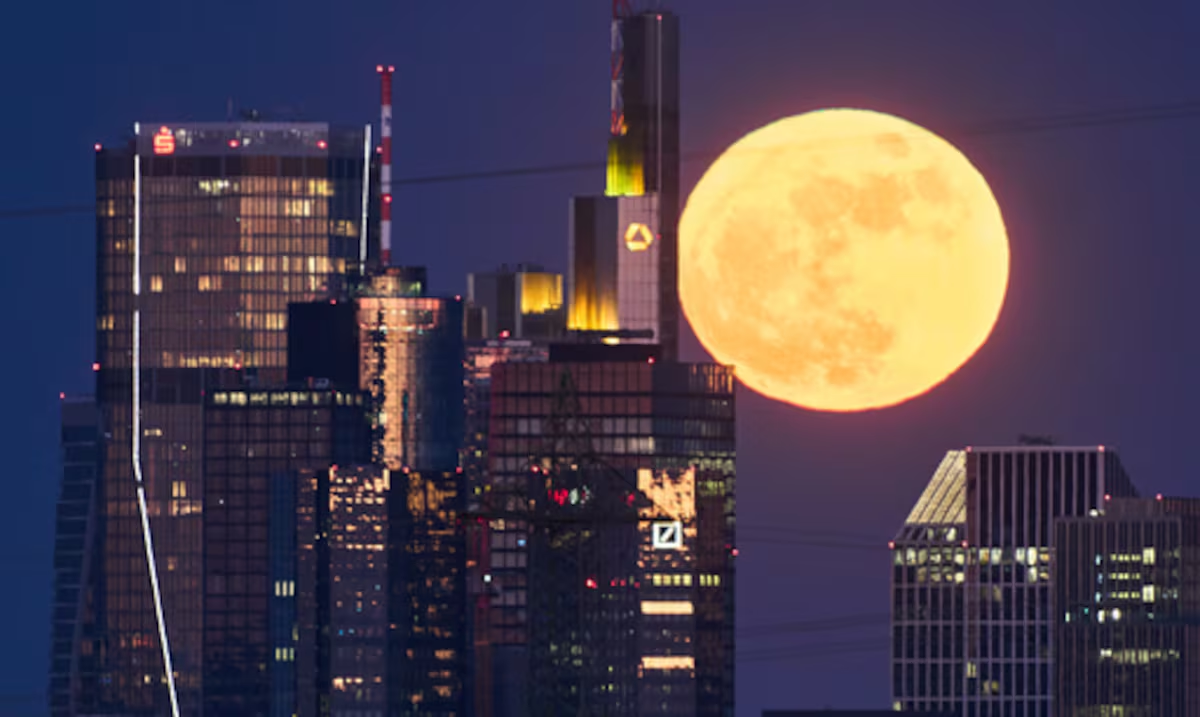
Cape Canaveral – Get ready for a rare micro blue moon this weekend, a blue moon that is also the most distant and smallest-looking full moon of the year.
Bonus: bright star Antares will bombard Sunday’s show for a heavenly three-for-one.
A blue moon occurs every two or three years, when a second full moon is squeezed into a single month. On May 1st the first full moon of this month occurred.
Since the Moon’s orbit is not a perfect circle, the next full moon will be farther from Earth than usual, at a distance of 252,360 miles (406,135 kilometers), making it appear a little smaller and fainter. It’s the opposite of a supermoon, when a full moon comes closer to us than normal. The most recent supermoon, for example, was just 225,130 miles (362,312 kilometers) away.
Gianluca Masi of the Virtual Telescope Project, which will offer a live broadcast from Italy, explained that Sunday’s micromoon will appear 6% smaller and 10% dimmer than an average full moon, “differences subtle enough to go unnoticed by most observers.”
The scene will be especially exciting south of the equator, across the Pacific.
For stargazers in Argentina, Chile, New Zealand, eastern Australia, parts of Antarctica and a handful of other islands, Antares will temporarily disappear as the blue micromoon passes in front of it.
1/18 | From the silence of space: Artemis II reveals stunning images of Earth. This image provided by NASA shows a view of Earth captured by NASA astronaut and Artemis II commander Reid Wiseman from the window of the Orion spacecraft after completing the translunar injection maneuver. – NASA via AP
The red supergiant star, located 550 light years away, is known as the “heart of scorpion” in the constellation Scorpio. One light year is equivalent to almost 9.7 billion kilometers.
There will be no disappearing act for those looking up anywhere else in the world, with Antares constantly visible next to the full moon.
And despite the name, this blue moon won’t look turquoise, sapphire, or any other shade. The term simply refers to the infrequent appearance of two full moons in one month.
This story was translated from English to Spanish with an artificial intelligence tool and was reviewed by an editor before publication.