
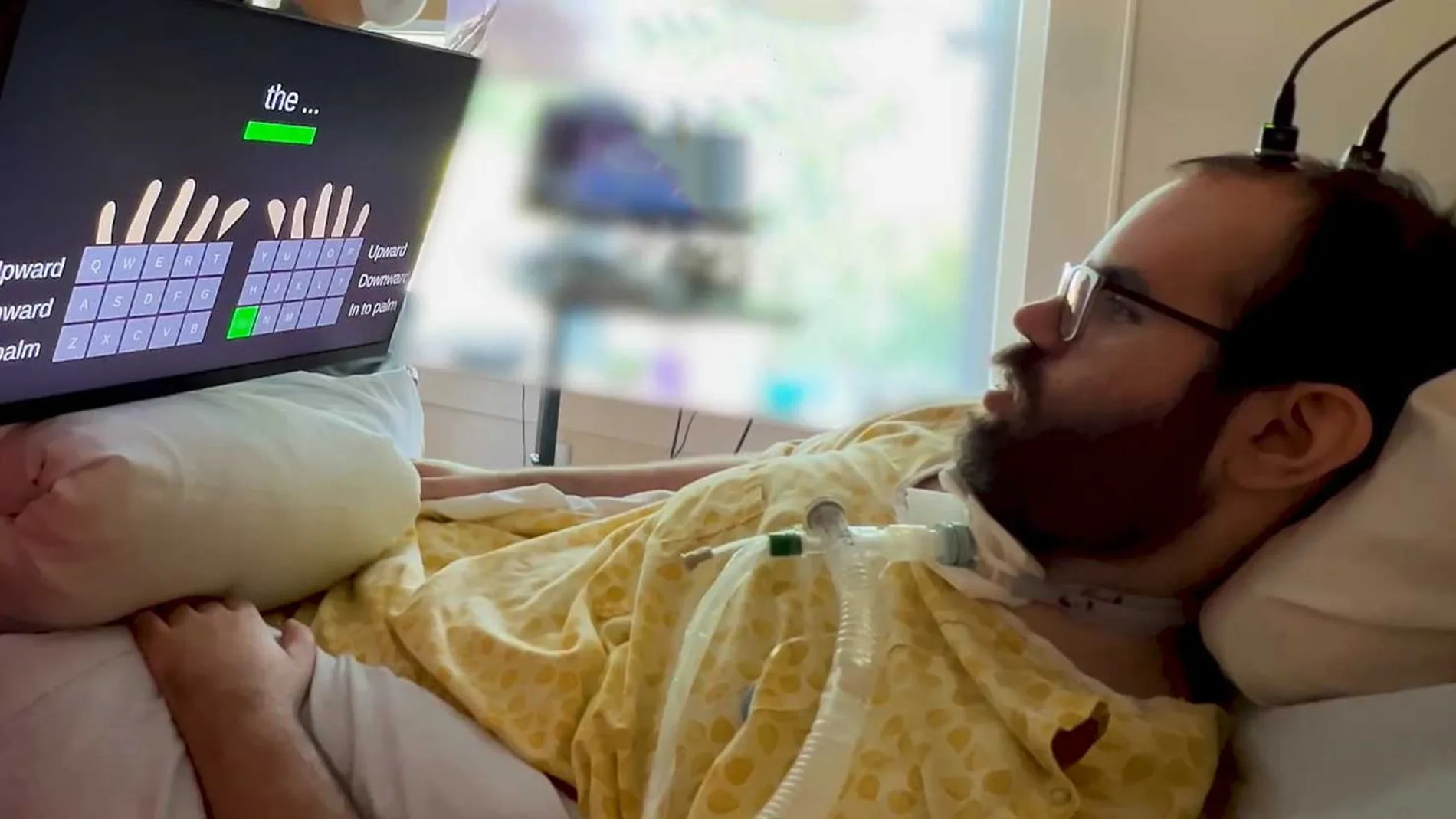
The loss of the ability to communicate is one of the most devastating consequences that paralysis has for people who suffer from it, but now American neuroscientists have developed a new method so that they can write by typing with their mind. A study by researchers from Mass General Brigham Neuroscience Institute and of the Brown University describes an investigational implantable brain-computer interface (iBCI) writing neuroprosthesis that can restore communication quickly and accurately. The tool, which uses the QWERTY keyboard and imagined finger movementsworked well with two participants in the clinical trial, one with amyotrophic lateral sclerosis (ALS) and another with a cervical spinal cord injury. Their results are published in Nature Neuroscience.
‘For many people with paralysis, when they lose the use of both their hands and speech muscles, communication can become difficult or impossible. People with severe speech and motor impairments often end up depending on technologies such as eye trackingspelling words, one letter at a time, using an eye-tracking system. These systems are too slow for many users. Patients often find the use of this and other types of augmentative and alternative communication systems frustrating. Brain-computer interfaces are on their way to becoming an important new alternative to what is currently offered‘ said senior lead author Daniel Rubin, a critical care neurologist at the Neurotechnology and Neurorecovery Center from the Mass General Brigham Neuroscience Institute.
Communication devices for people with paralysis have been problematic for many years. Patients often describe them as slow, error-prone, and difficult to use; some people even abandon them altogether. This gap between what is available and what is necessary is what motivates BrainGatea team of neurologists, neuroscientists, engineers, computer scientists, neurosurgeons, mathematicians and other researchers from several partner institutions working together to create better communication and mobility tools for people with neurological diseases, injuries or limb loss.
‘Since 2004, our BrainGate team has advanced and tested the feasibility and effectiveness of implantable brain-computer interfaces in restoring communication and independence to people with paralysis. The BrainGate consortium demonstrates the strength of academic and university researchers working together, thinking about what is possible and then pushing the boundaries of restorative neurotechnology. And, in doing so, we make it much easier for the industry to create the final form of implantable medical devices for our patients‘, says the co-author Leigh Hochbergresponsible for the clinical trial and director of the same center to which Rubin belongs.
BrainGate’s new iBCI writing neuroprosthesis uses microelectrode sensors placed in the motor cortexa part of the brain that controls movement. A QWERTY keyboard is then displayed in front of the participant, with each letter assigned to fingers and finger positions (up, down, or flexed). When the participant intuitively attempts these finger movements, the electrodes detect the brain’s electrical activity and send a signal to a computer system capable of translating that neural activity into letters.. That output is then processed using a predictive language model to ensure a consistent and accurate communicative result.
The two clinical trial participants, one with advanced ALS and the other with a spinal cord injury, were able to use this new iBCI writing neuroprosthesis to communicate quickly and accurately. The participants They calibrated their devices with just 30 sentences; one of them managed to reach a maximum writing speed of 110 characters, or 22 words per minutewith an error rate per word of 1.6%. That’s on par with the writing accuracy of a person without motor disabilities. Additionally, both participants used the device from the comfort of your own homedemonstrating its potential for translation into clinical practice and home use in the future.
‘Decoding these finger movements is also a big step towards the possibility of restoring complex reaching and grasping movements in people with upper extremity paralysis. And there is also room to improve this communication tool, for example by implementing a stenography system or a personalized keyboard to make typing even faster. Our brain-computer interface is a great example of how modern neuroscience and artificial intelligence can be combined to create something capable of restoring communication and independence to people with paralysis,’ says Justin Judea postdoctoral researcher at Mass General Brigham and also a co-author of the study.
This advance is added to others, such as the one achieved by Neuralink in 2024 with Noland Arbaugh. The patient, with tetraplegia, managed control the cursor of a computer, play video games and write with the implant developed by Elon Musk’s company. The difference is that, while Arbaugh moved the cursor with his mind on a virtual keyboard, the BrainGate system decodes attempted finger movements on the keyboard.