
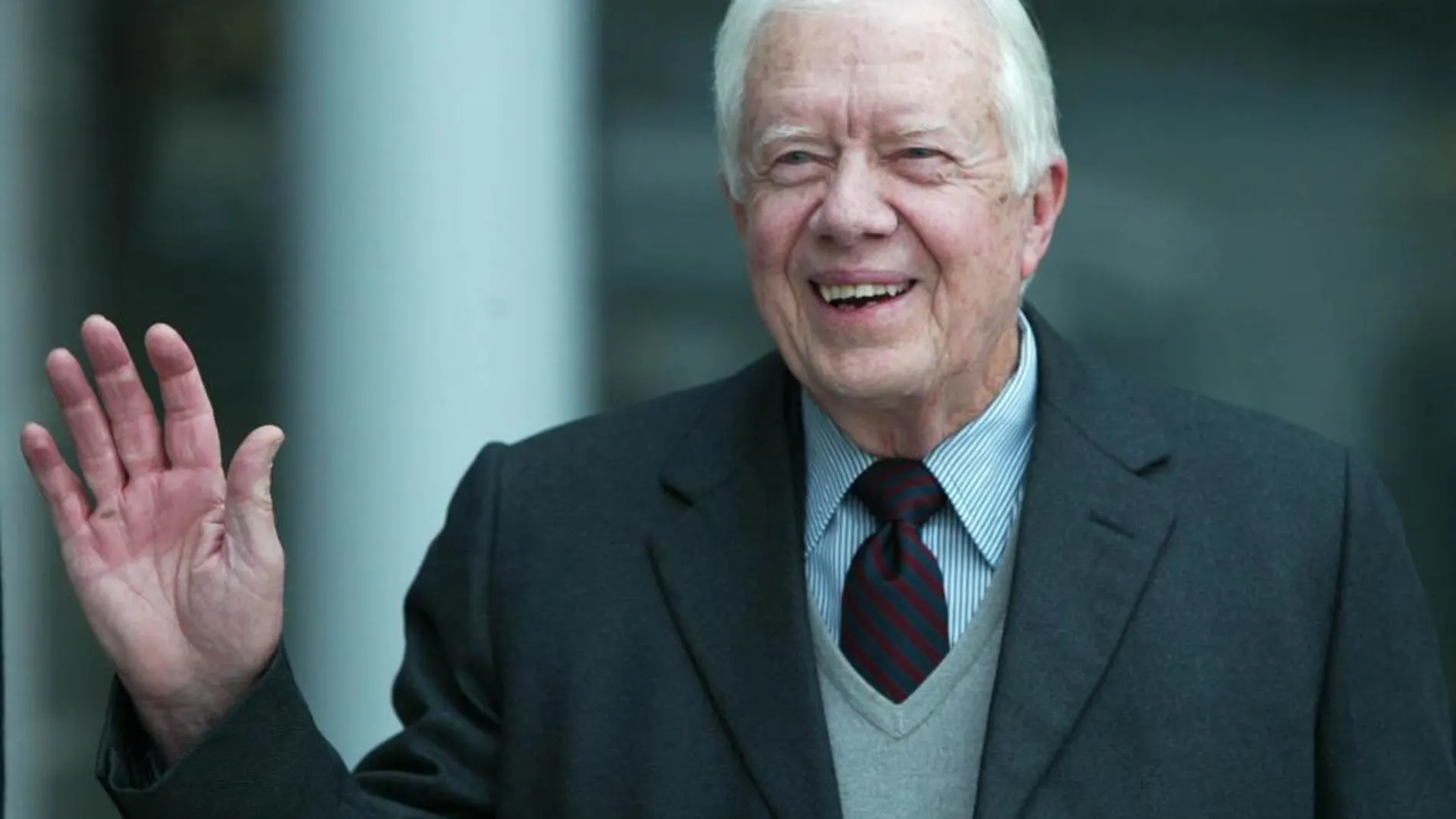
Born into a family of farmers, Jimmy Carter became the 39th president of the United States. Known for his dedication to offering peaceful solutions to international conflicts and for the economic and social development he carried out in the North American country, the politician and humanist received the Nobel Peace Prize in 2002. A work that continued, posthumously, as in the case of Jack Nicholson, thanks to the purchase of the farm where he had grown up since childhood.
Despite his arrival at the White House in January 1977 and remaining there until 1981, the representative of the Democratic Party never forgot his origins. Before devoting himself to politics, young Carter had worked alongside the rest of his brothers on the family farm located in the state of Georgia. This had been acquired by his relatives in the 20th century and in it They lived through hard times like the Great Depressionwhere they lacked electricity and running water.
However, as he recounted in his memoirs ‘An Hour Before Dayligh: Memoir of a Rural Boyhood’, this time allowed him to discover the harsh reality of his neighbors and, above all, the importance of agriculture and nature for the economy of the country. For this reason, during his mandate, he promoted different environmental policies and the use of renewable energy. A work that continued after his departure from the White House, when he decided to found the Carter Center in 1982.
Carter decided to return to the farm at the end of his term
Likewise, he also chose to move back to the Plains house, located on the family farm. A modest one-story house built by his predecessors in 1960 and in which he lived with his wife until his death, on December 29, 2024, at the age of 100. Long decades in which the couple He dedicated himself to preserving the native landscape, as well as hunting and fishing.. Following those ideals that Carter had learned in his rural childhood.
When the ranch became uninhabited, a conservation organization saw an opportunity to continue the legacy the former president had left and continue caring for land that had been so dear to him. The farm, with an area of 995 hectares, It was purchased for a total of 8.5 million dollars with the aim of opening it to the public for different outdoor activities, according to “The Guardian.”
The non-profit organization, Conservation Fund, seeks to enable hunting and fishing, as well as other activities, by 2027. Likewise, it is intended that the almost 1,000 hectares of the Carter farm will end up joining the Lanahasse Creek Wildlife Management Area and be transferred to the Georgia Department of Natural Resources. Despite this, the family home will remain intact due to its historical and cultural importance.
The former president began to repopulate the native forest
Another initiative Carter began on the ground was the restoration of the native forest that once covered the region. For this, and as the organization explains, the politician He had part of the farm replanted with young longleaf pines and ordered that mature species be protected. A work with which he managed to convert his ranch into the habitat of different species, which saw their forests and streams as a refuge.
Currently, you can find specimens as diverse as deer, quail or turkeys, as well as land turtles, a species in danger of extinction and whose protection has passed into the hands of the NGO Conservation Fund. Given this, its vice president in the central-southeast region, Stacy Funderburke, has declared that she feels “honored to help keep this land a healthy habitat for wildlife, and we look forward to the day when it is open to all who want to enjoy it,” reports “The Washington Post.”
For his part, the politician’s grandson, Jason Carter, assured the “Associated Press” that he agrees with the actions that the organization intends to carry out, since they involve the preservation of what was his grandparents’ home. “For our family, this land has always been much more than a farm.. It was our home, a place that my grandparents treasured” and he was grateful that it was protected “for generations to come.”