
There is a paradox in home training: the more sophisticated the devices we use to reproduce physical effort, the more evident what is not in front of us can become. A stationary bike allows you to measure power, monitor heart rate and accurately reproduce the resistance of a climb. But none of those metrics alone turn a room into a mountain road. Nor does it prevent, after several weeks, The routine ends up outweighing the desire to train.
Technology has been trying to resolve this contradiction for some time. First it turned exercise into a connected activity, then it added virtual worlds, competitions and riding companions. Now, Zwift wants to go one step further with the launch of Zwift Plus, a subscription option that combines two tools with different but complementary functions: Zwift Video, which It allows you to travel real roads through high definition recordings, and Zwift Coach, a personalized training system that adapts the plans to the characteristics and objectives of each user. The proposal is based on a simple idea: training stops being a routine and becomes an experience. And to achieve this it is not enough to offer an attractive landscape on a screen. You have to make the cyclist feel like they are traveling through that territory. Let’s go in parts.
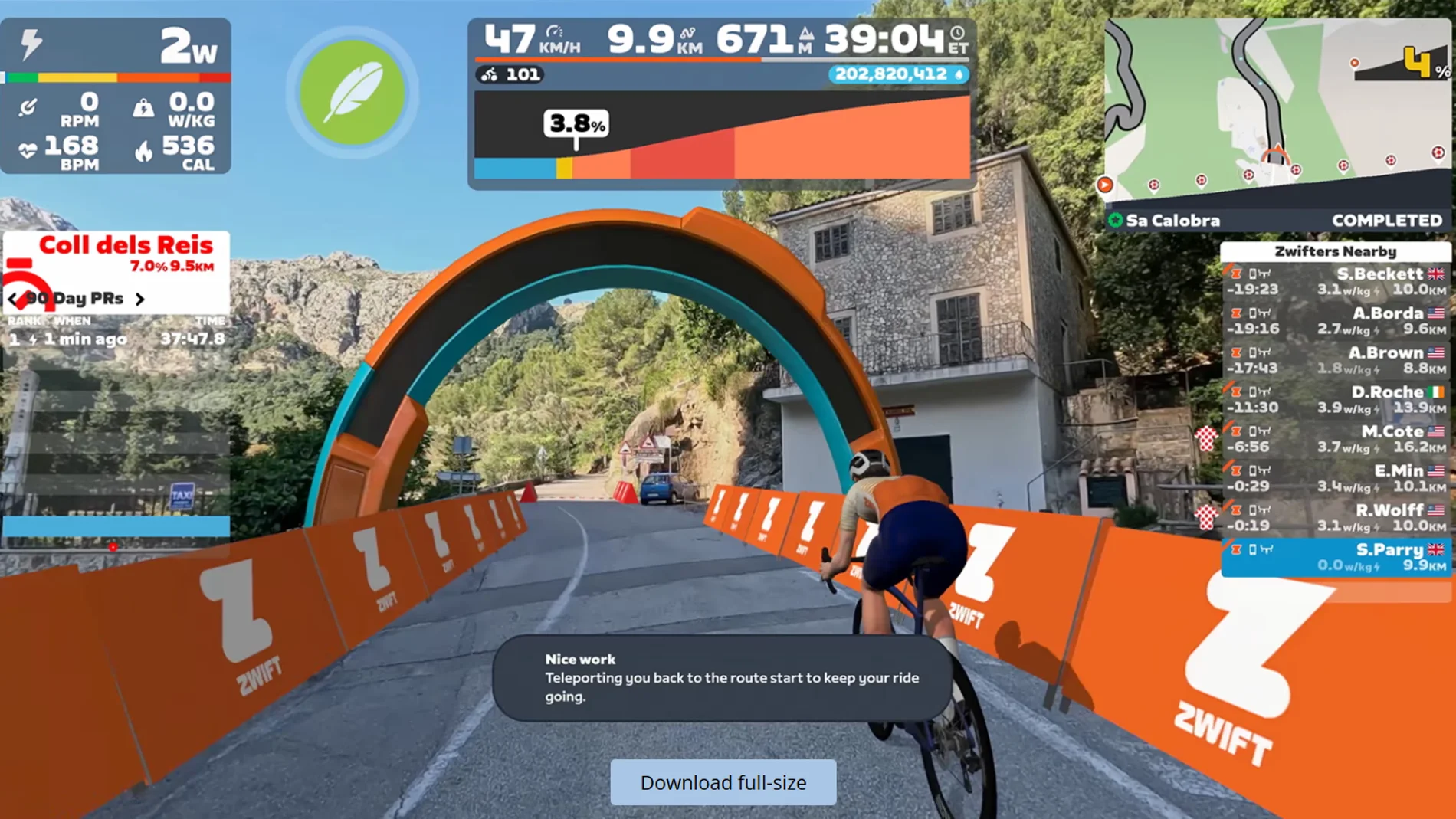
Zwift Video incorporates continuous recordings of real roads. It is not about watching a video while pedaling, but rather synchronizing the images with the speed and effort of the user. The unevenness and slopes of each route are reproduced through changes in roller resistanceso that an upload is not only an image that appears on the screen: it is also an effort that must be overcome. The virtual road responds to pedaling and the body participates in the experience.
The initial catalog brings together 21 routes in six countries and adds 385 kilometers of new roads. Among the settings there are some names that any cycling fan recognizes: the Col du Galibier, the Col du Lautaret or the Cime de la Bonette, in the French Alps; Sa Calobra and the Coll de Femenia, in Mallorca; or the roads that go up to Mount Teide, in Tenerife. There are also tours of Chapman’s Peak, in South Africa; the Lofoten Islands, in Norway; southern Utah and Colorado, in the United States, and different landscapes of the Scottish Highlands. The choice of these places is not accidental. Each road has its own personality: a slope that requires regular effort, a curve that anticipates the next section or a landscape that invites you to look up. In conventional training, the goal is usually at the end of the session. Here the focus is the during, not the goal.
The routes allow you to complete laps and perform different types of training. They also incorporate common elements of the Zwift experience, such as segment classifications, PowerUps, experience points and the possibility of sharing the road with other users who are traveling the same route. The company plans to add events and virtual meetings in the coming months, in addition to incorporating new destinations periodically. But aimless exploration is not always enough to maintain consistency. There appears the second piece of Zwift Plus. If Zwift Video provides the territory, Zwift Coach works like a compass: It guides the effort, proposes objectives and helps decide what to do in each session, although the final decision remains in the hands of the cyclist.
The system combines a training model based on peer-reviewed scientific studies with anonymized power and heart rate data from millions of cyclists on the platform. For designing plans takes into account objectives, recent fitness, preferences, experience and available time. Based on that information, it proposes a personalized program and adjusts it when circumstances change.
One of the interesting aspects is that it does not understand training as a mandatory succession of structured sessions. The company itself points out that 63% of its users combine different types of activity, while only 13% exclusively carry out structured training. For this reason, the system also includes routes, constant pace groups (the so-called RoboPacers) and events. The idea is that the plan adapts to each person’s way of training, and not that they have to fit their entire life into a rigid calendar.
Before each session, the Zwift Coach explains what is going to be done and why. Then provide feedback on the results. through the Coach Analysis section, the activity report and Zwift Companion. If the cyclist goes out to train outdoors, changes his schedule or finishes a competition with more fatigue than expectedthe system can reset the program. It is not limited, therefore, to indicating how many minutes you have to pedal or at what intensity: it tries to give continuity to the entire training.
The combination of both tools raises an interesting question about the future of home exercise. For years, much of the innovation has focused on better measuring performance: more sensors, more data, more indicators and more precision. All of this can be useful, but it also runs the risk of turning sport into a succession of figures and objectives. The The experience of pedaling along an unknown road introduces another ingredient: curiosity. And that is the key to maintaining attention and consistency.
Zwift Plus thus brings together two ways to combat the limits of the home gym. One opens a window to the outside; the other helps you find your way. The cyclist can follow the plan, improvise, change routes or simply pedal for pleasure. The compass orients, but does not decide the journey. Perhaps the greatest revolution in home training It is not about making the gym look more and more like the outside, but rather about making the outside start to fit inside the gym.